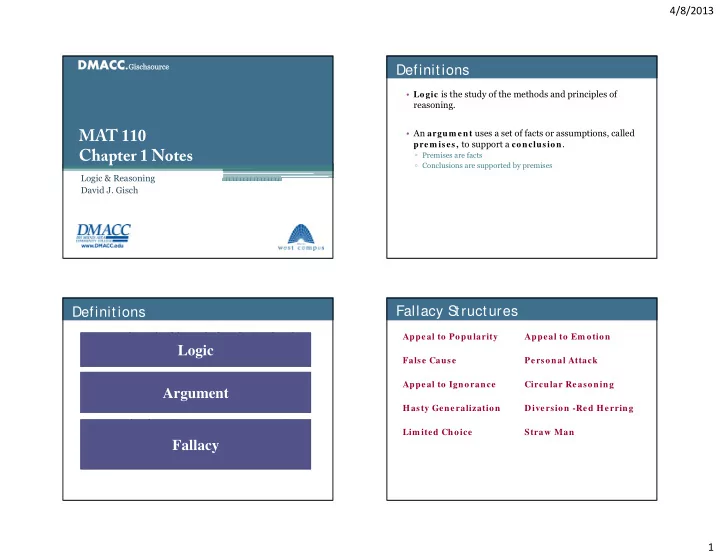
MAT 110 prem ises, to support a conclusion . Chapter 1 Notes - - PowerPoint PPT Presentation

mat 110
SMART_READER_LITE
LIVE PREVIEW

MAT 110 prem ises, to support a conclusion . Chapter 1 Notes - - PowerPoint PPT Presentation

4/8/2013 Definitions Logic is the study of the methods and principles of reasoning. An argum ent uses a set of facts or assumptions, called MAT 110 prem ises, to support a conclusion . Chapter 1 Notes Premises are facts


slide-1
SLIDE 1

4/8/2013 1

MAT 110 Chapter 1 Notes

Logic & Reasoning David J. Gisch

Definitions

  • Logic is the study of the methods and principles of

reasoning.

  • An argum ent uses a set of facts or assumptions, called

prem ises, to support a conclusion.

▫ Premises are facts ▫ Conclusions are supported by premises

Definitions

  • Logic is the study of the methods and principles of

reasoning.

  • An argum ent uses a set of facts or assumptions, called

prem ises, to support a conclusion.

  • A fallacy is a deceptive argument—an argument in

which the conclusion is not well supported by the premises.

Logic Argument Fallacy

Fallacy S tructures

Appeal to Popularity False Cause Appeal to Ignorance Hasty Generalization Lim ited Choice Appeal to Em otion Personal Attack Circular Reasoning Diversion -Red Herring Straw Man

slide-2
SLIDE 2

4/8/2013 2

Propositions and Truth Values

Definitions

  • A proposition makes a claim (either an assertion or a

denial) that may be either true or false. It must have the structure of a complete sentence.

  • Any proposition has two possible truth values:

T = true or F = false.

  • A truth table is a table with a row for each possible set of

truth values for the propositions being considered.

Propositions and Truth Values

  • It is a proposition if:

▫ It is a complete sentence ▫ It makes a claim ▫ The claim can be true or false

  • It will not be a proposition if:

▫ It is a question ▫ Does not assert or deny anything ▫ Is not a complete sentence

Are they propositions?

  • Joan is sitting in a chair.
  • I did not take the pen.
  • Are you going to the store?
  • Three miles south of here
  • 7 + 9 = 2
slide-3
SLIDE 3

4/8/2013 3

Negation (Opposites)

p not p T F F T

The negation of a proposition p is another proposition that makes the opposite claim of p. ← If p is true (T), not p is false (F). ← If p is false (F), not p is true (T). Symbol: ~

What would the negative be?

  • Joan is sitting in a chair.
  • I took the pen.
  • Betsy is the fastest runner on the team.
  • 7 + 9 = 2

S etting up a Truth Table

  • The number of row depends on the number of

combinations.

▫ If you have two statements, each statement can be true or false so that is 2 2 4 combinations or rows. ▫ If you have three statements, each statement can be true or false so that is 2 2 2 8 combinations or rows.

p q p and q T T T T F F F T F F F F

Each row represents a possible combination of p and q.

Double Negation

p not p not not p T F T F T F

The double negation of a proposition p, not not p, has the same truth value as p.

slide-4
SLIDE 4

4/8/2013 4

Double Negations (Opposites)

  • Double negation has the same truth value as the original

proposition

  • It’s like turning over a coin

▫ Start with heads ▫ Turn it over once, tails ▫ Turn it over again, back to heads

Propositions are often joined with logical connectors—words such as and, or, and if…then. Example: p = I won the game. q = It was fun.

Logical Connectors

Logical Connector and

  • r

if…then New Proposition I won the game and it was fun. I won the game or it was fun. If I won the game, then it was fun.

p q p and q T T T T F F F T F F F F

Given two propositions p and q, the statement p and q is called their conjunction. It is true only if p and q are both true. Symbol:

And S

tatements (Conj unctions) NOTE

  • A conjunction is only true if both

p and q are true.

p q p and q T T T T F F F T F F F F

slide-5
SLIDE 5

4/8/2013 5

  • An inclusive or means “either or both.”
  • An exclusive or means “one or the other, but not both.”

The word or can be interpreted in two distinct ways: In logic, assume or is inclusive unless told otherwise.

Or S

tatements (Disj unctions) Or S tatement ( Disj unctions)

  • Example: INCLUSION
  • A health insurance policy covers hospitalization in cases
  • f illness or injury.

▫ Covers illness Or ▫ Covers injury Or ▫ Both

Or S tatement (Disj unction)

  • Example:EXCLUSION
  • A restaurant offers soup or salad.

▫ Offers soup Or ▫ Offers salad NOT ▫ Both

p q p or q T T T T F T F T T F F F

Or S

tatements (Disj unctions)

Given two propositions p and q, the statement p or q is called their disjunction. It is true unless p and q are both false. Symbol:

slide-6
SLIDE 6

4/8/2013 6

NOTE

  • A disjunction is true unless both p

and q are false.

p q p or q T T T T F T F T T F F F

If … Then S tatement (Conditional)

  • If all politicians are liars then Representative Smith is a

liar.

  • Conditional propositions

▫ p is called the  Hypothesis or  Antecedent ▫ q is called the  Conclusion  Consequence ▫ q is true on the condition that p is true.

A statement of the form if p, then q is called a conditional proposition (or implication). It is true unless p is true and q is false.

p q if p, then q T T T T F F F T T F F T

 Proposition p is called the hypothesis.  Proposition q is called the conclusion.

If… Then S

tatements (Conditionals)

If… Then

Think of If-Then statements as a rule. RULE: If your grade is greater than 94%, then you get an A.

  • 1. Sally gets a 98%, and therefore an A.
  • 2. Sally got a 98%, but got a B.
  • 3. Sally got a 90%, and received an A.
  • 4. Sally got a 60% and received a C.
slide-7
SLIDE 7

4/8/2013 7

Truth Tables

∨∼

Truth Tables Truth Table Practice

Note: ~ signifies NEGATION  signifies AND  signifies OR Practice by writing the truth values of each row in the table above. p q ~ p ~ q p  q ~ p  ~ q ~ ( p  q) T T T F F T F F

Truth Table Practice

Note: ~ signifies NEGATION  signifies AND  signifies OR Practice by writing the truth values of each row in the table above. p q ~ p ~ q p  q ~ p  ~ q ~ ( p  q) T T F F T F F T F F T F F

slide-8
SLIDE 8

4/8/2013 8

Truth Table Practice

Note: ~ signifies NEGATION  signifies AND  signifies OR Practice by writing the truth values of each row in the table above. p q ~ p ~ q p  q ~ p  ~ q ~ ( p  q) T T F F T F F T F F T F T T F T F F

Truth Table Practice

Note: ~ signifies NEGATION  signifies AND  signifies OR Practice by writing the truth values of each row in the table above. p q ~ p ~ q p  q ~ p  ~ q ~ ( p  q) T T F F T F F T F F T F T T F T T F F T T F F

Truth Table Practice

Note: ~ signifies NEGATION  signifies AND  signifies OR Practice by writing the truth values of each row in the table above. p q ~ p ~ q p  q ~ p  ~ q ~ ( p  q) T T F F T F F T F F T F T T F T T F F T T F F T T F T T

Sets and Venn Diagrams

slide-9
SLIDE 9

4/8/2013 9

Definition

  • A set is a well-defined collection of objects.

▫ We denote sets with capital letters ▫ We write sets with brackets as follows 3, 4, 5 ▫ This is referred to as roster form of a set.

  • Any item belonging to a set is called an elem ent or

m em ber of that set.

▫ We denote elements of a set as follows 3 ∈ 3, 4, 5 7 ∉ 3, 4, 5

Why well-defined? Give me the set of people in this room who are nice.

Ellipses

  • Use three dots, …, to indicate a continuing pattern if

there are too many members to list. For example, {1945, 1946, 1947 . . . 1991} { 6, 7, 8 . . .} { . . ., -3, -2, 1, 0, 1, 2, . . .}

You need to list three items to establish a clear pattern!

Definition

  • Repetitions of elements do not matter. Whether it is

listed once or twice it is still a member of the set and that is all that matters.

  • Order also does not matter in sets, unless it is used to

establish a pattern.

3, 4, 5 4, 3, 5 3, 3, 3, 4, 5 5, 5, 3, 4, 4, 4

Definition

  • The set of all things being discussed is referred to as the

universal set. We denote the universal set as set .

  • For example, if we were discussing arithmetic in third

grade we might use the universal set of whole numbers. In college algebra the universal set would be all real numbers.

slide-10
SLIDE 10

4/8/2013 10

The Real Numbers

Example: Let the universal set be the set of real numbers. Natural = { Whole = { Integers = { Rational = { Irrational = {

S ets

Example: Write out each of the following sets in roster form. (a) The set of all numbers (integers) between 2 and 7. (b) The set days of the week that begin with the letter S. (c) The set of planets in our solar system that begin with the letter C.

S ets and Propositions

  • Now that we’ve been introduced to sets and have studied

a little bit about set we are ready to discuss propositions that make claims about sets.

  • As you know, Propositions are in the form of complete

sentences.

  • The sets referenced in a proposition can be identified as

follows:

▫ one set appears in the subject of the sentence ▫ one set appears in the predicate of the sentence.

S ets and Propositions

  • There are four standard categorical

propositions

– All Subject are Predicate – No Subject are Predicate – Some Subject are Predicate – Some Subject are not Predicate

– Note:

  • S (propositions in the subject)
  • P (propositions in the predicate)
slide-11
SLIDE 11

4/8/2013 11

Venn Diagram

  • Venn diagrams are pictorial representations of sets.

▫ The box represents all things in the universal set. ▫ Circles within the box represent a set of things. ▫ Note that there is a dichotomy in the diagram. Once you draw a circle (set) the part inside represents that set but it also implies the part outside is NOT that set. ▫ So you do not draw two circles.

Men Women

S ets and Propositions

Example: All whales are mammals.

All S are P

Non-mammals

S ets and Propositions

Example: No fish are mammals.

No S are P

S ets and Propositions

Example: Some doctors are women.

Some S are P

slide-12
SLIDE 12

4/8/2013 12

S ets and Propositions

Example: Some teachers are not men.

Some S are not P

S et Relations

  • Sets can be

▫ Proper subsets (one is contained in the other).  |  | ▫ Have some overlap (called the intersection).  |  | ▫ Have no overlap (called disjoint sets).  |  |

Venn Diagrams

Example: Eight hundred students were surveyed and the results of the campus blood drive survey are shown below. (a) How many students were willing to donate blood or serve breakfast? (b) How many were willing to do neither?

180 42 51 Donated Breakfast

Venn Diagrams

Example 7.2.8: A survey of 120 college students was taken at

  • registration. Of those surveyed, 75 students registered for a math

course, 65 for an English course, and 40 for both math and English. Of those surveyed, (a) How many registered only for a math course? (b) How many registered only for an English course? (c) How many registered for a math course or an English course? (d) How many did not register for either a math course or an English course?

slide-13
SLIDE 13

4/8/2013 13

Venn Diagrams

Example 7.2.9: Use the Venn Diagram below to answer the following. (a) How many students read none of the publications? (b) How many read Business Week and Fortune but not the Journal? (c) How many read Business Week or the Journal? (d) How many read all three? (e) How man do not read the Journal?