Mastering Multistate Taxation of S Corporations: State Variances in - - PowerPoint PPT Presentation

mastering multistate taxation of s corporations state
SMART_READER_LITE
LIVE PREVIEW

Mastering Multistate Taxation of S Corporations: State Variances in - - PowerPoint PPT Presentation

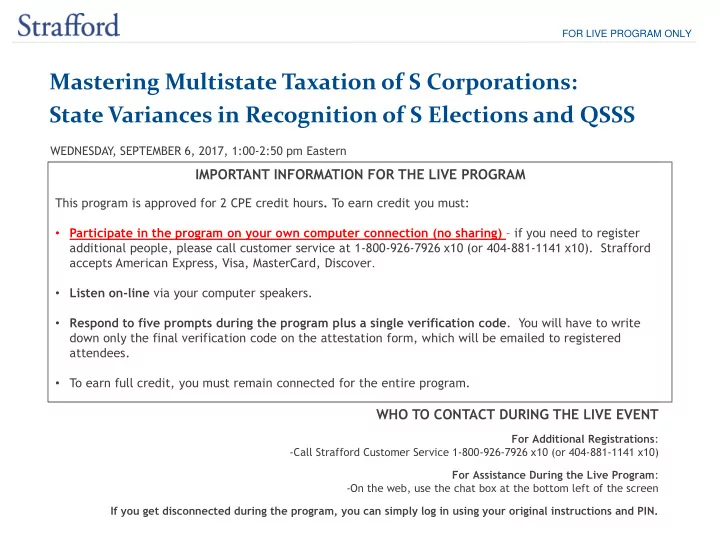
FOR LIVE PROGRAM ONLY Mastering Multistate Taxation of S Corporations: State Variances in Recognition of S Elections and QSSS WEDNESDAY , SEPTEMBER 6, 2017, 1:00-2:50 pm Eastern IMPORTANT INFORMATION FOR THE LIVE PROGRAM This program is approved


slide-1
SLIDE 1

WHO TO CONTACT DURING THE LIVE EVENT

For Additional Registrations:

  • Call Strafford Customer Service 1-800-926-7926 x10 (or 404-881-1141 x10)

For Assistance During the Live Program:

  • On the web, use the chat box at the bottom left of the screen

If you get disconnected during the program, you can simply log in using your original instructions and PIN.

IMPORTANT INFORMATION FOR THE LIVE PROGRAM

This program is approved for 2 CPE credit hours. To earn credit you must:

  • Participate in the program on your own computer connection (no sharing) – if you need to register

additional people, please call customer service at 1-800-926-7926 x10 (or 404-881-1141 x10). Strafford accepts American Express, Visa, MasterCard, Discover.

  • Listen on-line via your computer speakers.
  • Respond to five prompts during the program plus a single verification code. You will have to write

down only the final verification code on the attestation form, which will be emailed to registered attendees.

  • To earn full credit, you must remain connected for the entire program.

Mastering Multistate Taxation of S Corporations: State Variances in Recognition of S Elections and QSSS

WEDNESDAY , SEPTEMBER 6, 2017, 1:00-2:50 pm Eastern

FOR LIVE PROGRAM ONLY

slide-2
SLIDE 2

Tips for Optimal Quality

Sound Quality When listening via your computer speakers, please note that the quality

  • f your sound will vary depending on the speed and quality of your internet

connection. If the sound quality is not satisfactory, please e-mail sound@straffordpub.com immediately so we can address the problem.

FOR LIVE PROGRAM ONLY

slide-3
SLIDE 3
  • Sept. 6, 2017

Mastering Multistate Taxation

  • f S Corporations

Jeffrey Glickman, JD, LL.M, Partner, State and Local Tax Aprio, Atlanta jeff.glickman@aprio.com David Seiden, CPA, Partner Citrin Cooperman, New York dseiden@citrincooperman.com

slide-4
SLIDE 4

Notice

ANY TAX ADVICE IN THIS COMMUNICATION IS NOT INTENDED OR WRITTEN BY THE SPEAKERS’ FIRMS TO BE USED, AND CANNOT BE USED, BY A CLIENT OR ANY OTHER PERSON OR ENTITY FOR THE PURPOSE OF (i) AVOIDING PENALTIES THAT MAY BE IMPOSED ON ANY TAXPAYER OR (ii) PROMOTING, MARKETING OR RECOMMENDING TO ANOTHER PARTY ANY MATTERS ADDRESSED HEREIN.

You (and your employees, representatives, or agents) may disclose to any and all persons, without limitation, the tax treatment or tax structure, or both, of any transaction described in the associated materials we provide to you, including, but not limited to, any tax opinions, memoranda, or other tax analyses contained in those materials. The information contained herein is of a general nature and based on authorities that are subject to change. Applicability of the information to specific situations should be determined through consultation with your tax adviser.

slide-5
SLIDE 5

Mastering Multi-State Taxation of S Corporations: State Variances in Recognition of S Elections and QSSS

DLI-266527916

Karen Harriger Currie

Mastering Multi-State Taxation of S Corporations: State Variances in Recognition of S Elections and QSSS

slide-6
SLIDE 6

Agenda

  • Current landscape of state treatment of S

corporations and qualified subchapter S subsidiaries

  • S corporations with nonresident shareholders
  • Taxation of nonresident shareholders
  • Composite return requirements
  • Other issues

6

slide-7
SLIDE 7

Federal S Corporation Election

  • Under subchapter S of the Internal Revenue

Code a “small business corporation” may elect to become a nontaxable entity

  • A corporation that has made a valid S election

pursuant to IRC Section 1362(a) receives tax treatment that is similar to a flow through entity; the shareholders must include their pro rata share of S Corporation income and loss

  • n their individual income tax returns

7

slide-8
SLIDE 8

Current State Tax Landscape

  • Full conformity to federal S election
  • Partial conformity to federal S election
  • States that require a separate S corporation election
  • States that depart from federal tax treatment
  • Nonconformity to federal S election
  • Other issues

8

slide-9
SLIDE 9

Federal Conformity

  • Many states expressly follow the federal S

election for state tax purposes

  • See e.g., Alaska, Arizona, Delaware, Florida,

Idaho, Indiana, Iowa, Kansas, Maryland, North Dakota, Virginia, Utah

9

slide-10
SLIDE 10

Partial Conformity – Separate Elections

  • Some states require that a separate state S

election be made

  • See e.g., Arkansas, Mississippi, New Jersey,

and New York

  • What if the S corporation was not aware of the

fact that it was doing business in a particular state?

10

slide-11
SLIDE 11

Partial Conformity – Elections

  • Nonresident shareholders in Georgia must

consent to pay Georgia income tax

  • Failure to consent will result in taxation as a C

corporation

  • Wisconsin provides the option to elect out of S

corporation treatment and be taxed as a C corporation

11

slide-12
SLIDE 12

Partial Conformity – Other Taxes

  • Franchise or license taxes
  • See e.g., Mississippi, Missouri, New Mexico, North

Carolina, Oklahoma, Pennsylvania, Rhode Island, South Carolina, West Virginia

  • Minimum taxes
  • Other taxes
  • Alabama business privilege tax
  • Illinois personal property replacement tax
  • Ohio commercial activity tax

12

slide-13
SLIDE 13

Partial Conformity – Income Taxes

  • California: subject to a 1.5 percent tax on net

income

  • Massachusetts: S corporations with total

gross receipts > $6M subject to the income measure of the corporate excise tax at varied rates depending on receipts

  • New Jersey: subject to a reduced corporate

tax rate based on the difference between the highest personal income tax rate and the corporation business tax rate

13

slide-14
SLIDE 14

Nonconformity

  • District of Columbia
  • New Hampshire
  • New York City
  • Tennessee
  • Texas
  • Washington

14

slide-15
SLIDE 15

Nonconformity

  • Louisiana requires that a subchapter S

corporation doing business in the state file in the same manner as C corporation

  • However, exclusion is available for taxable

income of an S corporation based on the ratio

  • f issued and outstanding shares owned by

Louisiana resident individuals to total

15

slide-16
SLIDE 16

Unique Issues

  • Election may be revoked for failure to file

returns

  • See e.g., Arkansas
  • Election may be forced if sufficient investment

income

  • See e.g., New York

16

slide-17
SLIDE 17

Timing Considerations

  • Kentucky
  • For tax years beginning on or after January 1, 2005

and before January 1, 2007, S corporations were subject to income tax

  • Oklahoma
  • S corporation is not subject to tax for tax years

beginning after December 31, 1996

  • Pennsylvania
  • For tax years prior to 2006, separate state election

was required

17

slide-18
SLIDE 18

Qualified Subchapter S Subsidiaries

  • A “qualified subchapter S subsidiary” (QSub) is

a subsidiary of an S corporation that is not treated as a separate corporation

  • All of the QSub's assets, liabilities, and items
  • f income, deduction, and credit are treated as

the assets, liabilities, and items of income, deduction, and credit of the S corporation

  • The American Jobs Creation Act of 2004 (2004

Jobs Act) gave the IRS the authority to require a QSub to file an information return

18

slide-19
SLIDE 19

Qualified Subchapter S Subsidiaries

  • Generally states that recognize the federal

subchapter S election also recognize the federal QSub election

  • A limited number of states require a QSub to

make a separate state election

  • See e.g., New Jersey and New York
  • A number of states are silent regarding

treatment of a QSub

19

slide-20
SLIDE 20
slide-21
SLIDE 21

STATE TAXATION OF NONRESIDENT S-CORPORATION SHAREHOLDERS

SEPTEMBER 6, 2017 Presented By: Jeffrey C. Glickman, J.D., LL.M. Partner-in-Charge, State and Local Tax Services Aprio, LLP Atlanta, Georgia

slide-22
SLIDE 22

DISCLAIMER

22

Any tax advice contained in this communication (including any attachments) is not intended or written to be used, and cannot be used, for the purpose of (i) avoiding penalties under the Internal Revenue Code or under any state or local tax law or (ii) promoting, marketing or recommending to another party any transaction or matter addressed herein.

slide-23
SLIDE 23

AGENDA

Nexus for Nonresident Shareholders Taxation of Nonresident Shareholders Special Issues

23

slide-24
SLIDE 24

NEXUS FOR NONRESIDENT SHAREHOLDER

  • S-corporations are legally formed under state law as corporations (i.e., they are

formed under a state’s corporations (or similar) code)

  • There is no such thing as an S-corporation under state law
  • S-corporations are solely an income tax classification, and their treatment as

pass-through entities where the shareholders are taxable instead of the entity is set forth in the IRC

  • This is different from entities formed as partnerships under state law
  • State law partnerships (which are typically treated as partnerships under the

tax law) are viewed as conducting the business of the partnership on behalf of the partners, and partners have the ability to legally bind and obligate the partnership

  • This is referred to as the aggregate theory of partnerships (i.e., the partnership and its

partners are together conducting business)

  • Example: A shareholder of a corporation can not sign a note with a bank in the name
  • f the corporation; however, a partner may sign a note with a bank in the name of the

partnership

24

slide-25
SLIDE 25

NEXUS FOR NONRESIDENT SHAREHOLDER

  • So what does all of this have to do with nexus?
  • States have generally been successful at arguing that under the aggregate

theory of partnerships, a nonresident partner has nexus in all of the states in which the partnership does business

  • Certain states have ruled that nexus did not exist for nonresident limited

partners whose only connection with the state was that it owned a limited partnership interest in a partnership that did business in the state

  • See Lanzi v. State Dep’t of Rev., 968 So.2d 18 (Ala. Civ. App. 2006), cert. denied,

Case No. 2040298 (Ala. 2007) – addressed Minnesota resident who owned an interest in a multimember Alabama LLC

  • See DiBelardino v. Virginia Dep’t of Taxation, Case No. CL06-5696 (June 22, 2007)

and Dutton v. Virginia Dep’t of Taxation, Case No. CL06-6291 (June 22, 2007) – both were Virginia Circuit Court cases addressing nonresident members of LLCs.

25

slide-26
SLIDE 26

NEXUS FOR NONRESIDENT SHAREHOLDER

  • For S-corporations, because they are formed legally as corporations, it appears

that states have not applied nexus to nonresident shareholders based on the same theories as with partnerships

  • In essence, owning stock in an S-corporation is legally – and for nexus purposes –

the same as owning stock in Coca-Cola – individual shareholders don’t have nexus in the states where Coca-Cola does business solely due to their stock ownership

  • So, if the S-corporation is not a taxable entity, and the states can’t tax nonresident

shareholders, what options do the states have to make sure that all of the S- corporation income is taxed

  • Example: S-corporation does 100% of its business in GA and its sole shareholder is a

Tennessee resident – if the S-corporation is not a taxable entity, and GA can’t tax the nonresident shareholder, how does the S-corporation income ultimately get taxed at the state level

  • It seems reasonable that GA should be able to collect income tax on 100% of the income

earned by the S-corporation and/or its shareholder

26

slide-27
SLIDE 27

OPTIONS FOR TAXATION OF S-CORPORATION INCOME

  • Directly tax the S-corporation on its income/revenues (i.e., tax the entity like a

C-corporation)

  • There are several states that do this, such as Texas (margin tax), California (1.5%

tax), and Ohio (CAT)

  • Not going to focus on these – our focus is going to be on how states have chosen to

economically extract the tax from the nonresident shareholder

  • Nonresident Shareholder Agreements
  • Withholding on income of nonresidents
  • Composite Returns
  • States vary in how they utilize these options

27

slide-28
SLIDE 28

NONRESIDENT SHAREHOLDER AGREEMENT

  • These are forms filed by each nonresident shareholder that are typically filed with

the state S-corporation return

  • The forms state that the nonresident agrees to be subject to the taxing jurisdiction
  • f the state (i.e., that the state has nexus over the nonresident), and agrees to

comply with all filing and income tax payment requirements of the state

  • In some states, the agreement is required to establish the S-corporation status (i.e.,

without these agreements, the entity will be taxed as a C-corporation)

  • In some states, the agreement is required to join in the filing of a composite return
  • In some states, the agreement is not required, but can be executed in order to

relieve the S-corporation of other tax requirements, such as nonresident withholding/estimated payment, or the filing of a composite return

  • Depending on the state, the form must be filed annually or in the first year that the

S-corporation/nonresident shareholder has a filing requirement in the state

28

slide-29
SLIDE 29

NONRESIDENT WITHHOLDING

  • This is really the main tool that states have at their disposal to tax the income
  • f nonresidents in respect of their ownership interest in the S-corporation
  • Both Alabama and Virginia, in response to losing the nexus cases mentioned above,

enacted nonresident member withholding statutes

  • While the economic impact of withholding is on the nonresident shareholder,

the withholding tax is legally imposed on the entity (i.e., the taxpayer that the state clearly has jurisdiction to tax)

  • For example, if the S-corporation fails to withhold but the nonresident

shareholder files a return and pays income tax, the state may still go after the entity for failing to comply with the withholding requirements

  • In those cases, while the state may agree to forgive the actual tax owed,

penalties are often imposed and can be onerous (e.g., Georgia’s penalty used to be 100% but was reduced to 25% in 2008)

  • In some states, the liability for the penalty may be “joint and several” meaning

that members may be liable for the penalty as well

29

slide-30
SLIDE 30

NONRESIDENT WITHHOLDING (CONT’D)

  • Withholding may be required on amounts “distributed or credit” or on “amounts
  • f taxable income sourced to the state, whether distributed or not”
  • In other words, withholding may be required even if the money is not

distributed to the nonresident shareholder

  • Possible exceptions to withholding requirement
  • Signing of nonresident shareholder agreement consenting to jurisdiction
  • Electing to participate in composite return
  • De minimis – typically be based on distributive share of income or on amount of tax to

be withheld

  • Withholding due dates differ – some on date of S-corporation return, some tied

to composite due date or individual return due date, and some are required quarterly (may be referred to as estimated tax payments)

30

slide-31
SLIDE 31

COMPOSITE/GROUP RETURNS

  • A composite return is a return filed by the S-corporation on behalf of its

electing nonresident members that relieves such nonresidents from having to file an individual nonresident tax return in each of the states in which the S-corporation files a tax return

  • Most states allow for a composite return to be filed
  • State approval may be required
  • A minimum number of participants may be required
  • Participating in a composite return may except the nonresident member from

having the entity withhold

  • Estimated composite payments may be required

31

slide-32
SLIDE 32

COMPOSITE/GROUP RETURNS

  • Typical requirements for a nonresident member to participate in a

composite return:

  • Nonresident for entire taxable year
  • Does not maintain a permanent place of abode at any time during the tax year
  • The member’s and spouse’s only source of income from the state must be from the S-

corporation (if other income from state is also attributable to a pass-through entity, then multiple composite returns may be allowed)

  • Waive right to claim state itemized deductions, personal exemptions, credits, and loss

carryovers

  • Have same tax year as other members (generally not an issue for S-corporations

since all member are usually calendar year taxpayers)

32

slide-33
SLIDE 33

COMPOSITE/GROUP RETURNS

  • In most states, the tax is computed by multiplying the member’s share of

income apportioned to the state by the highest marginal individual tax rate

  • Some states may provide alternative calculation options
  • Often participating in a composite results in more tax being paid to the

nonresident state

  • In most states, participating in a composite return is considered as meeting the

individual filing requirements, so “true ups” are not allowed – there are exceptions to this

  • Typically, once the composite is filed, it can not be amended to remove a

member unless it is later determined that the member did not qualify; alternatively, the individual is directed to file a return and take a credit for the tax paid on the composite

33

slide-34
SLIDE 34

SPECIAL ISSUES – RESIDENT STATE CREDIT

  • S-corporation shareholders who pay tax to multiple states due to the multi-

state business of the S-corporation may not always get full credit on their individual resident state income tax return

  • Criticare, Inc. and Marina Shakour Haber v. Director, Division of Taxation,

Docket No. 008253-2013, N.J. Tax Court, (July 8, 2014)

  • Taxpayer, a NJ resident, was sole shareholder of S-corporation doing business in NY

and NJ

  • The S-corporation filed in NY and apportioned 80% of its income to the state; thus, the

taxpayer paid income taxes to NY as a nonresident on 80% of S-corporation’s income

  • On her NJ resident income tax return, taxpayer reported all income from the S-

corporation, computed tax on that amount and then proceeded to take a credit for the tax paid to NY

  • NJ denied a portion of the credit based on statute that limits the amount of the credit in

the case of a resident S-corporation shareholder

34

slide-35
SLIDE 35

SPECIAL ISSUES – RESIDENT STATE CREDIT

  • Criticare, Inc. and Marina Shakour Haber v. Director, Division of Taxation, Docket
  • No. 008253-2013, N.J. Tax Court, (July 8, 2014) (cont’d)
  • NJ statute (§ 54A:4-1(c)) provides that “no credit shall be allowed against the tax otherwise

due . . . for the amount of any income tax . . . imposed for the taxable year on S corporation income allocated to this State”

  • “S corporation income allocated to the state” is defined by reference to NJ’s allocation

statutes

  • Therefore, since under NJ allocation rules, more income would have been allocated to NJ,

the credit was reduced

  • Example: S-corporation does business in NJ and NY and has income of $100,000 (assume

individual tax rate in each state is 10% and that sole shareholder is a NJ resident). Under NY apportionment rules, NY source income is $80,000, and shareholder pays NY nonresident tax of $8,000. Under NJ allocation rules, NJ source income is $40,000. On NJ resident return, shareholder reports income of $100,000, owes $10,000 and would like to take credit of $8,000 for taxes paid to NY. However, under this case, NJ will only allow a credit of $6,000 ($100,000 x 60% allocation to NY under NJ rule x 10% tax rate). Therefore, taxpayer ends up paying a total tax of $12,000 ($8,000 to NY and $4,000 to NJ) instead of $10,000.

35

slide-36
SLIDE 36

SPECIAL ISSUES – RESIDENT ADJUSTMENT

  • In some states, S-corporations will be required to pay entity-level taxes. Will

the shareholder‘s resident state provide an adjustment for individual income tax purposes so that the income is not taxed twice at the state level?

  • H. Alan Rosenberg v. Douglas J. Macginnittie, Commissioner, Georgia

Department of Revenue, No. 1414626 (GA Tax Tribunal, Nov. 25, 2014)

  • Taxpayer, a GA resident, owned an interest in an LLC that did business in Texas
  • LLC paid Texas Franchise Tax, based on amount of taxable margin apportioned to

Texas

  • GA statute (§ 48-7-27(d)(1)(C)) provides that a GA individual resident who is a partner
  • r member of a partnership or LLC (treated either as a partnership or disregarded

entity) is allowed to make an adjustment to federal AGI “for the entity’s income taxed in another state which imposes on the entity a tax on or measured by income”

  • Issues for GA Tax Tribunal: Is Texas Franchise Tax “a tax on or measured by income”

and how should the adjustment be calculated?

36

slide-37
SLIDE 37

SPECIAL ISSUES – RESIDENT ADJUSTMENT

  • H. Alan Rosenberg v. Douglas J. Macginnittie, Commissioner, Georgia Department
  • f Revenue, No. 1414626 (GA Tax Tribunal, Nov. 25, 2014) (cont’d)
  • State ruled for the taxpayer, rejecting the state’s interpretation of the term “income” to mean

“net income”

  • The Tribunal concluded that the term “income” and “gross income” are synonymous and

include all sources of income without regard to deductions or expenses

  • Since Texas’ Franchise Tax includes in its total revenue calculation basically all items of

income that make up gross income under the IRC, the Tribunal concluded that the tax was measured by income

  • This is significant since it raises the possibility that other entity-based taxes (Washington

B&O, Ohio CAT, etc.) may be viewed as measured by income, thus allowing residents an adjustment

  • Even though this was a partnership/LLC case, GA’s statute (§ 48-7-27(d)(1)(B)) provides

that “Georgia resident shareholders of Subchapter “S” corporations may make an adjustment to federal adjusted gross income for Subchapter “S” income where another state does not recognize a Subchapter “S” corporation”

  • Consider whether similar adjustment are available – what does it mean for a state to not

recognize a Subchapter “S” corporation? Does any income tax on the entity qualify?

37

slide-38
SLIDE 38

SPECIAL ISSUES – RESIDENT ADJUSTMENT

  • On July 13, 2015, the GA Tax Tribunal issued a final consent order in the case,

addressing the second issue regarding the method for calculating the adjustment (this was a difficult issue since the Texas Franchise Tax’s margin base is not equivalent to Georgia’s net income base)

  • The calculation of the adjustment is as follows:
  • (1) Determine the pass-through entity's Georgia taxable income before

apportionment;

  • (2) Multiply the amount in (1) by the pass-through entity's apportionment ratio in the

state where it paid entity level tax; and

  • (3) Multiply the amount in (2) by the Georgia resident's distributive share percentage

from his or her ownership interest in the pass-through entity

38

slide-39
SLIDE 39

SPECIAL ISSUES – SALE OF S-CORPORATION STOCK

  • Historically, the sale by an S-corporation shareholder (or other owner of an interest

in a pass-through entity) of his/her interest in the entity was treated by states as the sale of an intangible that was sourced to and taxed by the shareholder’s state of

  • residence. While that rule generally holds true today, some states have begun to

apply different rules in certain cases.

  • NY Advisory Opinion TSB-A-15(5)I, May 29, 2015
  • Taxpayer was a Georgia resident shareholder of an S-corporation that owned NY real estate

and derived all of its income from operating parking lots and real estate rentals

  • S-corporation redeemed all of Taxpayer’s stock and gave Taxpayer an installment note
  • Issue was whether gain from redemption of stock constituted NY source income
  • NY Tax Law § 631(b) provides that income from NY sources includes income from an

interest in real property located in NY, which includes interest in a flow-through entity that

  • wns New York real estate with a fair market value that is at least 50 percent of the fair

market value of all the assets owned by the entity (taking into account only those assets

  • wned by the entity for at least two years prior to the transaction giving rise to the income)

39

slide-40
SLIDE 40

SPECIAL ISSUES – SALE OF S-CORPORATION STOCK

  • NY Advisory Opinion TSB-A-15(5)I, May 29, 2015 (cont’d)
  • The amount of such gain attributable to New York is equal to the gain reported for

federal purposes multiplied by a fraction, the numerator of which is the fair market value of the New York real property on the date of the sale or exchange and the denominator of which is the fair market value of all of the assets of the entity on the date of the sale or exchange

  • The NY rule applies to S-corporation owners as well as owners of other pass-

through entities

  • Other states, such as Massachusetts, treat the sale of an interest in a business

by a nonresident as sourced to the state to the extent the entity conducted business in Massachusetts; however, the rule has not been extended to interests in S-corporations

  • Nonetheless, a nonresident owner should pay particular attention to the impact
  • f selling his/her interest in a business, particularly if that nonresident resides

in a low or no tax state

40

slide-41
SLIDE 41

THANKS!

Jeff Glickman, J.D., LL.M.

Partner-in-Charge, State & Local Tax 770.353.4791 jeff.glickman@aprio.com

slide-42
SLIDE 42
slide-43
SLIDE 43

S Corporations – IRC §338(h)(10) State Tax Implications

Presented by David Seiden, CPA Strafford CPE, September 6, 2017

slide-44
SLIDE 44

S Corporations – IRC §338(h)(10)

Background: Federal tax election (made by both Buyer and Seller) that treats the sale of stock in an S corporation (“Target”) as a “deemed” sale of Target’s assets. Primary benefit is to provide Buyer with a stepped- up in basis in Target’s assets. Generally results in additional tax burden for Seller (ordinary income vs. capital gain treatment).

44

slide-45
SLIDE 45

S Corporations – IRC §338(h)(10)

State Tax Considerations: Non-recognition of IRC §338(h)(10) “Election”. Separate Election required for state tax purposes. Business v. Nonbusiness income treatment of gain. Other Apportionment Issues Sales Tax Shareholder-level credit for taxes paid to other states

45

slide-46
SLIDE 46

S Corporations – IRC §338(h)(10)

Non-Recognition of IRC §338(h)(10) “Election”: State and local taxing jurisdictions that do not recognize “S Corporation” status.

  • Louisiana
  • D.C.
  • NYC

Ohio CAT/Washington State B&O Tax New Hampshire Business Profits Tax Texas

46

slide-47
SLIDE 47

S Corporations – IRC §338(h)(10)

Separate IRC §338(h)(10) State S Corp Election Required: California (opt-out election) Wisconsin Mississippi

47

slide-48
SLIDE 48

S Corporations – IRC §338(h)(10)

Business v. Nonbusiness income Treatment of IRC §338(h)(10) Gain:

  • Business Income is apportioned
  • Nonbusiness income is allocated
  • Nonbusiness income tests

» Transactional » Functional » Operational (NJ) » Some state apply test to entire transaction, others on an asset- by-asset basis.

Good luck taking nonbusiness income treatment….win some - lose a lot!

48

slide-49
SLIDE 49

S Corporations – IRC §338(h)(10)

Apportionment:

– Certain states exclude IRC §338(h)(10) gain/receipts from Target’s receipts factor. – Certain states include gross receipts from “deemed” asset sale in Target’s receipts factor. – Certain states include net gain from “deemed” asset sale in Target’s receipts factor. – Goodwill is typically largest component of §338(h)(10) gain, therefore sourcing methodology is critical.

49

slide-50
SLIDE 50

S Corporations – IRC §338(h)(10)

Sales Tax:

  • Bulk sale notification

»Required in certain states that have bulk sale reporting.

  • Sales tax on “deemed” sale of assets

» Generally, states do not subject §338(h)(10) “deemed” assets sale to sales

  • tax. Considered a stock sale for sales tax.

50

slide-51
SLIDE 51

S Corporations – IRC §338(h)(10)

Credit For Taxes Paid To Other States: – Denial of credit by resident state due to difference in sourcing rules on IRC §338(h)(10) gain.

51

slide-52
SLIDE 52

S Corporations – Retro-S Elections

Retroactive S Corporation Election

New York: Available to federal S Corps with “reasonable cause”. New Jersey – Available to foreign, unauthorized federal S Corps that:

  • Consistently filed New Jersey returns as though a timely

election was made and in full effect; and

  • properly reflected the pass-through items of S

corporation income on shareholders New Jersey personal income tax returns.

52

slide-53
SLIDE 53

About Presenter

David Seiden is the partner-in-charge of Citrin Cooperman’s State and Local Tax Practice. He brings more than 25 years of expertise in all areas of State and Local Tax (SALT). Prior to joining Citrin Cooperman, Dave was the founding partner in a NY-based SALT consulting firm, SALT Link, LLC. Prior to starting his own firm, Dave spent 17 years as a SALT partner at a Big Four accounting firm where he held various leadership roles. Presentations and Publications: Dave regularly writes articles and serves as a media resource on a multitude of tax-related topics. His articles and contributions have appeared in Crain's NY Business, The Huffington Post, Law360, Retail Merchandiser, and State Tax

  • Notes. He is also regularly engaged to speak at various conferences for organizations such as Moore Stephens

North America (MSNA). Affiliations/Education Dave is a member of the American Institute of Certified Public Accountants and the New York State Society of Certified Public Accountants. Dave earned his B.S. in Accounting from American University. He is a Certified Public Accountant in the State

  • f New York.

David Seiden, CPA dseiden@citrincooperman.com

53

slide-54
SLIDE 54

Disclaimer

  • Any tax advice contained in this presentation

(including any attachments) is not intended or written to be used, and cannot be used, for the purpose of (i) avoiding penalties under the Internal Revenue Code or under any state or local tax law or (ii) promoting, marketing or recommending to another party any transaction or matter addressed herein.

  • Any tax advice in this presentation is based on current

tax law. Any change in tax law can have a material effect on conclusions reached herein.

54

slide-55
SLIDE 55

citrincooperman.com