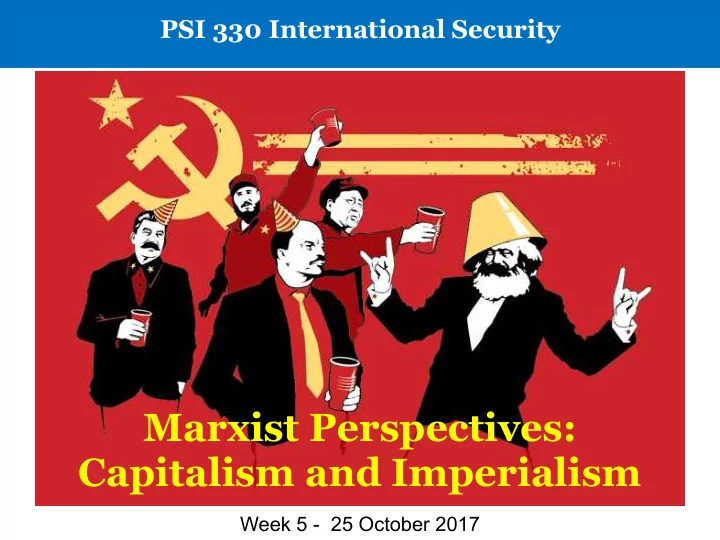
Marxist Perspectives: Capitalism and Imperialism Week 5 - 25 - - PowerPoint PPT Presentation

marxist perspectives capitalism and imperialism
SMART_READER_LITE
LIVE PREVIEW

Marxist Perspectives: Capitalism and Imperialism Week 5 - 25 - - PowerPoint PPT Presentation

PSI 330 International Security Marxist Perspectives: Capitalism and Imperialism Week 5 - 25 October 2017 Marxist Perpectives: The Core The Main Focus Class Struggle and Material Interests of those classes embody Mode of


slide-1
SLIDE 1

Marxist Perspectives: Capitalism and Imperialism

PSI 330 International Security

Week 5 - 25 October 2017

slide-2
SLIDE 2

Marxist Perpectives: The Core

  • The Main Focus
  • Class Struggle and Material Interests of those classes embody
  • Mode of Production and production relations
  • Understanding of the International Relations
  • Marx: heterogeneous state of war and peace
  • Lenin: homogenous state of war among independent countries
slide-3
SLIDE 3

Marxist Perpectives: An Overview

  • Approach to War and Peace
  • Is war progressive or reactionary for the proletariat?
  • What is the link between the military sector and economic progress?
  • How should one understand the role of the state for the defense of

national economic interests on the international scene?

slide-4
SLIDE 4

Classical Marxism

  • Explaining social change and sources of conflict
  • Class struggle have primacy over the forces of production
  • The conflict arise at the relations of production, reflecting upon the

political structures

  • War is intrinsically linked to the class struggle
  • Occurrence of War at different levels:
  • At National Level: Revolts, Strikes and Civil War
  • At International Level: Inter-state war
slide-5
SLIDE 5

Classical Marxism

  • Sources of War (International Level)
  • War between Capitalist and Pre-Capitalist Societies
  • Search for ever widening markets -> effectiveness of capitalist

production outweighed the pre-capitalist production, as well as weakened political and military resistance.

  • Independent interstate relations can only happen among societies

among similar modes of production

slide-6
SLIDE 6

Classical Marxism

  • Mode of Production Determines How War are Fought (Engels)

“Armament, composition, organization, tactics and strategy depend above all

  • n the stage reached at the time in production and on communications. It is

not the “free creations of the mind” {D. Ph. 43} of generals of genius that have had a revolutionizing effect here, but the invention of better weapons and the change in the human material, the soldiers.” (Engels 1947) “the military capabilities of a particular weapons system, which define its role in a particular military unit, reflect the manufacturing capabilities of a particular defense company” (Kaldor 1982, p. 15)

  • Contradiction in arms production
slide-7
SLIDE 7

Classical Marxism

slide-8
SLIDE 8

Classical Marxism

  • Economic conflict tend to replace military ones
  • Economic Interdependence
  • Unwillingness of Bourgeoise to wage war with other developed nations

due to costs

  • Capitalism may tend to more peaceful than the previous modes of

production

  • War can still occur:
  • inequality, exploitation, and the domination process engendered by the

international division of labour

  • Class struggle continues
slide-9
SLIDE 9

Classical Marxism

  • Socialism would bring Peace (Engels)
  • abundance, absence of exploitation, solidarity.
  • Workers are by nature devoid of national prejudice
  • National independence and bourgeois democracy was necessary for

crushing the vestiges of feudalism and in the development of the proletariat. (Marx)

slide-10
SLIDE 10

Theories of Imperialism

  • Marx:
  • Imperialism as another way to counteract decreasing profits
  • Imperialism as a force of social change
  • Hilferding:
  • The Imperialist policy as a result of rise of financial capital
  • Financial capital -> The necessity of protecting the domestic

industries -> Reinforcement of the role State -> Increased Militarism

  • Development of firms and internationalization -> Agreement

between powerful capitalist states

  • Exploitation of non-industrialized nations
slide-11
SLIDE 11

Theories of Imperialism

  • Luxemburg:
  • War is the result of differences modes of production
  • Imperialism as a solution for the demand blocks
  • Opening up new markets and exploration of non-capitalist states
  • Conflict among Capitalist states may arise due to disagreements of

sharing the territories

  • Military expenditures as a solution to defend and conquer empires.
slide-12
SLIDE 12

Theories of Imperialism

  • Lenin:
  • Imperialism = Economic and Political Division of the World
  • Institutions and forces -> Imperialism
  • Institutions = monopoly capital, merger of industrial and bank

capital, and the state

  • Forces created by Finance Capitalism:
  • Superabundance necessitates the search for profitable

investment

  • Export of capital, rather than export of goods.
  • Underconsumption drives monopolies to seek market in the

undeveloped areas of the world.

  • Control of markets and sources of raw materials is sought.
slide-13
SLIDE 13

Theories of Imperialism

slide-14
SLIDE 14

Revolutionary War

  • The Mass Resistance to War vs The War of the Masses
  • Transferring the class struggle into military (via conscription) (Lenin)
  • Anti-war sentiments
  • Mao (On Guerrilla Warfare):
  • A war waged for the emancipation of people
  • Guerrilla Warfare as a part of overall anti-imperialist struggle is employed

by the weak

  • Aims of the Guerrilla Warfare:
  • Weaken the adversary through local attacks
  • Expand the theatre of war to national level
  • Transferring the hegemony from external power to an immanent power
slide-15
SLIDE 15

Militarism

  • “the project of policing a global system of multiple states has generated [an]
  • pen-ended militarism which displays to the world a constant threat of war,

any time anywhere, with no clear objective or end- game” (Wood 2007, 166)

  • Changes in military technology instigates militarism by creating constant arms

production economy (Shaw 1988)

  • Arms production will bring the demise of the Capitalist production (Engels)
  • Political advantage: Creating national unity against an external threat
  • Dividing the working class
  • Economic advantage:
  • Arms Production and the Restoration of the Rate of Profit
  • The Critique of Economic Advantage
slide-16
SLIDE 16

Fundamental Questions

  • How would Marxist theory answer the four fundamental questions about

security?

  • What is Security?
  • Whose security?
  • What are the primary threats?
  • How can security be achieved?