Nkrumahs Theory of Neo-colonialism & Galtungs Structural - - PowerPoint PPT Presentation

nkrumah s theory of neo colonialism galtung s structural
SMART_READER_LITE
LIVE PREVIEW

Nkrumahs Theory of Neo-colonialism & Galtungs Structural - - PowerPoint PPT Presentation

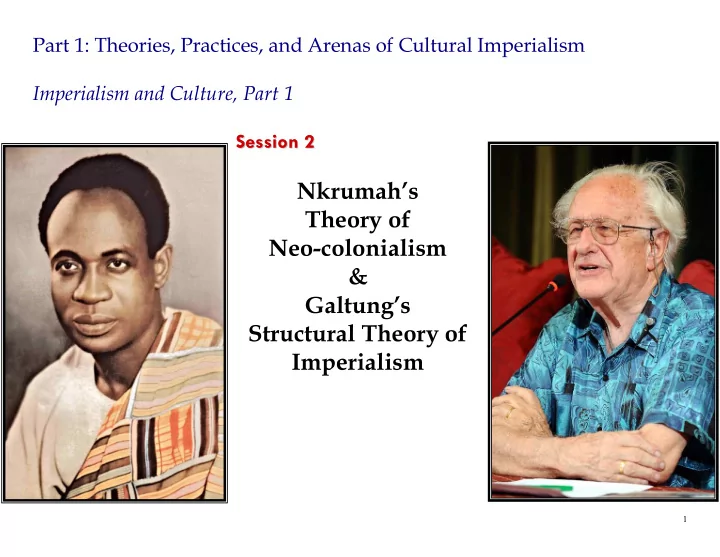
Part 1: Theories, Practices, and Arenas of Cultural Imperialism Imperialism and Culture, Part 1 Se es ss si io on n 2 2 S Nkrumahs Theory of Neo-colonialism & Galtungs Structural Theory of Imperialism 1 N K S T H N E


slide-1
SLIDE 1

1

Part 1: Theories, Practices, and Arenas of Cultural Imperialism Imperialism and Culture, Part 1 S Se es ss si io

  • n

n 2 2

Nkrumah’s Theory of Neo-colonialism & Galtung’s Structural Theory of Imperialism

slide-2
SLIDE 2

2

N NK

KR RU UM MA AH H’

’S

S T

TH

HE EO OR RY Y O OF F N

NE

EO O-

  • C

CO OL LO ON NI IA AL LI IS SM M

 Why “neocolonialism”?  “The highest stage of imperialism”?  “Foremost among the neo-colonialists is the United States, which has long exercised its power in Latin America”  The centre in the periphery  Focus: development, trade, prices, industrialization, markets  Indirect methods: “the methods of neo-colonialists are subtle and varied. They operate not

  • nly in the economic field, but also in the political, religious, ideological

and cultural spheres”

slide-3
SLIDE 3

3

 Cultural imperialism as part of neocolonialism:  Hollywood  News media  Evangelism  Peace Corps  USIA

slide-4
SLIDE 4

4

G GA

AL LT TU UN NG G’

’S

S S

ST

TR RU UC CT TU UR RA AL L T

TH

HE EO OR RY Y O OF F I

IM

MP PE ER RI IA AL LI IS SM M

 Conceptual building blocks:  Dependency  Unequal exchange  Value added, value minimized; Degree of processing  Extraction  center in the Center, and the periphery in the Periphery  Bridgeheads  (Dis)harmony of interest  Inter- and intra-national relations

slide-5
SLIDE 5

5

slide-6
SLIDE 6

6

 Centre-Periphery Relations Centre of the periphery: bridgehead  Definitions: Imperialism  “the special type of dominance system to be discussed here is imperialism”  “Imperialism will be conceived of as a dominance relation between collectivities, particularly between nations. It is a sophisticated type of dominance relation which cuts across nations, basing itself on a bridgehead which the center in the Center nation establishes in the center of the Periphery nation, for the joint benefit of both. It should not be confused with other ways in which one collectivity can dominate another in the sense of exercising power over it”

slide-7
SLIDE 7

7

 “imperialism is a system that splits up collectivities and relates some

  • f the parts to each other in relations of harmony of interest, and other

parts in relations of disharmony of interest, or conflict of interest”  “If we now would capture in a few sentences what imperialism is about, we might perhaps say something like this: In the Periphery nation, the center grows more than the periphery, due partly to how interaction between center and periphery is organized. Without necessarily thinking of economic interaction, the center is more enriched than the periphery” “a combination of intra- and inter-national relations” “if there is no bridgehead for the Center nation in the center of the Periphery nation, there cannot be any imperialism by this definition”

slide-8
SLIDE 8

8

 Two Mechanisms of Imperialism  (1) the principle of vertical interaction relation  (2) the principle of feudal interaction structure Vertical Interaction (1) the value-exchange between the actors = inter-actor effects (2) the effects inside the actors = intra-actor effects

slide-9
SLIDE 9

9

slide-10
SLIDE 10

10

 Three stages or types of exploitation Feudal Interaction (1) interaction between Center and Periphery is vertical (2) interaction between Periphery and Periphery is missing (3) multilateral interaction involving all three is missing (4) interaction with the outside world is monopolized by the Center, with two implications: (a) Periphery interaction with other Center nations is missing (b) Center as well as Periphery interaction with Periphery nations belonging to other Center nations is missing

slide-11
SLIDE 11

11

 Five Types of Imperialism

slide-12
SLIDE 12

12

slide-13
SLIDE 13

13

slide-14
SLIDE 14

14

 Communication Imperialism, Cultural Imperialism, Scientific Imperialism  feudal interaction  news communication “Periphery produces raw material that the Center turns into processed goods, the Periphery also produces events that the Center turns into

  • news. This is done by training journalists to see events with Center eyes”

 Cultural Imperialism & Scientific Imperialism Convertibility  Conclusions  Questions