
SLIDE 1
Aspire Medical Innovation
- Einsteinstr. 167
D-81677 München
aspire-medical.eu
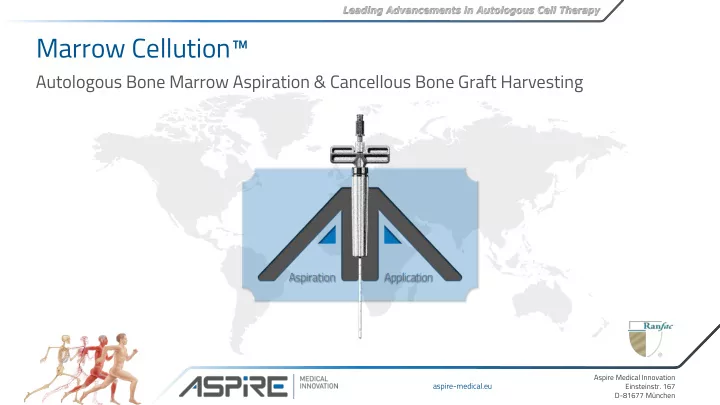
Marrow Cellution Autologous Bone Marrow Aspiration & Cancellous - - PowerPoint PPT Presentation
Marrow Cellution Autologous Bone Marrow Aspiration & Cancellous Bone Graft Harvesting Aspire Medical Innovation aspire-medical.eu Einsteinstr. 167 D-81677 Mnchen Traditional Trocar Design & Technique The path of least resistance
Aspire Medical Innovation
D-81677 München
aspire-medical.eu
proximal from the entry of the needle.
blood as the cannula is open ended.
contamination by exposing the open ended cannula to the resulting channel.
to the stronger forces associated with aspiration from distal end blocking side ports from within the lumen of the needle.
The path of least resistance is the physical pathway that provides the least resistance to motion by a given object or entity, among a set of alternative paths.
The regenerative qualities of bone marrow have been used for many decades and are considered the gold standard for stem cell harvesting.
Open End (Distal) Trocar with Side Port Fallacy
Traditional open ended (distal) trocar designed aspiration needles operate optimally for small biopsy volumes of 1- 2mL. After aspirating the first 1-2mL
bone marrow, peripheral blood will preferentially fill the vacated space, limiting the additional harvest of key stem and progenitor cells. Further aspiration attempts diminish the number of total nucleated cells (TNC) in the aspirate drops dramatically due to the lower viscosity of blood following the path of least resistance through the distal end channel, minimizing efficiency of side channels. Aspiration of larger quantities of bone marrow, typically required for most clinical indications, necessitate further manipulation and volume reduction processing steps such as, centrifugation systems or chemical gradient separation in a laboratory.
The unique patent pending techniques of implementing a closed end catheter through a introducer sheath overcomes distal end peripheral blood contamination.
Marrow Cellution™ Overcomes Limitations & Maximizes Cell Yield
The short sharp trocar introducer allows for easy access through soft tissue and cortical bone. A blunt trocar is then introduced to make access for closed end side port aspiration
and marrow, thereby mitigating pooling of peripheral blood. The patent pending design of the closed end catheter forces aspiration of marrow from lateral marrow space. The manual rotation of the handles allows the cannula to be raised to a desired position in a new level of undisturbed marrow for subsequent aspiration aliquots. The Marrow Cellution™ is able to collect up to 10mL of high quality marrow equivalent or superior to other systems that require additional manipulation steps such as centrifugation
Overcome Limitations & Maximize Cell Yield
retrieval device that incorporates unique features designed to minimize the limitations of traditional trocar needles.
the aspiration cannula is closed allowing marrow collection perpendicular to and around the channel created by the tip
quality bone marrow aspirate collected from various sites distributed within the marrow cavity.
equivalent to repeated puncture sites with a traditional trocar needle collecting small aspirate volumes, but with substantial savings of time, effort, reduced patient trauma, morbidity and risk of infection.
Channels Closed Tip Peripheral Blood Canal Introducer
Patent Pending Design Four channel, closed tipped, aspirating cannula prevents exposure of the needle tip to the channel filled with peripheral blood created by the needle as it is being retracted from the bone space.
The innovative Marrow Cellution™ System allows for specific aspiration to eliminate peripheral blood contamination and thereby significantly improving cellular yield performance. Overcome Limitations & Maximize Cell Yield
INNOVATIVE Reduces peripheral blood aspiration Closed-end aspiration design Cannula via sheath technology Novel patent pending design SPECIFIC Minimally invasive Minimizes OR Time Maximizes Sterility Conditions Low volume High yield Reduces Biologic Utilization Costs PERFORMANCE High Quality – Low Volume Higher CFU counts per mL Additional steps not required No Anticoagulant Contamination
Aspiration of larger quantities of bone marrow, typically required for most clinical indications, necessitate further manipulation and volume processing steps such as, centrifugation systems or chemical gradient separation in a laboratory. The Marrow Cellution™ System is able to collect up to 10mL from each puncture site of high quality marrow equivalent or superior to
techniques that require additional manipulation steps such as centrifugation or chemical separation in a laboratory.
Source: A. Caplan
Bone Marrow Aspirate Impaired Angiogenesis Results in Impaired Healing.
Essential Healing Factors Creating a rich microenvironment with vascular sufficiency is a critical, well established first step in bone formation.
Autologous Bone Marrow Aspiration & Bone Graft Harvesting
OVERCOME LIMITATIONS & MAXIMIZE CELL YIELDS
Maximizes Cell Yield Minimally Invasive Centrifugation Not Required Never Leaves the Sterile Field
Unsurpassed Cell Collection Cancellous Graft Collection
Reduces Blood Contamination Regulatory Compliant Reduces Donor Site Morbidity 100% Natural
Source: A. Caplan
“The mechanism of action in bone healing points to the hierarchical role of creating a vascular network before bone can be formed” Creating a microenvironment with vascular sufficiency is a critical first step in bone formation since impaired angiogenesis results in impaired bone formation.
Bone Remodeling Hematoma Formation
Hematoma Periosteum
Soft Callus Formation
New Blood Vessels External Callus Internal Callus
Hard Callus Formation
Boney Callus
Bone Healing Biology
BONE GRAFTING PROCEDURE = AUTOLOGOUS BONE GRAFT HARVEST & TRANSPLANTATION
Marrow Cellution = Minimally Invasive Bone Graft Composition (Liquid & Cancellous)
Source: Buda R. et al. J Bone Joint Surg Am. 2010;92:2-11.
Subchondral Bone Healing
Bone Marrow Aspirate
Seeding Loading Shaping Positioning Consolidation
Autologous Cell Collection & Cancellous Bone Grafting
The functional design of the Marrow Cellution™ System includes two unique features: a Closed Needle Tip to prevent aspiration of excess blood from the entry channel and a Handle With Threaded Guide for controlled movement
The MC-RAN-8C Marrow Cellution™ System provides the additional benefit to Percutaneously Harvest Bone Graft in the same minimally invasive procedure. Thereby, reducing donor site morbidity.
Marrow Cellution™ Bone Marrow Aspiration System (MC-RAN-11C). Allows for measured and controlled aspiration over a large geography within the marrow space, while restricting peripheral blood infiltration. Marrow Cellution™ Bone Marrow Aspiration- & Autologous Bone Harvesting System (MC-RAN-8C). Allows for the combination of high quality bone marrow aspirate and percutaneously harvested cancellous bone autograft.
"This is potentially a giant step in bone marrow processing. This needle will usher in a new age in bone marrow aspiration."
Orthopedic Surgeon, Boca Raton/FL
MC-RAN-11C MC-RAN-8C
MC-RAN-11C STS (OBESE PTS.) Item #: 74219-07M Effective Length: 4.5'' (11.4cm)
Components:
MC-RAN-11C Item #: 74219-06M Effective Length: 3.5'' (9cm)
Components:
MC-RAN-8C Item #: 74266-01M Effective Length: 3.5'' (9cm)
Components: all MC-RAN-11C components and
MC-RAN-8C STS (OBESE PTS.) Item #: 74266-04M Effective Length: 4.5'' (11.4cm)
Components: all MC-RAN-11C components and
into 10mL syringe
distal end of needle inside sterile bowl
inject Heparin until needle is fully rinsed.
stylet.
injecting Heparin into the open end of the guard.
2,000 Units/mL Heparin Flush Bath
Preparation of a Heparin Flush Bath
Alternate Preparation
Heparin 25,000 (Units) 5mL vial NaCl 7.5mL 2000 Units/mL Heparin Flush Bath
It is important that the strength per mL of the heparin rinse is at least 1,000 but preferably 2,000 and that you have adequate volume to rinse all of the needles and syringes.
Rotate Guide Grip to skin level and remove Blunt Stylet Remove Sharp Stylet, attach Syringe, draw 1ml marrow to test proper localization of Access Needle tip Heparin Flush: Rinse all components with heparin (2,000 Units/ml) Insert Access Needle just past cortex into medullary space. Ensure longitudinal orientation. Remove Syringe, insert Blunt Stylet. Continue to advance Access Needle to desired depth Remove Blunt Stylet, insert and attach Aspiration Cannula. Rotate handle 180°-360° counter clockwise to raise Cannula tip Draw 1ml marrow Repeat steps 8 & 9 until desired volume is attained
For further information please contact your local Marrow Cellution representative or consult www.aspire-medical.eu
Manufacturer: Ranfac Corp.. 30 Doherty Avenue Avon/MA 02322, USA www.ranfac.com EU-Representative: Aspire Medical Innovation GmbH Einsteinstraße 167 D-81677 Munich www.aspire-medical.euMarrow Cellution™
1 2 3 4 5 6 7 8 9 10
Abbreviated Instructions Overview. Information for Healthcare Professionals only. Refer to package insert for complete Instructions for Use.
Attach Syringe, draw 1ml marrow
AAOS 2013 Poster: Journal of Orthopedic Trauma (submission)
1ml of Marrow Cellution (CFU-F/ml=7,760) contains the same CFU-F Volume compared with the final output after „point of care“ processing of aspirated marrow (60mls) reduced to 7mls of concentrate. Count Harvest Biomet Harvest Arteriocyte Marrow Cellution Series 1 Series 2 Snap Aspiration Aspirate: 60mls, Concentrate: 7mls Aspirate: 60mls, Concentrate: 7mls Aspirate: 5mls Nucleated Cell Count (million/ml) 101,48 90,81 90,80 38,17 80,0 Absolute CFU-F Count 7.100 806 8.888 3.600 38.800 CFU-F/ml 1.014 134 1.270 514 7.760
Aspiration to Application without Centrifugation
„Snap Back“ Aspiration
References:: Hernigou P, et al. Treatment of Osteonecrosis with autologous bone marrow grafting. Clinical Orthopaedics and Related Research. Number 405, pp 14-23 Hernigou P, et al. Percutaneous Autologous Bone-Marrow Grafting for Non-unions – Influence of the Number and Concentration of Progenitor Cells. The Journal of Bone and Joint. Volume 87-A, No 7, July 2005
CFU-f
per mL and the number of CFU-f. Hernigou et al in several authoritative studies linked clinical outcomes in non-union and osteonecrosis to the number of CFU-f cells in the graft.
due to variations in the quality of the marrow aspirate or idiosyncratic to the patient with the remaining variation being due to the of number of nucleated cells per mL in the aspirate.
per mL. Interestingly, CFU-f is found frequently in marrow and very rarely in peripheral blood.
(P. Hernigou).
Source: Hernigou / Harvest Comparison with Marrow Cellution Data
System Hernigou Cobe Harvest SmartPReP™ Marrow Cellution™ Aspiration Volume 306mL (Mean) 120mL (Mean) 10mL or 20mL CFU-f in Aspirate 612/mL (Mean) 485/mL (Mean) 2275/mL Concentrate Volume 20mL (Mean) 15mL (Mean) 10mL or 20mL (Unchanged) Total CFU-f Delivered in Concentrate 2,579/mL (Mean) Range: 1,458 - 3,700 /ml 3,200/mL (Mean) Range: 2,500 - 4,100 /ml 2,275/mL (Unchanged) Yield of CFU-f in Concentrate 27.5% 82 % 100% CFU-f Delivered to Non-Union Site 51,589 (Mean) Range: 34,149 - 74,000 48,000 (Mean) Range: 37,500 - 61,500 22,750 in 10mL 45,500 in 20mL
Source: Validation Samples via Independent Laboratories
Additional Field Samples
Lab Orientation Volume (mL) TNC (x106) CFU-f / mL Total CFU-f in Graft
CBR Anterior 8
29.72 1,039 8,316
CBR Anterior 8
36.44 4,513 36,107
UT Posterior 8
42.00 1,146 9,168
CBR Posterior 10
21.60 1,199 11,990
CBR Posterior 10
24.00 1,999 19,990
Franciscan Posterior 10
45.00 4,222 42,222
Franciscan Posterior 10
31.00 3,400 34,000
Franciscan Posterior 10
22.00 3,000 30,000
CBR Posterior 10
18.00 630 6,300
CBR Posterior 10
25.22 814 8,144
CBR Posterior 10
32.44 804 8,044 Average 2,070 19,480
Marrow Cellution™ Centrifugation Systems Time 5 minutes 45 minutes Invasiveness 10mL 60mL – 240mL Efficiency 100% Utilizable 85% Discarded 15% Utilizable Contamination Risk 100% Sterile Field Offsite Processing Peripheral Blood Contamination Minimal High Personnel Time and Training None Extensive Technique Sensitivity No Extensive Regulatory Compliance Compliant Advanced Therapy Drug
Aspire Medical Innovation
D-81677 München
aspire-medical.eu
Regulatory Review & ATMP Assessment
Regulatory Compliance Becoming Increasingly More Restrictive
Definition of ATMP Advanced Therapy Medicinal Products
Gene Therapy Medicinal Products and Somatic Cell Therapy Products defined in Annex 1 to Directive 2001/83/EC
through the use of cells, with the aid of supporting structures and/or biomolecules” Defined in Reg: EU No. 1394/2007
Do I have an ATMP according to EU 1394/2007 Regulation?
ATMP Definition: Contains or consists… …of cells or tissues that have been subject to substantial manipulation so that biological characteristics, physiological functions or structural properties relevant for the intended clinical use have been altered,
…of cells or tissues that are not intended to be used for the same essential function(s) in the recipient and the donor (Homologous Use);
Tissue
NO YES NO YES Substantial Manipulation Same Essential Function in the Recipient and Donor
Aspire Medical Innovation
D-81677 München www.aspire-medical.eu