Marketing Management Marketing Management create exchan es that - - PDF document

marketing management marketing management
SMART_READER_LITE
LIVE PREVIEW

Marketing Management Marketing Management create exchan es that - - PDF document

5/3/2010 The nature of marketing Marketing is the process of planning and executing the conception , pricing , marketing communication and distribution of ideas, products, and services to Marketing Management Marketing Management create exchan es


slide-1
SLIDE 1

5/3/2010 1

Marketing Management Marketing Management

MNM202-Y

dtoitm3@unisa.ac.za

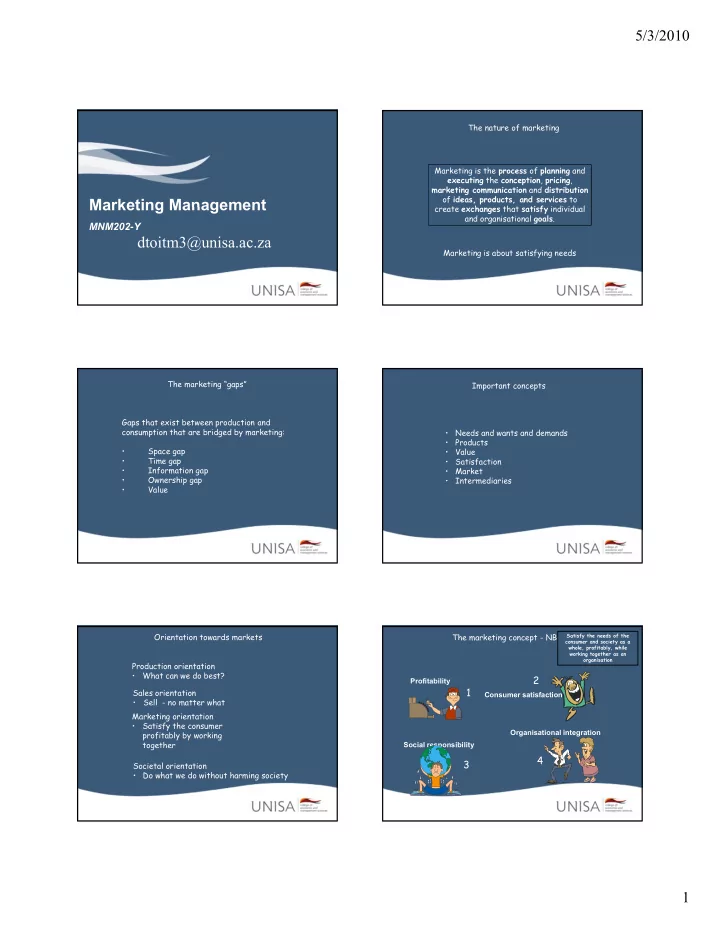
The nature of marketing Marketing is the process of planning and executing the conception, pricing, marketing communication and distribution

  • f ideas, products, and services to

create exchan es that satisfy individual create exchanges that satisfy individual and organisational goals. Marketing is about satisfying needs The marketing “gaps” Gaps that exist between production and consumption that are bridged by marketing:

  • Space gap
  • Time gap

g p

  • Information gap
  • Ownership gap
  • Value

Important concepts

  • Needs and wants and demands
  • Products
  • Value
  • Satisfaction
  • Market
  • Intermediaries

Orientation towards markets Production orientation

  • What can we do best?

Sales orientation

  • Sell - no matter what

Marketing orientation S ti f th

  • Satisfy the consumer

profitably by working together Societal orientation

  • Do what we do without harming society

The marketing concept - NB

Satisfy the needs of the consumer and society as a whole, profitably, while working together as an

  • rganisation

Consumer satisfaction Profitability

1 2

Organisational integration Social responsibility

3 4

slide-2
SLIDE 2

5/3/2010 2

The marketing process (Fig 1.3)

Chapter 3 Chapter 4 Chapter 6 Chapter 2 p & 5

What is Marketing environment?

  • Context in which factors and forces that

influence marketing activities of the organisation take place

  • These factors can:

– Be both controllable and uncontrollable – Shape the manner in which the business functions – Hence, they need to be carefully MONITORED

MARKETING ENVIRONMENT (COMPONENTS) MICRO ENVIRONMENT MARKET ENVIRONMENT MACRO ENVIRONMENT

MICRO ENVIRONMENT

Consist of controllable variables, which exist inside the organisation. Examples of internal variables are: top management, marketing management and financial management.

TOP MANAGEMENT

– Responsible for strategic decision of the

  • rganisation, mission and long term planning

and organisational culture.

  • Every business requires a mission statement as

guiding principle to define its reason for being a business.

  • Examples:

– SABC – “ to be a people centred, content driven, technology enabled, strategically focused and sustainable public service broadcaster...” – SAB – “ to own and nurture local and international brands which are the consumer’s first choice”.

OTHER DEPARTMENTS

  • Marketing management
  • Financial management
  • Human resources management
  • Production
  • Production
slide-3
SLIDE 3

5/3/2010 3

THE MARKET ENVIRONMENT

  • This refers to the the environment mostly closely

linked to the organisations strategy.

  • It can be seen as the centre around which all

decisions in organisation takes place Th h t l th b

  • The company has no control over the above-

mentioned variables in the market environment.

  • Marketing management can only react or influence

to changes taking place in the market environment

  • The main variables which function in the market

environment are:

CONSUMER

  • Consumer: Organisations survive on the basis
  • f meeting the needs, wants and providing

benefits for their customers.

  • Failure to do so will result in a failed business

strategy.

  • Company needs to study five types of customer

market( consumer market, industrial market, resale market, government market and international market)

SUPPLIERS

  • Suppliers : a product which has not been made, can not

be sold.

  • Therefore the suppliers of products and services are of

great importance for the continued existence of marketing directed organisation.

  • All companies, despite the product or service which they

ff d d h d li f

  • ffer, are dependent upon the constant delivery from

suppliers in one way or another.

  • These are persons or organisations who offer stock in

terms of products, services, advertising assistance, financing(sometimes) and advice to the organisation. E.g raw materials

INTERMEDIARIES

  • Intermediaries: helps the company to promote,

sell, and distribute its products to final buyers( reduce the number of transactions between the consumer and producer.

  • They contribute to a larger extent to the

marketing activities that takes place in the marketing channel)

  • E.G Makro, Pick ‘n Pay, Morkels

COMPETITORS

– Competitors: the marketing concept states that to be successful, a company must provide greater customer value and satisfaction than its competitor’s do . – Marketers must do more than simply adapt p y p to the needs of target consumers. – Must gain strategic advantage by positioning their offerings strongly against competitors ‘ offering in the minds of consumers.

MACRO ENVIRONMENT

  • Are the forces and factors that the organisation

has no control over them. e.g. Volkswagen South Africa and Toyota South Africa can do nothing against the lot of new motor vehicle manufactures presently entering the South African market. They have no power to control the competition in the vehicle market.

  • The following factors and variables in the external

environment can be of importance to marketing management:

slide-4
SLIDE 4

5/3/2010 4

SOCIAL

  • Marketers has to make decisions according to

what happened in the past and also by using the present situation in the market.

  • The changing role of families and working

women(dual income families)

  • Culture: different cultural groups have different

Culture: different cultural groups have different consumption patterns

  • HIV/AIDS
  • Marketers must understand the people’s views,

must market products that correspond to society’s core and address the needs of different sub cultures in a society.

INTERNATIONAL

  • International environment: companies that
  • perate internationally find themselves in a far

more complex business environment because every country has its own unique environmental factors, with its technology, culture and laws.

  • Developing countries depend on technology

imported from developed countries for their self development.

PHYSICAL / NATURAL

  • Physical/Natural environment: can be seen as

the environment from which the organisation gets its limited resources.

  • Marketers need to be aware of the threats and
  • pportunities associated with trends in the

natural environment: the shortage of raw materials, especially water; increase cost of energy(oil and electricity) and increased pollution levels(chemicals)

TECHNOLOGY

  • Technological environment: is perhaps the most

dramatic force now shaping our destiny.

  • New technology create new markets and
  • pportunities. However every new technology

replaces an old technology e.g. CD vs. Records, p gy g , DVD vs. Video cassettes; open-heart surgery, hydrogen bomb and the submachine guns.

  • The marketer should monitor the following

trends in technology: the pace of change, and the opportunities for innovation.

ECONOMIC

  • Economic environment : The economic variables

in a country can have great influence on the market of the organisation.

  • Three variables can influence the economic

environment, they are the income of the consumer, inflation and recession.

POLITICAL and LEGISLATIVE

  • Marketing decisions are strongly affected by

development in the political and legal environment. Government is seen as a creator of order in the sense that laws and regulations are created and enforced by them.

  • Sometimes these laws also create new opportunities

for business.(rating agencies for BEE Score Card)

  • This laws and regulations of the country are

represented in the constitution.

  • E.g trade polices, tax, consumer rights, BBBEE and

labour laws

slide-5
SLIDE 5

5/3/2010 5

SWOT ANALYSIS

  • The aim of SWOT(Strengths, Weakness,

Opportunities and Threats) is to help managers to identify internal strengths and weakness of a business and external opportunities and threats facing the business.

  • The strengths and weakness are all internal to

the organisation and are under the control of management.

STRENGHTS

  • These are features of a company’s market,
  • perations or people which help the company to

succeed.

  • This are areas a business does particular well,

p that sets it a part from its competitors.

  • Examples: good customer relations,

technological expertise, good financial standing.

WEAKNESS

  • These are features of a companies’ operation

which can inhibit it in the market place.

  • Examples : outdated technology, inferior

products, lack of marketing awareness. p g

  • It is the responsibility of management to fix this

problem.

OPPORTUNITIES

  • Is an area of buyer need in which the
  • rganisation can perform advantageously.
  • It could include a rapidly developing market

which the company is in position to enter. p y p

  • Examples: expanding into other countries,

introducing a new product line

THREATS

  • This are factors that are in the market outside the

company’s control, which could threaten its existence.

  • These are factors that can harm business.
  • Threats should not be treated as they are, but

Threats should not be treated as they are, but should be seen as a challenge or even as

  • pportunities for businesses
  • Examples: changes in consumer markets,

substitute products, unfavourable rate of exchange and increase in competitors.

Marketing research Process of designing, gathering, analysing and reporting information that may be used to solve a specific marketing issue

Questions to answer:

  • Who is the market?
  • How do we segment the market?
  • What are the wants and needs of the market?
  • How do we measure the market?
  • Who are our competitors?
  • Which model of the product will best suit the market?
  • What is the best price?
  • How will we communicate with the customers?
slide-6
SLIDE 6

5/3/2010 6

The marketing information system A system for generating and managing a flow of information for marketing decision making Components:

  • Internal reporting sub-system
  • Marketing intelligence sub-system
  • Statistical sub-system
  • Marketing research sub-system

The marketing research process Market potential vs Sales potential Market potential: The maximum possible sales of a specific product in a specific market over a specific period of time for all sellers in the industry. Sales potential: The upper limit of sales that a firm could possibly reach for a specific product in a specific market over a specific time period. Market potential and sales forecasting Levels of market measurement:

  • Consumer level
  • Product level
  • Geographic level
  • Time level

Relevant markets for measurement:

  • Total market
  • Available market
  • Target market
  • Penetrated market

Methods for estimating market and sales potential:

  • Breakdown methods
  • Build up methods

Market potential and sales forecasting

Market forecast: An estimate of the expected sales of a specific product in a specific market over a specific time for all p p sellers in the industry Sales forecast: An estimate of the number of units a firm expects to sell of a specific product in a specific market over a specific time

Consumer behaviour Determining customer’s needs and wants and how they make decisions about buying and using products. By studying these factors, marketers will know how to influence consumers to buy their products and services.

slide-7
SLIDE 7

5/3/2010 7

Consumer behaviour Types of purchase decisions:

  • Complex purchase decisions
  • Dissonance reducing behaviour
  • Habitual purchasing behaviour
  • Habitual purchasing behaviour
  • Variety-seeking purchase behaviour
  • Routine decision making
  • Impulsive decision making

Consumer behaviour

INDIVIDUAL FACTORS (things to ) Motivation

  • Definition

Perception

  • Definition
  • Sensory Stimuli
  • Perceptual defence

mechanisms Attitude

  • Definition
  • Characteristics
  • What to do with unfavourable

attitudes Learning ability

  • Definition

remember)

  • Levels
  • Maslow’s hierarchy
  • Motivation, attention,

repetition Lifestyle

  • Definition
  • A I O

Personality

  • Definition
  • Personality traits

GROUP FACTORS (things to remember) Opinion leaders

  • Definition
  • Diffusion Process

Culture

  • Definition
  • Sub-cultures

Family

  • Definition
  • Phases of family-cycle
  • Role differentiation in

families Reference groups

  • Definition
  • Types of groups
  • Ways in which groups

affect consumers

Market Segmentation, Targeting AND Segmentation

  • STP PROCESS:

Market Segmentation Target Marketing Market Positioning

STP PROCESS

  • IMPORTANCE OF SEGMENTATION
  • CRITERIA FOR EFFECTIVE SEGMENTATION

Market Segmentation

A market segment is defined as a group of customers who share a similar set of needs and wants A market segment is defined as a group of customers who share a similar set of needs and wants

  • CRITERIA FOR EFFECTIVE SEGMENTATION:

Measurable Actionable Accessible Large enough Differentiable

slide-8
SLIDE 8

5/3/2010 8

Bases for Segmentation

  • Geographic
  • Demographic
  • Psychographic
  • Behavioural

Behavioural Variables

  • Occasion
  • Benefits
  • User status
  • Usage rate
  • Loyalty status
  • Loyalty status
  • Buyer readiness
  • Attitude towards the product

Target marketing

  • ATTRACTIVENESS AND PROFITABILITY
  • WHAT IS TARGET MARKETING
  • CRITERIA FOR EVALUATING TARGET MARKETS
  • SEGMENT SIZE AND GROWTH POTENTIAL
  • COMPATIBILITY WITH ORGANISATIONAL OBJECTIVES
  • RESOURCES AND SKILLS OF THE ORGANISATION
  • COST OF REACHING THE TARGET MARKETS

TARGET MARKETING BASIC APPROACHES

POSITIONING

The place the product occupies in the consumer’s mind relative to competing products.

  • Positioning process (page 118 of your study guide)
  • Positioning methods

Positioning methods

  • Attribute positioning
  • Benefit positioning
  • Use/application positioning
  • User positioning

p g

  • Competitor positioning
  • Product category positioning
  • Quality/price positioning
slide-9
SLIDE 9

5/3/2010 9

Chapter Six – Integrate it all Product Promotion Price Place