Market Recognition and association representing 50 + members - - PDF document

market recognition and
SMART_READER_LITE
LIVE PREVIEW

Market Recognition and association representing 50 + members - - PDF document

Southern African Natural Products Trade Association Non-profit trade Market Recognition and association representing 50 + members Sustainability Schemes SMEs, producer groups, Gus Le Breton NGOs, researchers, in 8 countries Southern


slide-1
SLIDE 1

1

Market Recognition and Sustainability Schemes

Gus Le Breton

Southern African Natural Products Trade Association

Non-profit trade association representing 50 + members SMEs, producer groups, NGOs, researchers, in 8 countries

Southern African Natural Products Trade Association

Objective – develop income for rural producers (wild harvesting, traditional farming systems – pro- poor) Develop and facilitate markets for new natural products derived exclusively from selected indigenous plants

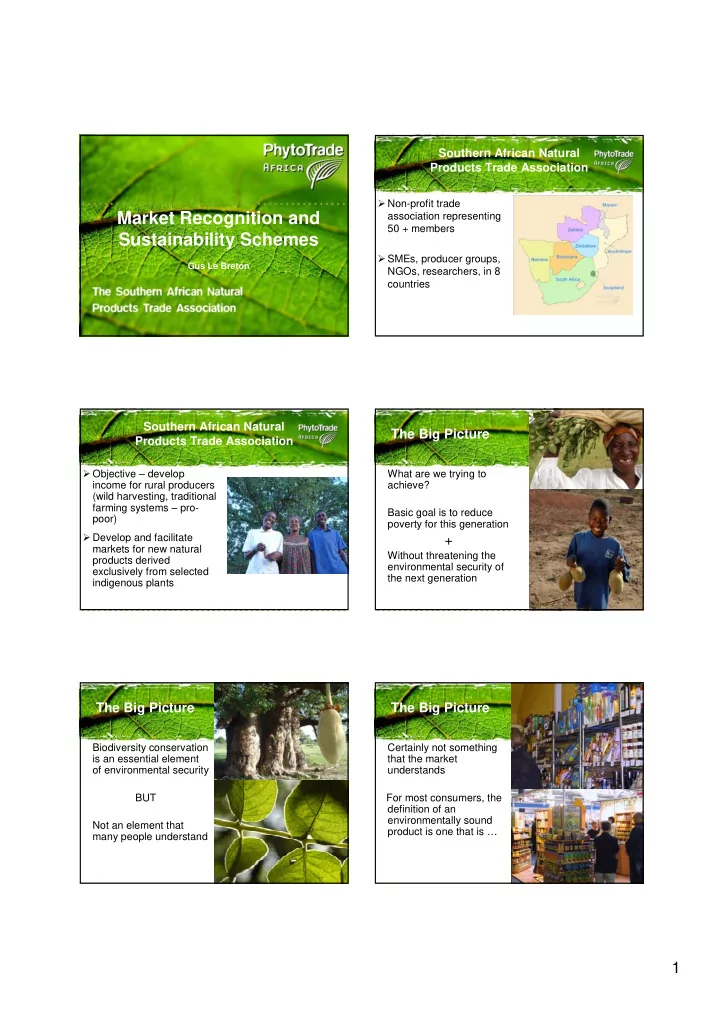
The Big Picture

What are we trying to achieve? Basic goal is to reduce poverty for this generation

+

Without threatening the environmental security of the next generation

The Big Picture

Biodiversity conservation is an essential element

  • f environmental security

BUT Not an element that many people understand

The Big Picture

Certainly not something that the market understands For most consumers, the definition of an environmentally sound product is one that is …

slide-2
SLIDE 2

2

The Big Picture

NOT TESTED ON ANIMALS!!

The Implications for Business

  • Any business that is making genuine steps

towards sustainable biodiversity management and poverty alleviation has no means of:

  • Assessing its progress
  • Differentiating itself on the market

The Implications for Business

  • If it cannot differentiate itself on the market, it cannot

cover the additional costs associated with biodiversity management and poverty alleviation

  • If a business cannot cover the additional costs

incurred, it will either:

  • Go out of business; or
  • Stop incurring those costs

The Implications for Poverty/Biodiversity

  • Biodiversity-friendly, pro-poor businesses

almost invariably incur greater costs

  • Those costs have to be covered somehow
  • Either they are covered through the market
  • Or they are covered through subsidies

(including fiscal incentives, tax breaks etc)

  • If they are not covered, there will be no

biodiversity-friendly, pro-poor businesses

Challenges

  • 1. Will the market ever get it?
  • 2. Will it ever be possible to differentiate

yourself?

  • 3. If so, will the benefits of differentiation
  • utweigh the costs?

Will the market get it?

  • The move towards naturals and organic is
  • verwhelming
  • L’Oreal buys the Body Shop, then Sanoflore
  • Colgate buys Tom’s of Main
  • Clarins buys Kibio
  • Etc. etc.
slide-3
SLIDE 3

3

Will the market get it?

“L'Oreal CEO Jean-Paul Agon has …. made it clear that he wants to increase the company's footprint in the naturals and

  • rganic arena, stating that current demand was too great to

ignore, indicating the possibility of further acquisitions in this area.” Cosmetics Design Europe Oct 2006 “Natural & organic cosmetic sales are increasing by over 20% a year whereas the conventional cosmetics industry is stagnating.” Organic Monitor Oct 2006

Will the market get it?

  • Question is whether the more complex

biodiversity/poverty argument will ever be understood by the market

  • All the signs are that it can and will be
  • Market is growing more sophisticated
  • Issues of biodiversity, equitable Access and Benefit

Sharing, genuine pro-poor impact are all appearing in consumers minds

  • Also starting to feature in the consciousness of

governments and of private investors (e.g. Natura)

Will the market get it?

3,430 13,600 3,745 Total 1,588 1,800 705 Kigelia 962 1,300 715 Baobab 502 2,300 915 Trichilia 263 2,400 880 Marula 38 1,500 90 Ximenia 37 2,400 95 Parinari 21 1,500 300 Kalahari Melon 20 400 45 Mongongo Value Millions USD Producers 000s HH Volume 000s MT Product

One natural products feasibility study conducted in 10 SADC countries in 2005

Will differentiation be possible?

  • It has to be
  • If there is consumer demand for biodiversity-

friendly, pro-poor goods and services, there will be demand for a differentiation system

  • Once this demand exists, the market will

respond

  • How the market responds will determine the

success

Will differentiation be possible?

  • Natural response would be through the rapid

implementation of a number of different certification/verification schemes

  • Many will be hastily conceived and poorly

developed, and will quickly sink

  • There will be a period of confusion in the

market before, eventually, the regulatory authorities step in

Will differentiation be possible?

  • A more measured and thoughtful response

would be to look ahead and plan for the time when differentiation becomes the norm

  • Develop something now that will serve this

function in the future

  • Thereby avoiding that initial period of boom-

bust confusion and regulatory intervention
slide-4
SLIDE 4

4

Will the benefits exceed costs?

  • Initially probably not
  • But in the longer term, the balance will tip in

favour of the differentiation mechanism

  • Ultimately, differentiation will cease to be an
  • ptional extra, it will become an inevitable pre-

requisite for entering the market

Conclusion

  • Is the scale of the market opportunity for

biodiversity-friendly, pro-poor goods and services big enough to warrant serious investigation?

Conclusion

  • Is market differentiation going to be possible

and desirable for this market?

Conclusion

  • Has the time come to start working towards

such a market differentiation mechanism?

Thank You www.phytotradeafrica.com