Maritime Shipping: the last frontier? An economy / environment - - PowerPoint PPT Presentation

maritime shipping the last frontier an economy
SMART_READER_LITE
LIVE PREVIEW

Maritime Shipping: the last frontier? An economy / environment - - PowerPoint PPT Presentation

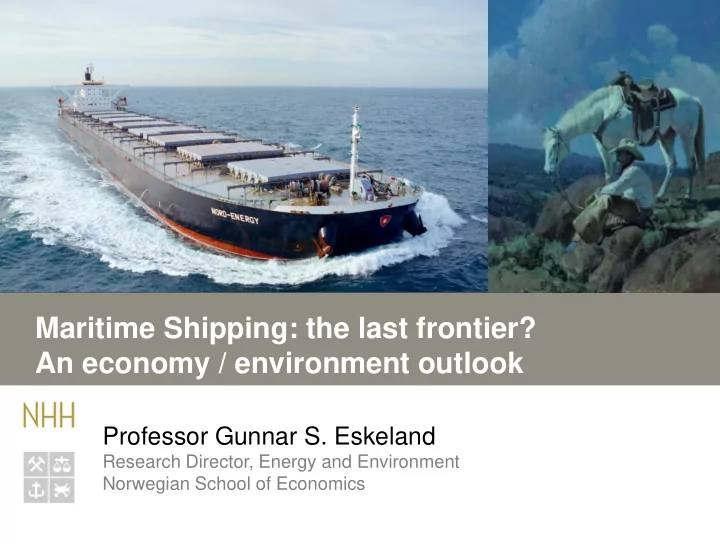
Maritime Shipping: the last frontier? An economy / environment outlook Professor Gunnar S. Eskeland Research Director, Energy and Environment Norwegian School of Economics AGENDA Mare libre: unruly frontiersman or well behaved servant? An

slide-1
SLIDE 1

Professor Gunnar S. Eskeland

Research Director, Energy and Environment Norwegian School of Economics

Maritime Shipping: the last frontier? An economy / environment outlook

slide-2
SLIDE 2

AGENDA

Mare libre: unruly frontiersman or well behaved servant? How we operate our ships is of utmost importance An outlook that is uncertain but with certain implications

Sector defends role, delivers on evnvironment

slide-3
SLIDE 3

An old problem: Find better means of

transporting yourself between meaningful places…

slide-4
SLIDE 4

Stretch a keel and go where it is flat…

slide-5
SLIDE 5

Today, these facts prevail:

  • Maritime transport is the cheapest

– Most efficient – Including energy efficient, emission efficient

  • After Malthus, Limits to growth, Exxon Valdez and

compelling climate change, maritime transport is

– Still competitive, – requires the same skills, – capital, technology, – incentive systems – Well, hear me out…

slide-6
SLIDE 6

Outlook: World economy 2013 to 14: from 3 to 3 3/4 % p a

slide-7
SLIDE 7
slide-8
SLIDE 8
slide-9
SLIDE 9

Where are we? Drybulk shipping

  • Large expansion of coal/iron
  • re mines underway

– 10-12% p.a. export growth possible – China running out of high- grade, low-cost iron ore – Domestic Chinese production replaced by imports

  • Renewed optimism

– Has generated substantial new ordering in 2013 – Orderbook back to 18% of fleet – May cap upside in light of still substantial overcapacity of ships (approx 25%)

Current: Weak Expected: Improving

slide-10
SLIDE 10

Where are we? Product tankers

  • US exports of refined oil

products strong

– Increasing domestic crude production, decreasing consumption of products – Surplus exported

  • New refining capacity in

the Middle East

– Refined products exports rather than crude (added value)

  • But modern refineries are

more flexible

– Can adapt faster to local demand

Current: Below average Expected: Stronger

slide-11
SLIDE 11

Where are we? Crude oil tankers

  • Changes in the US

– Increasing domestic production – Decreasing domestic consumption – Lower imports, particularly long haul – bad for tankers

  • OECD consumption back at

1995 levels

– Only (European) economic conditions or a more fundamental shift in energy mix?

  • Demand growth only from

emerging economies

– Increasing risk

Current: Weak Expected: Weak

slide-12
SLIDE 12
slide-13
SLIDE 13

General theme

  • Macro-economic outlook globally not especially

bright

  • Two possible ‘locomotives’, China and US,

uncertain both with respect to growth and bulk trade generation potential (structure)

  • Newbuilding despite fleet capacity reflects yard

capacity more than long term substantial need

  • = > tech revolution will not come fast
slide-14
SLIDE 14

Our studies: Reducing speed and emissions

  • Easiest way to lower fuel

consumption is to reduce speed

  • Hull & propulsion system is

designed for a particular speed & loading condition

– Actual operating profile may be very different – suboptimal

  • peration
  • External limits on speed

– Engine limitations (Maximum Continuous Rating, MCR) – Minimum steering speed – Engine fouling at continuous low engine ratings – Charter party clauses

slide-15
SLIDE 15

Optimal speed vs. market conditions

  • Goal: Maximise $/day profit (owners) or minimise $/tonne cost

(charterers) – both give same result

  • Key assumption: No expected change in rates and fuel prices
  • What matters is the ratio between the fuel price and the $/tonne

freight rate – not absolute levels

Bunkers/ spot rate price ratio

slide-16
SLIDE 16

Starting point: Map the status quo

  • In order to assess operational efficiency we need to know

what ships are actually doing over time

  • Example: trans-Atlantic Capesize bulker speeds since mid-

2011

9.00 10.00 11.00 12.00 13.00 14.00 15.00 01/07/2011 01/08/2011 01/09/2011 01/10/2011 01/11/2011 01/12/2011 01/01/2012 01/02/2012 01/03/2012 01/04/2012 01/05/2012 01/06/2012 01/07/2012 01/08/2012 01/09/2012 01/10/2012 01/11/2012 01/12/2012 Actual TA speed Theoretical optimum

Owners stick to slow- steaming also when it would be optimal to speed up Are there organisational and contractual issues that prevent efficient

  • peration?
slide-17
SLIDE 17

Unusual: Low freight markets, high bunker (energy) prices. Get used to it?

slide-18
SLIDE 18

Our study of speeds: AG VLCC

  • What we expected:
slide-19
SLIDE 19

We found: Speed optimization ‘missing in action’

slide-20
SLIDE 20

Future work remains but

  • Slower speeds can reduce emissions, without new

regulations, engines, hulls, prop’n technologies

  • Example:

– reduce speeds by 20% (from around 12 to 10 knots) – Bunker consumption &emissions per day down by 50% – Output per day (tonmiles) down by 20% – So emissions per unit of output down by 30!

slide-21
SLIDE 21

Innovation for the future

  • “Ultra-low carbon”/“ultra-low cost” shipping
  • Will probably require revolutionary changes in design rather than the

evolution over the last 100 years

  • Needed to open up new markets (e.g. water transportation)
slide-22
SLIDE 22

Big picture: an ideal climate policy can be envisaged as high fuel prices:

  • Takes transport from air to surface
  • From road to rail
  • From rail to sea
  • Slows speed
  • Maritime transport is an energy intensive activity, but

is also energy and emission efficient, with great potential to improve further. More, in fact, and at moderate costs, than most other sectors.

slide-23
SLIDE 23

Energy-efficient ship operation

  • MAROFF application: “Green

shipping under uncertainty, GREENSHIPRISK”

  • Broad consortium across sectors

and engineering/ economics

  • Center for Sustainable Energy

Studies

  • Goal:
  • Model uncertainty in shipping (markets,

regulatory)

  • Develop tools for more efficient use of

existing assets under uncertainty

  • E.g. more intelligent routing, speed choice,

terminal use

slide-24
SLIDE 24

NHH, Norwegian School of Economics in Bergen

  • Strandenes, Ådland, Assmann, Wallace (Eskeland),

Andersson (thanks!)

  • Master in Energy, Natural Resources and

Environment

  • Trying to understand the industry, its opportunities,

resources, challenges, workings…

slide-25
SLIDE 25

Any questions?