
SLIDE 1
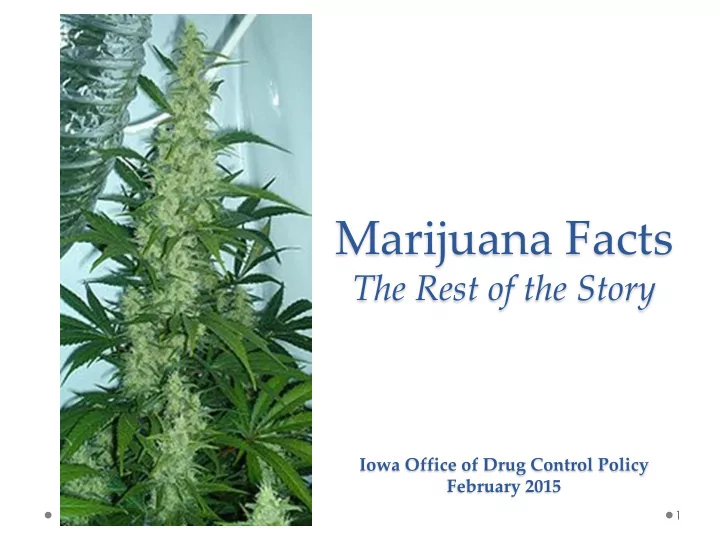
Marijuana Facts
The Rest of the Story
Iowa Office of Drug Control Policy February 2015
1
Marijuana Facts The Rest of the Story Iowa Office of Drug Control - - PowerPoint PPT Presentation
Marijuana Facts The Rest of the Story Iowa Office of Drug Control Policy February 2015 1 An Important Distinction The Iowa Office of Drug Control Policy (ODCP) supports the development of safe, tested and effective research-based medicines,
Iowa Office of Drug Control Policy February 2015
1
2
3
by State
States with Relaxed Marijuana Laws
(2014 Governing)
Past Month Use by 12-17 Year Olds
(2012-2013 NSDUH)
4
(Dark green states: “Medical” marijuana. Light green states: “Recreational” marijuana too. )
100 in Colorado & others elsewhere have enacted local bans on “medical” or “recreational” marijuana sales, & numbers are growing.
closing up to 600 “medical marijuana” dispensaries for violating federal controlled substance laws or state laws re: nonprofits, caregivers, medical use, etc. Similar raids have been conducted in Colorado.
5
medicine, saying “there is currently sound evidence that smoked marijuana is harmful.”
marijuana is unsafe, & “marijuana is not modern medicine.”
is addictive,” with nearly 4.5 million Americans meeting the clinical criteria for marijuana abuse or dependence.
6
7
impair short-term memory & motor coordination; slow reaction time; distort perceptions; raise heart rate; disrupt problem solving & learning ability; alter mood, judgment & decision-making; & in some people cause severe anxiety or psychosis.
2012 National Institute on Drug Abuse, NIH, Drug Facts
Association’s diagnostic criteria for marijuana abuse or dependence than for pain relievers, cocaine, tranquilizers, hallucinogens & heroin combined.
2011 U.S. Substance Abuse & Mental Health Services Administration, National Survey on Drug Use & Health 8
who start in adolescence, & to 25-50% among those who use marijuana daily.
2014 National Institute on Drug Abuse
THC), similar to forms increasingly found in the U.S., are 5 times more likely than non-users to have a psychotic
psychotic episode. 2015 The Lancet Psychiatry, Kings College London
2014 American Heart Association’s Scientific Sessions 9
less than 4% in 1995, a 3-fold increase. THC potency was less than 1% in 1972. September 24, 2014 University of Mississippi Marijuana Project, Revised
10
edibles) reportedly contain THC levels in excess of 80%.
2014 U.S. Department of Justice, Drug Enforcement Administration, National Drug Threat Assessment Summary
Past 30 Days: U.S. vs. Iowa
0% 5% 10% 15% 20% 25% 30% 35% 40% 45% 50% 1978 1980 1982 1984 1986 1988 1990 1992 1994 1996 1998 2000 2002 2004 2006 2008 2010 2012 2014 37.1%
11
11.9% 21.2% 17% 11%
2014 Monitoring the Future Survey & 2012 Iowa Youth Survey (available data)
5.98% of Iowans 12+ are current marijuana users. 52% of Iowa 11th graders say marijuana would be easy or very easy for peers to get in their neighborhood or community.
US 12th Graders Iowa 11th Graders
Marijuana 66.3%
Alcohol 21.9%
Other 7.5% Meth 4.1% Cocaine 0.2%
Primary Substance among 5,026 Juveniles in Treatment
IDPH Treatment Admissions, 2014
12
Alcohol 53.7%
Marijuana 23.0%
Other 7.2%
Meth 14.0%
Cocaine 2.1%
Primary Substance by 46,891 Adults Entering Treatment
IDPH Treatment Admissions, 2013
13
Primary Substance of Choice by Iowans in Treatment
0% 10% 20% 30% 40% 50% 60% 70% 80% 90% 1992 1994 1996 1998 2000 2002 2004 2006 2008 2010 2012 2013 2014 Alcohol Marijuana Meth Cocaine Heroin Other 7% 25.6%
IDPH Treatment Admissions, 2014
14
Most Iowans are not current marijuana users (past 30 days).
15
Use 5% Do Not Use 95% Use 5.98% Do Not Use 94.02% Iowa 6th, 8th & 11th graders currently using marijuana. Iowans 12 & older currently using marijuana.
2012 Iowa Youth Survey & 2012-2013 National Survey on Drug Use & Health
Eligible for Aid 99.996%
*DQ .004%
ICSAC, 2014
*In 2013-2014, 7
suspension of federal financial aid due to a drug conviction.
16
IDOC, 2014
1st Time Marijuana Possession 0%
1st Time Marijuana Possession as Most Serious Offense
17
Of 3,697 total prison admissions:
Marijuana
62.8%-59.0%
Meth
22.9%-15.8%
Cocaine
9.7%-8.9%
Other NA-3.5%
Opiates
9.7%-12.8% IDPH, 2014
Positive Drug Tests Reported 2002-2011
18
Marijuana Use as Causal or Contributing Factor
100 200 300 400 500 600 700 800 900 1,000 2006 2007 2008 2009 2010 2011 2012 2013 949 455
IDPH, 2013 Marijuana impairs/worsens respiratory systems, heart rate, coordination, judgment, memory, problem-solving & mood. It contributes to auto crashes & can cause severe anxiety & psychosis.
19
50 100 150 200 250 300 350 400 450
2014 Non-Alcohol Evaluations by Drug Recognition Experts
20
IDPS, 2014
5 10 15 20 25 30 Marijuana Prescription Meth Cocaine
2012
Types of Drugs Detected in Persons Killed in Crashes
21
IDPS & IDOT, 2014 2012 2012 2012 2013 2013 2013 2013 Poly-drug use & drugs mixed with alcohol were detected in some cases. Alcohol alone was detected in 94 other crash victims.
with data cite pain as their primary illness (vs. cancer, glaucoma, HIV/AIDS & other debilitating conditions.):
marijuana did not ease their pain. 2014 Colorado Springs Dr. Ken Finn, MD
22
registered by 50 physicians, or less than 3% of licensed
2011 Nussbaum, Boyer & Kondrad-MDs/Colorado Department of Public Health & Environment
“medical” marijuana users. One doctor helped 4,180 users in a year, or more than 11/day. 2012 The Oregonian
they used someone else’s “medical” marijuana.
2012 Salomonsen-Sautel, et al., Journal of the American Academy of Child Adolescent Psychiatry
states say one of their sources is another person’s “medical” marijuana. 2013 Monitoring the Future Survey/University of Michigan
23
in the call rate to poison centers for children requiring medical intervention between 2005 & 2011, while call rates did not change in other states. 2014 Annals of Emergency Medicine
exposures for young children 0-5 was 4.75/year from 2006-2009, but rose 268% to 17.5/year from 2010-2013.
2014 Rocky Mountain Poison & Drug Center
24
from 2007-2012, traffic fatalities involving operators testing positive for marijuana during the same period increased 100%.
2011 National Highway Transportation Safety Administration & 2012 Rocky Mountain HIDTA
82% from 2008 to 2013. 2014 Colorado Hospital Association
25
2012 Cerda, M., Drug & Alcohol Dependence
2011 Wall, M., Annals of Epidemiology
marijuana use rates among persons 12 & older (12.7% & 12.28% respectively vs. 7.4% for the U.S. & 5.98% in Iowa). This happened under “medical” marijuana laws, & a year before full-scale legalization. 2012-2013 National Survey on Drug Use & Health
teens all have approved “medical” marijuana.
2012-2013 National Survey on Drug Use & Health 26
0% 2% 4% 6% 8% 10% 12% 14% Kentucky Kansas Louisiana South Dakota Mississippi Oklahoma North Dakota West Virginia Utah New Jersey Idaho Arkansas Texas Wyoming Indiana Tennessee Virginia Nebraska Iowa Illinois North Carolina Minnesota Pennsylvania Missouri South Carolina Georgia Wisconsin Ohio Maryland Florida California New York Arizona Nevada Connecticut Montana Alaska Massachusetts Michigan Delaware New Mexico Maine Hawaii Oregon New Hampshire Washington District of Columbia Colorado Vermont Rhode Island
27
Teens in “Medical” vs. Non-”Medical” Marijuana States
2012-2013 National Survey on Drug Use & Health
“medical” marijuana states, with an average use rate of 1/4 students (vs. a national rate of 1/5 & an 1/9 Iowa rate).
2014 Centers for Disease Control, 2013 Colorado Youth Risk Behavior Survey & 2012 Iowa Youth Survey
32% in Colorado schools from 2008/2009-2012/2013.
2014 Colorado Department of Education
November 2013 Denver Post 28
Starbucks & McDonalds combined. 2012 CBS 60 Minutes
edibles in December 2014-January 2015, & estimates 10% of all recent marijuana submissions are these newer types.
January 2015 Iowa Department of Public Safety, Division of Criminal Investigation 29
*Colorado 46%
IDPS, 2014
2014 Iowa State Patrol Significant Highway Interdictions
30
*California 33%
*Oregon 8% *Arizona 8%
*All 24 from States with “Medical” or “Recreational” Marijuana Laws
*Washington 4%
County’s homeless shelter population as of March 2014.
2014 Pueblo County Colorado Sheriff Kirk Taylor
grounds in Colorado Springs. 1 girl said she brought marijuana from home because “it’s legal & cool.” 2014 KRDO-TV
31
destined for 40 other states, including Iowa, increased 397% from 2008-2013. 2014 El Paso Intelligence Center
in the Denver area. In the mountains & other vacation spots, visitors to Colorado account for 90% of ‘recreational’ dispensary traffic. Heavy users consume marijuana much more often, & more intensely, than other consumers.”
July 9, 2014, Colorado Department of Revenue Market Study
August 12, 2014, KUSA-TV 32
medicines containing the cannabis plant’s principal psychoactive compound tetrahydrocannabinol (THC) do have therapeutic potential to relieve pain, control nausea, stimulate appetite & decrease ocular pressure. Smoking
approved & legally available as prescription pills.
33
Cannabidiol (CBD), extracted from the cannabis plant, is an FDA orphan drug under study to treat seizures, & will be available for patient testing, including at University of Iowa Hospitals & Clinics.
solutions by patients with severe medical needs.
34
available in dose-specific forms that do not involve marijuana, are prescribed & dispensed regularly by health care professionals as safe & effective treatments.
to determine if they may be formulated similar to other medicines for medical use (e.g., morphine from opium, aspirin from tree bark, penicillin from moldy bread, etc.).
35
Dale Woolery 515-725-0310 or Dale.Woolery@Iowa.Gov Iowa Office of Drug Control Policy www.iowa.gov/odcp
36