Marginal Workers and Migrants in Hong Kong and China - Migration, - - PowerPoint PPT Presentation

marginal workers and migrants in hong kong and china
SMART_READER_LITE
LIVE PREVIEW

Marginal Workers and Migrants in Hong Kong and China - Migration, - - PowerPoint PPT Presentation

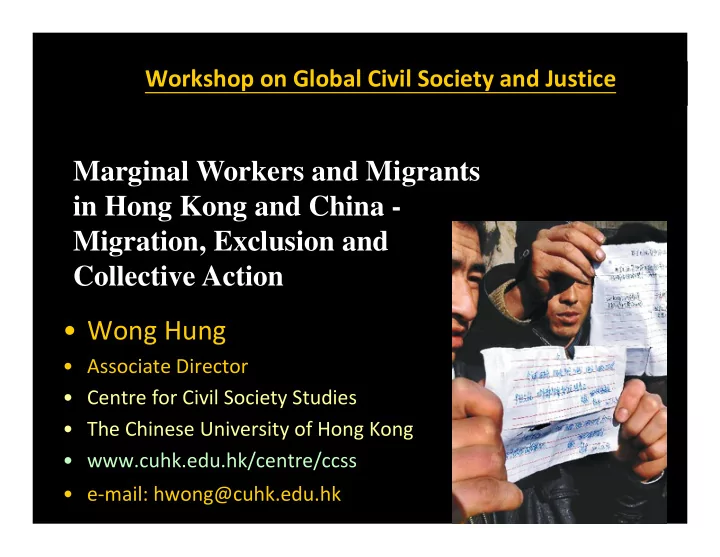
Workshop on Global Civil Society and Justice Marginal Workers and Migrants in Hong Kong and China - Migration, Exclusion and Collective Action Wong Hung Associate Director Centre for Civil Society Studies The Chinese University


slide-1
SLIDE 1

1

Workshop on Global Civil Society and Justice

  • Wong Hung
  • Associate Director
  • Centre for Civil Society Studies
  • The Chinese University of Hong Kong
  • www.cuhk.edu.hk/centre/ccss
  • e‐mail: hwong@cuhk.edu.hk

Marginal Workers and Migrants in Hong Kong and China - Migration, Exclusion and Collective Action

slide-2
SLIDE 2

Global Standards of Social Justice and Global Civil Society

  • Rawls (1971) : liberty principle and the

difference principle.

  • Liberty principle: everyone in the society

should have basic liberties, which include freedom of thought; freedom of speech and press, freedom of assembly and freedom of association, as well as freedom of movement and a reasonable degree of freedom to choose one’s occupation

2

slide-3
SLIDE 3

Difference Principle

  • fair equality of opportunity is offered

to everyone in the society

  • while social and economic

inequalities in society are to be arranged to the benefit of the least advantaged.

3

slide-4
SLIDE 4

Social Justice in China

  • In China, liberties and freedom, though

guaranteed by law and constitution may not be achieved in reality. The mass and the underprivileged have to fight for their own social justice

  • Via their day‐to‐day collective actions, to voice out

their grievances as well as to gain equal protection and access of service as other citizens.

  • Justice for all is a fundamental value behind these

collective actions of the ordinary mass.

4

slide-5
SLIDE 5

Collective Action

  • China’s migrant workers in the world’s

factories try to join the global civil society with their primitive but determined action to fight for social justice

  • On May Day 2009, more than a thousand

FDWs marched in the city and demanded "No to Discrimination, No to Slave‐like Wages" to advocate for including FDWs in the Statutory Minimum Wage (SMW) Bill.

5

slide-6
SLIDE 6

Objective

  • examine the different collective

actions conducted by rural migrant workers in China and FDWs in Hong Kong in fighting for social justice, which are part and parcel of the emerging global civil society

6

slide-7
SLIDE 7

Migrant workers in China

  • rural‐urban migration has been the major

locomotive pulling the train of rapid industrialization in China.

  • Migrant workers provided a mass supply of

cheap, diligent and obedient labour force for the world’s factories and the construction companies in the costal regions.

  • The number of rural‐urban migrant workers

increased from 30 million in the mid and late

  • f 1980s to about 140 million in 2008

7

slide-8
SLIDE 8

Dual system / dual structure

  • The qualified rural migrant workers do

not have the opportunity to work in a better job.

  • Without an urban registered household,

the rural migrants can neither enter the

  • fficial employment system nor enjoy

the same social security and service as urban residents in the city.

8

slide-9
SLIDE 9

Surplus labour in rural area

  • Even with the mass out‐migration in the rural

region, there were still more than 150 million surplus labour force in the rural region in 2009, with an annual increase of 6 million new entrants into labour market.

  • Most of these new entrants leave their farm

land and join the secondary and tertiary industries while a majority of them migrate to the cities in Eastern China.

9

slide-10
SLIDE 10

Discriminative employment policies

  • 1994: The Temporary Regulation on the

Administration of Cross‐Provincial Employment of Migrant Workers

  • 1996: The Implementation Plan of Systematic Project
  • n Cross‐Regional Employment of Migrant Workers.
  • These regulations became a supplement to the

Labour Law, which sets strict limits for urban employers to hire workers from outside their own provinces.

10

slide-11
SLIDE 11

Discriminative employment policies

  • local governments published their own

discriminative employment policies against rural migrant workers. These regulations all insist on the principle that local and urban people are given the priority in employment.

11

slide-12
SLIDE 12

Impact of the Global Financial Crisis

  • in 2008, China’s manufacturing sector

was badly hit by the GFC, owing to the drying up of China’s main export markets – the U.S., Europe and Japan.

  • Thousands of factories in Guangdong

closed down in the last quarter of 2008.

  • At least 20 million migrant workers in

China lost their jobs in 2009.

12

slide-13
SLIDE 13

The withering of safety net function

  • f land
  • Not only did unemployed migrant workers

have to move back from cities to their homeland, that surplus labour force in rural areas also could not move to cities.

  • With lots of rural migrants returning back to

their homeland, the problems shift from cities back to the rural areas.

  • It is because agriculture of the homeland

cannot serve as the ‘safety net’ as in the past.

13

slide-14
SLIDE 14

Limited income from agriculture

  • Since 2003, the percentage of agricultural income
  • ver total income has been less than 50%.
  • Though lots of policies have been introduced to

promote welfare and income of farmers, agricultural income is still less than half of the total income of the rural people.

  • To those unemployed migrant workers, though they

can have agricultural income as some kinds of protection, their total income has decreased significantly since the GFC.

14

slide-15
SLIDE 15

Jobless and Landless migrant workers

  • For those unemployed and landless migrant

workers, they do not have any social

  • protection. Without any means of living,
  • they undoubtedly would demand the

Government to do something.

  • If the Government does not properly handle

the grievances of these landless migrant workers, mass collective actions and mass incidents will happen.

15

slide-16
SLIDE 16

Government’s response

  • On 20 December 2008, the State Council of the Chinese

Government reminded all departments and provincial governments to pay attention to the “employment pressure” of the mass return of migrant workers to their homeland.

  • The notice, when interpreted in an alternate way,

signifies the severity of a series of problems including unemployment, low skill, low employability, poor wage protection, inadequate social security and service as well as landlessness faced by the migrant workers due to the GFC.

16

slide-17
SLIDE 17

Impacts on entreprises

  • Some enterprises had problems in selling their products

which have then induced a chain reaction to the economy as a whole.

  • Some foreign investors stopped their investment and
  • escaped. Owing to the break of the financial chain, some

enterprises reduced or even stopped their production, and even winded up and became insolvent.

  • Moreover, some bosses of the small and medium‐sized

enterprises just disappeared to escape from paying debts and salary.

17

slide-18
SLIDE 18

Rising labour disputes

  • A new labour law effective 1 January 2008 gave

Chinese workers, including migrant workers, new labour rights, namely the right to severance payment.

  • However, many factory owners, citing the recession

caused by the GFC, evaded the law's requirements and even winded up their factories without paying two to three months’ wages to the workers.

  • The number of labour disputes handled by Chinese

courts, unions and arbitration bureaus almost doubled to 960,000 in 2008

18

slide-19
SLIDE 19

“Mass Incidents”

  • The mass layoffs of the jobless and landless

migrant workers do not lead to the open revolts of the migrant workers as expected by some commentators.

  • On the contrary, various relatively small‐scale,

largely localised “mass incidents” (quntixing shijian) or collective actions were witnessed in different parts of China.

19

slide-20
SLIDE 20

Blue book of China Society (2005)

  • mass incidents in China increased from

around 87,000 incidents in 1993 to more than 87,000 in 2006.

  • Participants of the mass incidents also

increased from 730,000 to 3,070,000 during the same period

20

slide-21
SLIDE 21

Rising trend in 2008

  • The rising trend of mass incidents was even greater in

2008, especially in the last quarter after the GFC.

  • 28 June Guizhou Weng’an County riot,
  • 5 July Shaanxi Fugu County police dispute,
  • 17 July Guangdong Huizhou city riot,
  • 19 July Yunan Menglian rubber farmers incident,
  • 19 October Hebei Langfang city railway land issue,

21

slide-22
SLIDE 22
  • 24 October Jiangxi Tonggu County forest dispute,
  • 17 November Gansu Longnan County urban renewal

dispute,

  • 18 November Hubei Wuhan unemployed workers

dispute,

  • 20 November Guangdong Shantou City Taxi drivers

boycott,

  • 21 November Chongqi Kai County coal mine dispute
  • 25 November Guangdong Dongguan labour dispute

22

slide-23
SLIDE 23

In a mass incident, the migrant workers showed their debt notes to the press

23

slide-24
SLIDE 24

Migrant construction workers marched on the street

24

slide-25
SLIDE 25

In Zhengzhou, migrant painters surrounded an Audi which worth 1.6 million RMB to demand pay back of 120,000 debt payment from the boss, the owner of the Audi.

25

slide-26
SLIDE 26

At one of the mass incidents of migrant workers, one

  • f them wrote down the telephone number of the

labour protection hotline on his lower arm, with a policeman monitoring the incident in the background.

26

slide-27
SLIDE 27

Rising labour disputes

  • labour disputes created lots of these mass incidents.

According to the statistics of the Supreme People's Court, in the first ten months of 2008, the court cases on labour dispute in China increased by 93.52%, when compared to the same period in 2007.

  • Another figure regarding the mass incidents of

migrant workers to demand wage in debt in Beijing shows that in November 2008, number and participants of these incidents increased by 146% and 132% when compared to the same month in 2007

27

slide-28
SLIDE 28

Trends of the mass incidents

  • owing to the return of migrant workers to their home

county, the land use and basic social security protection became the new focus of mass incidents in the rural areas

  • the taxi driver boycott issues had a chain effect and

spread from one city to another city. These mass incidents were industry specific, targeted at specific policy, with a short period of action planning and spread from city to city as well as from industry to industry.

28

slide-29
SLIDE 29

Trends of the mass incidents

  • owing to the shortage of loan, disputes
  • f informal loans increased. These

unlawful deposits involved a large number of people and money.

  • Many of the victims were landless

farmers, unemployed and the poor, who faced more grievances.

29

slide-30
SLIDE 30

Trends of the mass incidents

  • in the past, most mass incidents were non‐violent in

nature and the most common format was petition to government officials.

  • However, these recent incidents are more violent in

nature, wider in scope and happened more frequently.

  • Most mass incidents in the past were initiated by

some kinds of organizers in the past, but the recent incidents are more spontaneous and without

  • rganizers.

30

slide-31
SLIDE 31

Trends of the mass incidents

  • The venues of mass incidents were mostly in the

counties or rural areas, but now they extend to the big cities in the coastal regions, signifying the migration of peasant to the city and so do their disputes.

  • most of the recent mass incidents, which were related to

widespread corruption and ineffective governance of local government and the brutal and unlawful practice of the police force

31

slide-32
SLIDE 32

Characteristics

  • The mass people were tired of and

distrust the local government.

  • These mass incidents have made people

walk out on the streets, but they were not political revolts.

  • Most of the mass incidents were right‐

based struggles for resources and mixed up with struggles of political rights of expression and association.

32

slide-33
SLIDE 33

Govt’s Conspiracy hypothesis

  • the Government does not perceive that the mass

incidents are of this spontaneous nature. enemies inside and outside the countries will make use of the migrant workers’ disputes to destroy social harmony.

  • Union leader said unions should prevent enemies inside

and outside the countries, using the difficulties of the enterprises, from infiltrating and destroying the migrant workers group

33

slide-34
SLIDE 34

Social Exclusion of Migrant Workers

  • Rural migrant workers in China are a special socially

excluded group. As they do not have an urban registration household, they cannot enjoy the same medical, education, social security and retirement benefits as the urban population.

  • Though the Central government have made lots of

improvements in medical insurance and basic education in the rural areas, many local governments have still maintained social exclusion policies towards migrant workers and their children.

34

slide-35
SLIDE 35

Unequal access and unprotected

  • Unequal access to health care and education as well

as unequal protection in unemployment and retirement are the structural causes of the discontent of the migrant workers.

  • The official trade union cannot provide effective

protection and organization for the migrant workers, so the migrant workers must fight for their social justice in getting back their salary, their land and their dignity on their own.

35

slide-36
SLIDE 36

Foreign Domestic Workers in Hong Kong

  • Foreign Domestic Workers (FDWs) in Hong Kong are

mostly housemaids (domestic helpers) employed by Hong Kong families.

  • They make up approximately 3% of the population in

Hong Kong and an overwhelming majority of them are women.

  • In 2005, there were 223,394 FDWs in Hong Kong

with 53.11% coming from the Philippines, 43.15% from Indonesia and 2.05% from Thailand

36

slide-37
SLIDE 37

FDWs vs. Foreign Domestic Helpers

  • The Hong Kong government has drawn up rules and

regulations specifically regarding the employment, labour, and condition of stay of foreign domestic helpers. An employer and an employee are required to enter into a two‐year standard contract specifically for the employment of foreign domestic helpers.

  • A FDW is required to work and live in the employer's

place of residence, and to be provided with suitable living accommodation with reasonable privacy

37

slide-38
SLIDE 38

Minimum wage for FDWs

  • Foreign domestic helpers' wages are subject

to a statutory minimum wage, the breach of which is sanctionable under the Employment Ordinance.

  • The current minimum wage for FDWs is

HK$3,580 per month. (1 US$ = 7.8HKD)

38

slide-39
SLIDE 39

Statutory minimum wage

  • There has been no statutory minimum wage (SMW) in

Hong Kong, although a bill to set up one was introduced in July 2009. The territory’s Secretary for Labour and Welfare, Matthew CHEUNG, predicted that the new minimum wage would take effect in late 2010 or early 2011.

39

slide-40
SLIDE 40

SMW

  • In recent years, the wages of low‐income groups in Hong

Kong have declined in response to the loss of low‐cost jobs to mainland China. Recently, the economic recession has put even more downward pressure on low‐ income wages.

  • Hong Kong government hopes to put a stop to falling

wages with the institution of a minimum wage.

40

slide-41
SLIDE 41

Exclusion of FDWs from new SMW

  • The bill represented a major change for

Hong Kong, which has never set up a minimum wage and has long prided itself

  • n laissez‐faire economics and flexible

labour market.

  • However, the Government intends to

exclude FDWs in the new SMW.

41

slide-42
SLIDE 42

Response of FDWs organisation

  • migrant workers’ organizations in Hong Kong

believe that FDWs as workers should be included in the SMW.

  • it is true that the working condition of FDWs is

peculiar, it is neither impossible nor unreasonable to compute an acceptable SMW for FDWs.

42

slide-43
SLIDE 43

Exclusion of FDWs

  • Exclusion of the live‐in FDWs from the ambit of the

minimum wage legislation is a discriminatory act and a form of social exclusion.

  • When the Hong Kong government implemented the levy
  • n employers of FDWs in 2003, it also put FDWs in the

same category as other imported foreign workers, but now a different standard of SMW will be introduced to the FDWs.

43

slide-44
SLIDE 44

ILO Convention

  • This may violate the ILO Convention No.97 Migration for

Employment Convention (Revised) 1949, for which Hong Kong is a signatory, which states that "Each Member for which this Convention is in force undertakes to apply, without discrimination in respect of nationality, race, religion or sex, to immigrants lawfully within its territory, treatment no less favourable than that which it applies to its own nationals ...."

44

slide-45
SLIDE 45

Foreign domestic workers petition for inclusion in the SMW

45

slide-46
SLIDE 46

FDWs’ movement

  • The domestic workers’ organizations are well‐
  • rganized. They have arranged petitions,

marches, lobbying

  • to demand that “Like all HK workers, FDWs

must also be protected and our rights should be upheld. We are not slaves and we do deserve justice, our labour rights, and our dignity as workers.”

46

slide-47
SLIDE 47

Conclusion

  • Similar with their counterparts in mainland

China, the FDWs in Hong Kong fight for social justice to enjoy the same rights of the local workers, despite the difference in races or countries of origin.

  • The above are the voices of the migrant and

marginal workers around the world as part of the Global Civil Society movement, to unite themselves and achieve social justice and dignity

47

slide-48
SLIDE 48

Thank you!

48