Mangrove for the Future building resilience in coastal zones - - PowerPoint PPT Presentation

mangrove for the future building resilience in coastal
SMART_READER_LITE
LIVE PREVIEW

Mangrove for the Future building resilience in coastal zones - - PowerPoint PPT Presentation

Mangrove for the Future building resilience in coastal zones Mapping and natural resources governance in small island communities Raquibul Amin Senior Operations Manager The Beginning: Build Back Better . In 2006, after the Indian


slide-1
SLIDE 1

Mapping and natural resources governance in small island communities

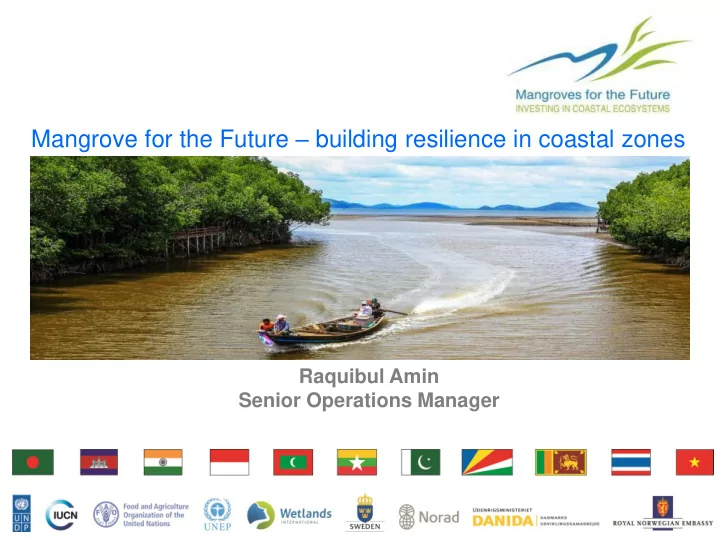
Mangrove for the Future – building resilience in coastal zones

Raquibul Amin Senior Operations Manager

slide-2
SLIDE 2

The Beginning: “Build Back Better”

.

In 2006, after the Indian Ocean Tsunami, IUCN, the International Union for Conservation of Nature, and the United Nations Development Programme (UNDP) developed the initiative,

Mangroves for the Future (MFF)

with the vision that natural infrastructure and

strengthening resilience can protect against

future natural disasters. Since then, MFF has grown to include eight institutional partners, plus 11 countries.

US President Bill Clinton, UN Special Envoy for Tsunami Recovery, acclaimed MFF as one of the most responsive initiatives of the post- tsunami period.

slide-3
SLIDE 3

Where MFF works (geographical scope and countries)

Members: Bangladesh, Cambodia, India, Indonesia, Maldives, Myanmar, Pakistan, Seychelles, Sri Lanka, Thailand, Viet Nam Outreach: Malaysia

MFF is co-chaired by IUCN and UNDP, and is funded by Danida, RNE and Sida.

slide-4
SLIDE 4

Mangroves are a flagship ecosystem, but MFF is inclusive of all coastal ecosystems

Coral reefs Estuaries Seagrass Sand dunes

slide-5
SLIDE 5

Regional Steering Committee National Coordinating Bodies (Government, NGOs, Private Sector)

  • supported by National Coordinators and Secretariat

Governance structure: Partnerships for implementation SECRETARIAT

slide-6
SLIDE 6

National implementation: NSAP

  • The National Strategy and

Action Plan (NSAP) is the key reference document guiding implementation at the national level.

  • Prepared under the guidance of

each National Coordinating Body

  • Dynamic; reflects national

priorities relevant to coastal area management.

  • Identifies country priorities under

MFF

slide-7
SLIDE 7

MFF Grant Facilities

  • Small Grant Facility
  • MFF maximum contribution: USD 25K
  • Small Grant Facility for Private Sector engagement
  • MFF maximum contribution: USD 25K
  • Co-funding: minimum equal to MFF contribution
  • Medium Grants Facility
  • MFF maximum contribution USD 100K
  • Co-funding: minimum 10%
  • Regional Grants Facility
  • MFF maximum contribution: USD 200K
  • Co-funding: minimum 20%
slide-8
SLIDE 8

Resilient Ecosystem Dependent Coastal Community:

MFF Resilience Approach

slide-9
SLIDE 9

Shrimp farming and mangrove destruction

slide-10
SLIDE 10

10

slide-11
SLIDE 11

India small grant project: Integrated Mangrove Fishery Farming Systems (IMFFS)

  • Aquaculture Authority of India

exploring possibility of eco- labeling IMFFS products

  • MSSRF is now reproducing the

model along the east coast of India with the Climate Adaptation Fund, and the support of the Government of India.

  • MFF is working with local

partners to implement the model amongst marginalised and vulnerable tribal fisher communities in Andhra Pradesh.

MFF in partnership with M.S. Swaminathan Research Foundation (MSSRF) designed and implemented a brackish water and mangrove-based farming system in Phase 1.

slide-12
SLIDE 12

January 2013

Nhung Mien Forest Management Unit

slide-13
SLIDE 13

Mangroves & Markets

  • Ca Mau Province-2012-2016, BMU funding, IUCN and SNV
  • Starting off with 740 farmers in Nhung Mien
  • Minh Phu has signed 5-year contracts with farmers:

– 10% price premium – All sizes

  • Organic standard: Naturland

– Requires 50% mangrove cover per national law

  • Supports provincial vision of “organic coast”
  • Replicated the model in Ben Tre and Tra Vinh through MFF
  • MFF is contributing to developing PFES system for mangrove

aquaculture

slide-14
SLIDE 14
slide-15
SLIDE 15

Land cover change in Chakaria Sundarban (1972-2015)

1972 1980 1989 2015

slide-16
SLIDE 16

Feasibility study

  • Forestry and Fisheries expert: Mangrove-polyculure is

possible in Chakaria Sundarban

  • Economic analysis:

– net present value of introducing mangrove-polyculture indicates a positive return – financial benefit-cost ratio calculation indicates that mangrove-polyculture is not feasible for private producers – Transformation to mangrove-polyculture needs incentive based public policy intervention

slide-17
SLIDE 17

Conclusion: MFF and Aichi Targets

  • MFF contributes to Aichi targets

through its governance structure (National Coordinating Body and Regional Steering Committee) and projects.

  • The Chair of National Coordinating

Body (NCB) is usually the Secretary

  • f the Ministry of Environment, who is

the focal person of the CBD.

  • MFF though NCBs provide support to

existing national institutional arrangements for coastal governance by providing ‘soft governance’ – an

  • pportunity for information exchange

and policy influence that supports wise practice for coastal ecosystems management.

slide-18
SLIDE 18

THANK YOU