
SLIDE 1
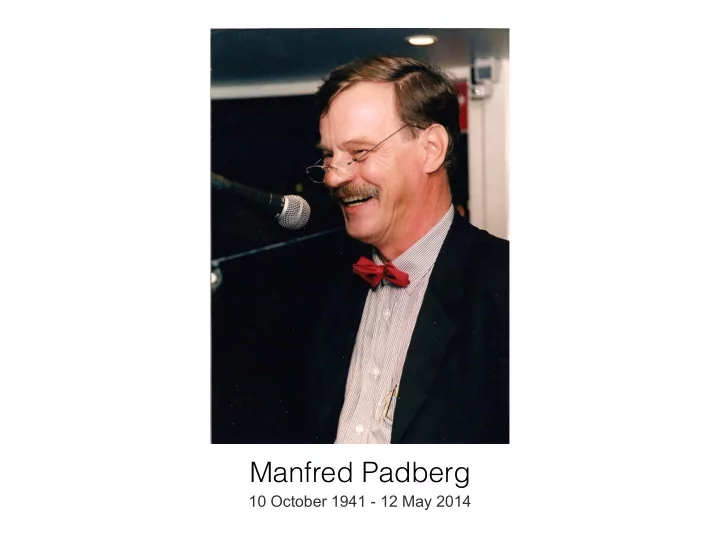
Manfred Padberg 10 October 1941 - 12 May 2014 New York 1985 - - PowerPoint PPT Presentation
Manfred Padberg 10 October 1941 - 12 May 2014 New York 1985 Auerbachs Keller Leipzig 1989 Augsburg 1990 CORE Louvain-la-Neuve 2009 Erlangen 2010 . . . A letter of 2009 New York 1985 Berlin 2001 Berlin 2001 Suzy Mouchet Manfred Padberg
Manfred Padberg was my first and best doctoral student. Almost half a century ago I became Manfred's professor and then his doctoral thesis advisor. This happened at GSIA, the Graduate School of Industrial Administration of Carnegie Mellon University, where Manfred studied for his PhD between 1968 and 1971. Those were heady days for me. I had joined the place just one year earlier, as a fresh immigrant from behind the Iron Curtain and was thoroughly enjoying my new freedom and the wonderful research environment. One day a young German showed up at my office, with a Diplom in Mathematics from Muenster and with a Ford Foundation fellowship to study in the US for a doctorate, for which he chose the area of Operations Research.
getting along with Manfred, but the fact that he was my first doctoral student may have facilitated the process. It seems that we have entered each other's lives at the appropriate moment. We worked closely together for four years and developed an interaction from which I certainly benefitted a lot, given Manfred's talent and enthusiasm for our subject, which of course was integer programming. I am talking about enthusiasm, but it was more than that: Manfred did have fire in his belly, as they
not go to sleep until the question was settled. As to Manfred's perception of our relationship, in the preface of his wonderful book on Linear Optimization and Extensions, Manfred talks about "the 'invisible hand' of Egon...whose enthusiasm and superb teaching of the subject literally got me hooked
have taken it as a routine compliment, but Manfred can certainly not be accused of throwing around praise and kind words too easily. So when I read this I thought to myself that, maybe, I should reconsider my bias towards research in the "teaching-versus-research" equation: if indeed I got Manfred Padberg hooked on Combinatorial Optimization, and Manfred got Martin Groetschel hooked, and Martin got Michael Juenger and Gerd Reinelt hooked, and so on, then who knows what is more important for the future of the profession: the research, the facts and properties that it establishes,
This is not the place to enumerate Manfred's contributions to our field, but let me mention a few crucial facts. In his early work, Manfred discovered some basic properties of set partitioning polytopes, like the fact that any vertex can be reached from any other vertex by fewer integer pivots than the number of equations. His characterization of perfect zero-one matrices reinforced the already existing ties between graph theory and 0-1 programming. Padberg's focus on characterizing the facets of various combinatorial polyhedra set a trend. His work with Groetschel laid the foundations of the polyhedral study of the traveling salesman polytope. These and other discoveries
programming.
cutting planes generated at various nodes of a search tree can be lifted so as to be valid everywhere, then interspersing them with branch-and-bound yields procedures that vastly amplify the power of either enumeration or cuts by themselves. One of the basic discoveries of the 1980's in the realm of combinatorial optimization, arrived at by three different groups of researchers in the wake
and Rao were one of these groups.
tradition of Operations Research. In his joint work with several researchers he set an example of how to formulate and handle efficiently very large scale 0-1 programs with practical applications in industry and transportation. The fields of Combinatorial Optimization, Integer Programming and, more generally, Operations Research, will badly miss him.
Remembering Manfred Padberg I had the honor of spending over three years as a new Assistant Professor with Manfred at NYU from 1986-89. His intellectual ability and accomplishments made him a little intimidating at first for a new hire like me. But Manfred went out of his way to make me feel comfortable and “part of the team.” Despite being very busy, he was always happy to engage on research questions that I was thinking about and offer very good advice. The first thing I learnt from him was to “always read the first paper where a problem was introduced. That is where you will understand context and what the real issues are.” Manfred was very good at getting to the core of a problem so he could use his toolbox to solve practical problems in a way that made a difference. I try to follow his advice to this day because the first paper often arises from a practical application and reveals a lot about the problem. Manfred was a very generous colleague in terms of his time and knowledge. I had a couple of papers early on where the idea for the paper germinated in a conversation with Manfred. Manfred, however, declined to take any credit, pushing me to publish the papers on my own as a single author. As a junior faculty member I still remember the feeling when the first of these single author papers appeared. It gave me confidence that I could produce on my own. In my opinion, Manfred’s greatest quality was being a courageous leader. As leader of the group at NYU he led from the front. He was willing to absorb arrows for the good
for me. When annual salary increases were announced, Manfred checked with me about my increase. When I informed him about the size of my raise, he told me that I should have got a bigger increase. He then suggested that I consider getting an external offer because the powers at NYU were more generous to faculty with external offers. I then obtained an offer from the Kellogg School of Management. Within a day of receiving the offer, NYU gave me a significant salary increase as Manfred had predicted. Coincidentally it turned out that my wife was expecting our first child. This news made us reconsider the offer and move away from New York to Kellogg. When I think of how my career unfolded in better ways than I could have imagined, I always think of the important role Manfred played – both intellectually and as a
sacrifice for the group. It is a spirit that Manfred embodied and that I have tried to internalize to the extent that I can. I will forever be grateful that my path crossed Manfred and continue to be inspired by his courage and generosity.