MANET : Overview Nodes freely roam Multi-hop communication towards - - PDF document

manet overview
SMART_READER_LITE
LIVE PREVIEW

MANET : Overview Nodes freely roam Multi-hop communication towards - - PDF document

URSA : Providing Ubiquitous and Robust Security Support for MANET Jiejun Kong, Petros Zerfos, Haiyun Luo, Songwu Lu, Lixia Zhang University of California, Los Angeles {jkong,pzerfos,hluo,slu,lixia}@cs.ucla.edu Outline Mobile Ad-hoc Network


slide-1
SLIDE 1

1

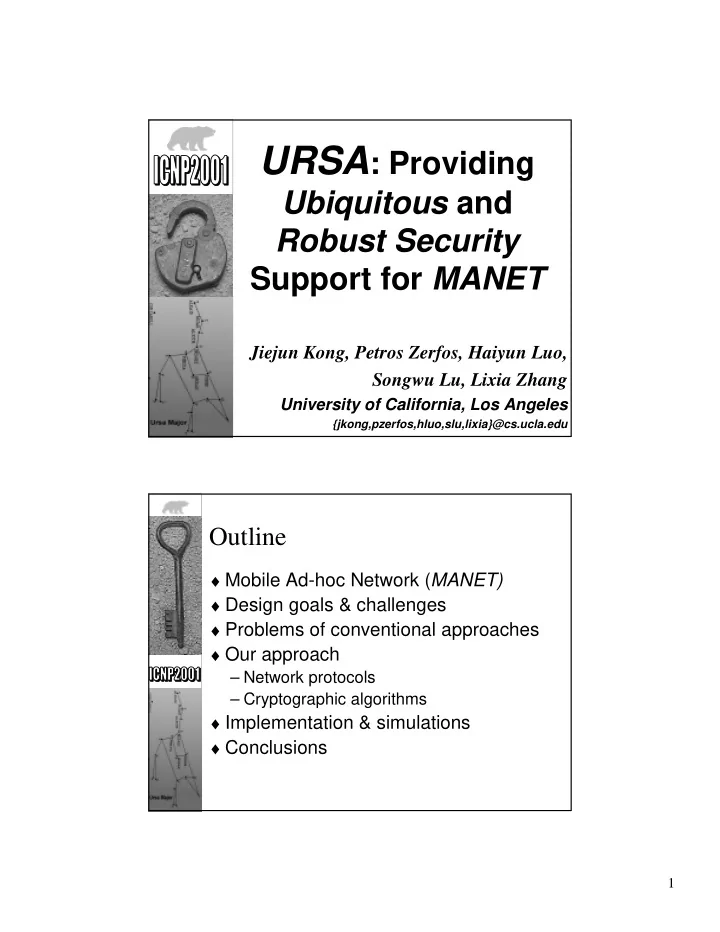
URSA: Providing

Ubiquitous and Robust Security Support for MANET

Jiejun Kong, Petros Zerfos, Haiyun Luo, Songwu Lu, Lixia Zhang

University of California, Los Angeles

{jkong,pzerfos,hluo,slu,lixia}@cs.ucla.edu

Outline

♦ Mobile Ad-hoc Network (MANET) ♦ Design goals & challenges ♦ Problems of conventional approaches ♦ Our approach – Network protocols – Cryptographic algorithms ♦ Implementation & simulations ♦ Conclusions

slide-2
SLIDE 2

2

MANET: Overview

♦ Nodes freely roam ♦ Multi-hop communication towards remote nodes ♦ Shared wireless medium is error-prone

Security Supports for MANET

♦ Security Supports – Authentication – Service availability – Message privacy – Message integrity – Non-repudiation ♦ More difficult than the wired scenarios – Mobility – State constantly changes – Security threats over vulnerable wireless links

slide-3
SLIDE 3

3

Design Challenges

♦ Security breach – Vulnerable wireless links – Occasional break-ins may be inevitable over long time ♦ Service ubiquity in presence of mobility – Anywhere, anytime availability ♦ Network dynamics – Wireless channel errors – Node failures – Node join/leave ♦ Network scale

Conventional Approaches

♦ Centralized & Hierarchical scheme – Single server – Multi-server infrastructure

Server Server Server Server

slide-4
SLIDE 4

4

Problems of Conventional Approaches (Centralized & Hierarchical)

♦ Service performance comparison – Low success ratio: 80% – Large average delay

Our Approach

♦ Ubiquitous and robust service provision in the

presence of random mobility

♦ Localized algorithms and protocols ♦ One-hop wireless communication

slide-5
SLIDE 5

5

Why this model?

♦ No single point of compromise – Hackers must break into K nodes simultaneously to compromise the system ♦ No single point of DoS attack & node failure ♦ K offers tradeoff between intrusion tolerance

and service availability

– K=1, single point of compromise, maximal availability – K=N, single point of DoS attack, maximal intrusion tolerance

System Overview

♦ Each node carries a verifiable, unforgeable

personal certificate

♦ Certificate is signed by network system key

SK

♦ Certificate may be issued, renewed, or

revoked

♦ Every mobile node periodically renews its

certificate

♦ Ubiquitous services enabled by secret

sharing

slide-6
SLIDE 6

6

System Components

♦ Certification services – Localized certificate issuing, renewal, revocation ♦ Self-initialization service – To provide a secret share to an entity – To provide scalable proactive secret share update service ♦ Proactive secret share update service – To resist long-term adversaries without changing the shared secret

Network Protocol

♦ Broadcast service request ♦ Compute partial certificates ♦ Combine K partial certificates

  • 1. Broadcast request
  • 3. Routing shuffling package
  • 2. Unicast shuffling package
  • 4. Unicast partial secret share

Service request Return partial certificates (K=5)

slide-7
SLIDE 7

7

Cryptographic Algorithms: Threshold Secret Sharing

♦ Polynomial-based threshold secret sharing – Given a secret d and a random polynomial of degree K-1 f(x) = d + f1•x + f2 • x2 + …… + fK-1 • xK-1 mod n – Each entity vi obtains its secret share “f(vi) mod n” – d can be recovered by Lagrange interpolation ♦ In RSA cryptosystem, the d in the signing key

SK=(d,n) is shared and distributed

Lagrange Interpolation

f(0)=secret f(x1) f(x2) f(x3) f(x4) f(x5) x5 x4 x3 x2 x1

Polynomial with degree K-1

∑ ∑

= =

=

K j j K j j j

n d n lv v f d f

1 ___ 1

) (mod ) mod ) ( ) ( ( ) (

) ( ) )( ( ) ( ) ( ) )( ( ) ( ) (

1 1 1 1 1 1 K j j j j j j K j j j

v v v v v v v v v x v x v x v x x lv − − − − − − − − =

+ − + −

L L L L

slide-8
SLIDE 8

8

Multi-signature

♦ Threshold secret sharing reveals d to a

coalition

♦ d is not revealed if partial certificates are

used

– The cornerstone is the equation Xd1 • Xd2 • … • XdK = X(d1 + d2 + … + dK) – Each coalition member contributes a signed partial certificate XSKi = (Xdi mod n) which corresponds to an RSA SK-signing in computation – The certification service requester combines K partial-certificates and obtains a correctly-signed certificate XSK = (Xd mod n)

Implementation & Simulation

♦ Implementation in C – Minimized extension: RSA-compatible operations – Optimized for wireless low-end devices

  • Code size
  • Instruction set

– Coded as value-added plug-in to existing security systems ♦ Simulation in ns-2 – Communication efficiency dimensions: network size (scalability), node mobility, wireless channel errors – Performance metrics: success ratio, average delay, average # of attempts

slide-9
SLIDE 9

9

Implementation: RSA and Certification Performance

♦ Comparable performance with standard RSA

signing

♦ Little impact of K on computation overhead

Implementation: Self Initialization

(K=5, time unit: milli-second)

♦ Self initialization and proactive secret share update

  • nly use inexpensive operations (+,-, *, multiplicative

inversing, and less than K degree exponentiation), thus incur little computation overhead

=1.37 SPEC =12.1 SPEC =20.5 SPEC Key 2.528 24.414 0.754 5.245 0.473 1.420 2048 2.006 10.251 0.630 3.480 0.460 0.798 1536 1.996 8.215 0.840 4.926 0.411 0.561 1280 1.847 7.024 0.781 3.321 0.319 0.490 1024 1.497 5.163 0.443 2.588 0.382 0.459 768 1.196 3.861 0.378 1.145 0.288 0.413 512 Sum Partial Sum Partial Sum Partial (bit)

slide-10
SLIDE 10

10

Simulation: Certification Services

  • Avg. # of Attempts vs. Node Speed

♦ Our approach: Reliable and predictable

behavior

♦ Centralized & hierarchical approaches:

Unreliable and/or unpredictable behavior

Simulation: Self Initialization

  • Avg. Delay vs. Node Speed

♦ Mobility does not affect the protocols very much ♦ Scale well to the network size

slide-11
SLIDE 11

11

Simulation: Proactive Update

Updated Node Percentage vs. Delay

♦ “Explosion” effect: as more and more entities

  • btain the new version of secret shares, the

task is getting easier and faster

Conclusion

♦ Certification-based approach – Secret sharing – Multi-signature ♦ Localized and distributed protocols – Faster and more robust than other approaches – Service ubiquity – Scalable ♦ Flexible trade-off between intrusion

tolerance & service availability