Managing Web Service Quality James Skene, Franco Raimondi and - - PDF document

managing web service quality
SMART_READER_LITE
LIVE PREVIEW

Managing Web Service Quality James Skene, Franco Raimondi and - - PDF document

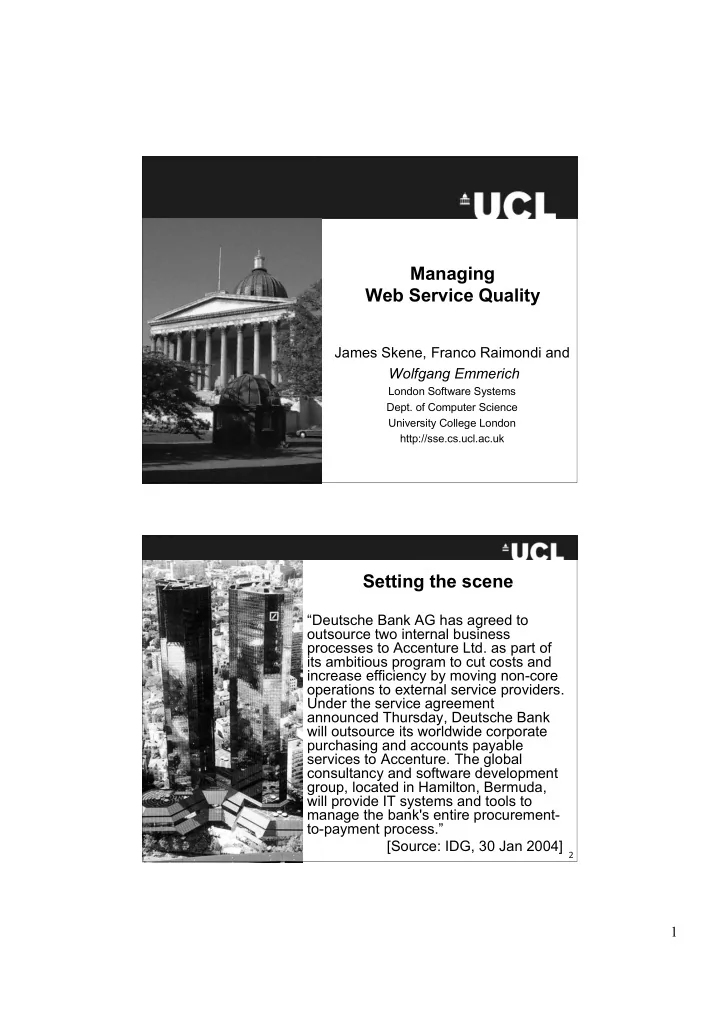
Managing Web Service Quality James Skene, Franco Raimondi and Wolfgang Emmerich London Software Systems Dept. of Computer Science University College London http://sse.cs.ucl.ac.uk Setting the scene Deutsche Bank AG has agreed to


slide-1
SLIDE 1

1

Managing Web Service Quality

James Skene, Franco Raimondi and Wolfgang Emmerich

London Software Systems

  • Dept. of Computer Science

University College London http://sse.cs.ucl.ac.uk

2

Setting the scene

“Deutsche Bank AG has agreed to

  • utsource two internal business

processes to Accenture Ltd. as part of its ambitious program to cut costs and increase efficiency by moving non-core

  • perations to external service providers.

Under the service agreement announced Thursday, Deutsche Bank will outsource its worldwide corporate purchasing and accounts payable services to Accenture. The global consultancy and software development group, located in Hamilton, Bermuda, will provide IT systems and tools to manage the bank's entire procurement- to-payment process.” [Source: IDG, 30 Jan 2004]

slide-2
SLIDE 2

2

3

Setting the scene

Tracking Funds Transfer Order Accounts Receivable Accounts Payable Purchase Request Server Purchase Request Client

4

Web Service Quality

  • Current SOA standards mainly

focus on functionality

  • But organizations depend on

quality of services provided by 3rd parties

  • Their service needs to be

delivered with agreed quality

– Availability / Timeliness – Reliability – Confidentiality – Integrity, …

slide-3
SLIDE 3

3

5

Quality Management

  • Testing web services alone is

insufficient because service quality determined by

– Resource provision available in the run-time environment – Service usage profile

  • For web services, we need to

– have quality norms and standards – know how to measure quality – have continuous quality monitoring – use quality criteria for service selection

  • These need to be reified at run-time

6

Managing quality in WS Architectures

Purchase Request Server Purchase Request Client Client Monitor Server Monitor SLA violations Component Message passing Generation Feedback Loop SLA

slide-4
SLIDE 4

4

7

Service Level Agreements

  • Associate penalties to aberrant

service behaviour

  • Are often part of service delivery

contracts

  • Mitigate risk
  • Previously mostly written in natural

language

– Ambiguous – Incomplete – Inconsistent

  • We focus on SLAs in formal

languages

8

Service Level Agreements

  • Determine required and

provided service quality

  • Written in terms of

– Non-functional requirements – Usage constraints

  • Often annexed to a service

provision contract

  • Bi-lateral
  • Bi-directional
slide-5
SLIDE 5

5

9

SLA content

SLAs determine conditions, e.g.

  • Reliability
  • Timeliness
  • Availability
  • Throughput
  • Backup

May include terms determining

  • Monitorability
  • Penalties
  • Administration
  • Schedules of applicability

10

SLA Language Engineering

  • Aim: defining precise and

unambiguous SLAs language

  • Use OMG’s Meta Object

Facility (MOF) to define

– Abstract syntax of SLA language – Service observation domain model

  • Define semantics of SLA langu-

age in model denotational style

– Behavioural constraints between syntax and domain model SLA Abstract Syntax Service Observation Domain Model Behavioural constraints

See: J. Skene, D.D. Lamanna and W. Emmerich: Precise Service Level Agreements. Proc. ICSE 04

slide-6
SLIDE 6

6

11

Syntax definition for web service SLAs in MOF

ServiceTerms ReliabilityClause +maximumLatency +reliability +window InputThroughputClause +inputWindow +concurrency FailureModeDefinition +kind +maximumLatency OperationDefinition ServiceConditions SLA ServiceDefinition PenaltyDefinition

1..* operations penalty terms conditions penalties failureModes

  • perations

services 1..* 1..* 1..* 1..* reliability inputThroughput 1..* 1..*

See: http://uclslang.sourceforge.net

conditions sLA 12

SLA in OMG Human readable Textual Notation

SLA() { terms = ServiceTerms[terms]() { penalties = { ::slang::PenaltyDefinition[p1]("Pay client 100 dollars.") } services = ServiceDefinition[service](Notification port")

  • perations = {

OperationDefinition[o1]("notify") { } OperationDefinition[o2](”subscribe") { } } failureModes = { FailureModeDefinition[f1]() { kind = OPERATION;

  • perations = {OperationDefinition[o1]}

maximumLatency = ::types::Duration(5, S) } } }

slide-7
SLIDE 7

7

13

SLA in HUTN (cont’d)

conditions = ServiceConditions[conditions]() { inputThroughput = { InputThroughputClause[iTC1]() { inputWindow = ::types::Duration(1, min) inputConcurrency = 10

  • peration = {OperationDefinition[o1]}

} } reliability = { ReliabilityClause[rC1]() { failureModes = {FailureModeDefinition[f1]} // When > 5 secs reliability = ::types::Percentage(0.9) window = ::types::Duration(1, min) penalties = { UnreliabilityPenaltyClause() { penalty = ::slang::PenaltyDefinition[p1] } } } } }

14

Further SLA syntax: Administration

SLA Administration ViolationCalculation Reconciliation Account Party Violation Evidence +date

calculation admin violation reconciliation agreed

  • wner

evidence 1..* 1..*

ServiceTerms ClientDefinition

violator clientDefinition terms party

ServerDefinition

serverDefinition party sLA sLA admin admin

slide-8
SLIDE 8

8

15

Service observation domain model

Party Evidence +date ServiceUsageRecord +duration +outcome:Outcome Report ReportRecord +sent +received Outcome +SUCEEDED:int=1 +FAILED:int=2 +NO_RESPONSE:int=3 +DATA_AGED:int=4 DefectReport +defectKind DefectKind +PARAMETER:int=1 +OPERATION:int=2 +SERVICE:int=3 +DATA:int=4 OperationDefinition

  • wner

evidence

  • peration

1..* 1..* records report measurement report defectEvidence 16

Semantics of input-throughput clause

class InputThroughputClause { invariant { conditions.sLA.admin->forAll( a : ::services::Administration | violationFirstUsage(a.reconciliation.agreed)->forAll( first : ::services::es::ServiceUsageRecord | a.calculation.violation->one( v : ::services::Violation | v.violator = conditions.sLA.terms.clientDefinition.party and v.violatedClause = self and v.penalty = penalty and v.evidence = violationEvidence(a.reconciliation.agreed, first) ) ) ) }

slide-9
SLIDE 9

9

17

Reminder

Purchase Request Server Purchase Request Client SLA Server Monitor Client Monitor SLA violations

18

Generating SLA Monitors

  • SLAs machine readable
  • MOF gives standard

representation

  • Idea: Generate monitoring

component from SLA

  • Given service observation

data monitor decides whether actual service level complies with SLA

  • Generator written using

– Java Metadata Interface (Sun) – Eclipse Platform

slide-10
SLIDE 10

10

19

Key idea

  • SLAs concern many timeliness constraints:

– Latency – Input and Output Throughput – Reliability – Availability

  • Events can be intercepted and time stamped without

changing web service requester and provider

  • Monitors can be expressed using timed automata
  • Detection of SLA violations reduces to acceptance of

timed words that consist of timed events

20

Timed Automata

  • A time sequence is a sequence of real numbers

τ=τ1τ2…τn such that τi>τi-1.

  • A timed word is a pair (w,τ) where w is a word of

length n and t is a time sequence of length n

  • Timed automata extend finite automata in the

following way:

– They introduce a set of clocks – They allow definition of time constraints over transitions – They allow to reset clocks.

  • Timed automata accept timed words and recognize

timed languages.

See: Alur & Dill, 1994: A Theory of Timed Automata. Theoretical Computer Science 126(2):183-253

slide-11
SLIDE 11

11

21

Expressing Web Service Reliability Constraints

  • Negate constraint (i.e. timed automaton accepts

timed word that indicates non-reliability)

  • In this example, no more than one failure occurrence

(fm) per minute.

  • Online monitoring per transition is efficient (constant

in number of outgoing transitions per state).

See: F. Raimondi, J. Skene, W. Emmerich & B. Wozna: A Methodology for On-line Monitoring Non-Functional Requirements Specifications of Web Services. Proc. PROVECS Workshop at Tools Europe. Zurich. 2007.

22

On-line monitoring Architecture

Client Provider

interceptor

SLA Monitor SLA Violation Evidence SLA Timed Automata

slide-12
SLIDE 12

12

23

Performance

24

Summary

Purchase Request Server Purchase Request Client SLA Server Monitor Client Monitor SLA violations

slide-13
SLIDE 13

13

25

Ongoing Work

  • SLAs with Virtualization:
  • SLAs and Orchestration:

– SLAs with service providers – A service composition

What SLA can be offered for the composite service?