Managing Information Overload - - PowerPoint PPT Presentation

managing information overload
SMART_READER_LITE
LIVE PREVIEW

Managing Information Overload - - PowerPoint PPT Presentation

Managing Information Overload http://flickr.com/photos/deapeajay/1928521563 / Lisa Spiro October 2010 Do you know anyone with infomania? Constantly checking email Flicks from one web page to another without fully digesting anything


slide-1
SLIDE 1

http://flickr.com/photos/deapeajay/1928521563/
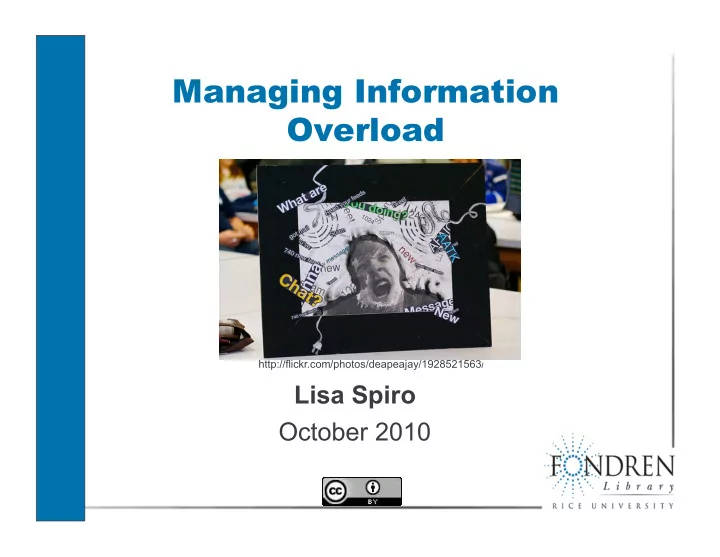
Managing Information Overload

Lisa Spiro October 2010

slide-2
SLIDE 2

Do you know anyone with infomania?

  • Constantly checking email
  • Flicks from one web page

to another without fully digesting anything

  • Difficulty focusing
  • Feels that can never know

enough

  • Works way too many

hours with too few results

slide-3
SLIDE 3

What is information overload?

  • “exposure to or provision of too much

information; a problematic situation or state of mental stress arising from this” (OED)

  • Other terms for information overload:
  • “data smog”
  • “glut”
  • “information explosion”
  • “infomania”
slide-4
SLIDE 4

When Was This Said?

“We have reason to fear that the multitude of books which grows every day in a prodigious fashion will make the following centuries fall into a state as barbarous as that of the centuries that followed the fall of the Roman Empire.” (17th C French scholar)

slide-5
SLIDE 5

Strategies for Managing IO in the Early Modern Era

  • Speed research by consulting reference

works: book reviews, encyclopedias, bibliographies, indices, etc.

  • Develop more efficient reading &

notetaking methods:

  • Selecting: reading from the canon, reading

parts

  • Sorting: cutting & pasting, grouping extracts

into categories; organizing books

  • Storing: notetaking systems--topical,

chronological, in notebook or separate sheets of paper; use of symbols to speed notetaking

The Reader, 1856, by Ferdinand Heilbuth (1826-1889)

slide-6
SLIDE 6

Development of the Attention Economy

  • “What information consumes is rather obvious: it

consumes the attention of its recipients. Hence a wealth of information creates a poverty of attention, and a need to allocate that attention efficiently among the overabundance of information sources that might consume it.” (Nobel-winning economist Herbert Simon, 1971)

  • “The physics of the Media world are changing from a

world where attention is abundant and distribution channels are scarce to a world where distribution is unlimited and attention is scarce” (Ian Rogers, Yahoo! Music)

slide-7
SLIDE 7

Manifestations of Information Overload

  • Interruption:
  • Knowledge workers get on average 3 minutes of

uninterrupted time on a task (Zeldes)

  • Deluge of data
  • 50-100 emails per day average at Intel (Zeldes)
  • Average American consumes 34 gigabytes per day

(UCSD study)

  • Finding the needle in the haystack:
  • Difficult to find what you need in 1000s of Google hits
  • Too many choices:
  • Barry Schwartz in The Paradox of Choice argues that

“unlimited choice” can “produce genuine suffering.”

slide-8
SLIDE 8

Information Overload (IO) and Decreased Productivity

Zeldes et al of Intel link IO to…

  • Wasting time
  • as much as 25% of the work-week at Intel is wasted due to

IO

  • 20 minutes per day spent on unnecessary emails
  • Interruptions mean having to redo work or take time to

retrace steps

  • Diminished mental capacity
  • Lack of problem solving ability
  • IO= temporary decline in IQ by as many as 10 points

according to HP study (more than smoking marijuana?)

  • Increased rate of error
  • Less creativity
  • Lack of “thinking time”
  • We need time to reflect & generate new ideas
slide-9
SLIDE 9

IO & Decreased Quality of Life

  • Ignorance
  • Neil Postman: Too much information makes it meaningless.
  • Stress
  • Feeling overwhelmed
  • Work interferes at home, diminishes quality time
  • Physical problems:
  • Poor vision, headaches, sore backs, etc.
  • Example:
  • NY Times reported recently that bloggers were suffering

health problems from overwork/ stress

slide-10
SLIDE 10

Time for an Info Diet?

http://infovegan.com/2010/07/28/banting

slide-11
SLIDE 11

Or Is Information Overload Hyped?

  • Tech consultant Stowe Boyd argues we’re moving

from a linear, assembly line model to “continuous partial attention”:

  • rapid, multi-stream, non-linear
  • social
  • keeping many things in view (like playing a video game)
  • “It depends on the situation, but I think we are

underestimating the brain’s capacity to adapt to new challenges. Studies have been done showing that people can actually enhance their cognitive abilities, which helps them to process more information at the same time.” (Fred Mast)

slide-12
SLIDE 12

We have a choice…

  • "attention is the most powerful tool of the

human spirit. We can enhance or augment

  • ur attention with practices like meditation

and exercise, diffuse it with technologies like email and Blackberries, or alter it with

  • pharmaceuticals. In the end, though, we are

fully responsible for how we choose to use this extraordinary tool.” (Linda Stone)

slide-13
SLIDE 13

Coping with Information Overload

  • Cultivate Space for

Reflection

  • Develop Productive

Habits

  • Embrace Constraints
  • Filter Information

Effectively

  • Manage Your Email
  • Use Appropriate

Process & Tools

http://www.flickr.com/photos/tonyjcase/2381294958/

slide-14
SLIDE 14

Fighting “Infomania” at Intel (2007-2008)

Intel is experimenting with different methods for reducing information overload, including:

  • “Quiet time”: Engineers block their calendars for 3

hours on Tuesday mornings

  • No email Friday: engineers encouraged to talk with

each other rather than email

  • Batching emails rather than constant drip
  • Moving to RSS subscription model for blast emails
  • Software-based email effectiveness coach.

See http://blogs.intel.com/it/authors#nathan_zeldes

slide-15
SLIDE 15

Cultivate Space for Reflection

  • Unplug and reflect. Take frequent

breaks--getting away from a problem allows you to clear your head.

  • Find sanctuary, space away from

technology-- garden, meditate, walk, spend time w/ people

  • Don’t multitask. Close out all

interruptions and make yourself focus

  • n a task for at least 20 minutes.
  • Clear clutter
  • Limit exposure to unnecessary

information-- unsubscribe from mailing lists & magazines, turn off the TV

  • Be healthy--sleep, exercise, eat well

etc

http://flickr.com/ photos/dharmasphere/ 33750826/

slide-16
SLIDE 16

Develop Productive Habits

  • Do a productivity audit: Where do you waste time?
  • Tools like slife, timeEdition, wakcopa and Klok

help you track your time

  • Map out your day: have goals, organize a schedule
  • Set aside a certain time of the day to process

information

  • Make it easy to pick up a task--take notes about

what still needs to be done.

  • Write down ideas as they come to you.
  • Create a folder for items you still need to act on
  • Step back: establish a weekly review
slide-17
SLIDE 17

Relaxation Break

  • Counting backwards,

http://chronicle.com/blogs/ profhacker/got-a-minute-count- backwards/22801 OR

  • Get energy flowing,

http://chronicle.com/blogs/ profhacker/got-a-minute-get- your-energy-flowing/22722

slide-18
SLIDE 18

Embrace Constraints

  • Say no sometimes
  • Stop when you’ve found enough information
  • Make your to-do lists specific and actionable so
  • you know what to do
  • tasks don’t seem so huge
  • Establish deadlines
  • Turn to trusted information sources—but go beyond

your own biases

  • Establish boundaries:.
  • “Satisficing”: seeking what is “good

enough” (Herbert Simon)

slide-19
SLIDE 19

Filter Failure?

“What we're dealing with now is not the problem

  • f information overload, because we're always

dealing (and always have been dealing) with information overload...Thinking about information overload isn't accurately describing the problem; thinking about filter failure is.” (Clay Shirky)

http://www.flickr.com/photos/ verbeeldingskr8/3638834128/

slide-20
SLIDE 20

Filter Information Effectively

  • Focus on knowing what

you need, when you need it

  • Use filters w/ Gmail or

Thunderbird to automatically file email

  • Use social filters, e.g.

Twitter, delicious, PostRank

  • Use advanced search to

narrow by date, etc.

slide-21
SLIDE 21

Manage Your Email

  • Turn off automatic alerts
  • Check only 3 or 4 times a day at set times (not first

thing in the morning)

  • Consider adopting “quiet time”
  • Rather than letting the email linger, act on it, put it in

a folder of items to be acted on later, file it, or delete it

  • Get off email lists that are no longer relevant
  • Use “canned responses,” e.g. in Gmail
  • Be concise and direct in your responses. Adopt the

5-sentence email

  • Don’t CC people who don’t need to be included
slide-22
SLIDE 22

Managing IO while researching

  • Consult a reference work to get a general

knowledge of the field and find references

  • Establish a hypothesis, then filter information by

looking for data to back up or refute that hypothesis

  • Prioritize. Focus on what you need to know: when do

you have enough?

  • Organize your stuff through tagging, filing, etc. (or

depend on search tools to find your stuff for you)

  • Take notes.
  • Connect what new information to what you already
  • know. Learning depends on connecting &

contextualizing.

  • Skim.
slide-23
SLIDE 23

http://www.flickr.com/photos/ petehindle/4691312748/

“Getting Things Done” (GTD)

  • Popular productivity system by David Allen for

dealing with information overload

  • Key principles:
  • Get “stuff” out of your head onto paper (or another

medium)

  • Have a system for deciding what to do with your

stuff when it appears.

  • Organize your stuff, and set up reminders
  • Keep your system current; review it frequently
slide-24
SLIDE 24

GTD Workflow Overview

1.

Collect: Identify what you have. Gather everything into “buckets”.

2.

Process: Empty your bucket. Decide whether tasks are actionable or can be filed or thrown away. If it can be done in 2 minutes, do it. Otherwise, defer

  • r delegate.

3.

Organize: Figure out where to put your stuff-- & put it there. Non-actionable stuff goes in reference file, incubation (tickler) file, or trash. Actionable stuff goes on calendar, project list, etc.

4.

Review: Regularly review goals, stuff & system.

5.

Do: Act based on context (where you are), time available, energy available, and priority.

slide-25
SLIDE 25

http://www.flickr.com/photos/programwitch/344093509/#/

GTD: Workflow

slide-26
SLIDE 26

GTD SOftware

Lots of software is available to support GTD (e.g. GTDInbox for Gmail in Firefox, Thinking Rock as personal organizer) Thinking Rock

slide-27
SLIDE 27

Use a Timer

  • Set a timer to:
  • Break up tasks into manageable chunks
  • Focus
  • Set limits (e.g. on online research)
  • Set small deadlines
  • Remind yourself to take breaks
  • Timers:
  • PC: CoolTimer, cooktimer
  • Mac: TimeOut, Minuteur, Meditation Timer,

FlexTime

  • Device: Polder, cooking timer

http://www.flickr.com/ photos/s_v_p/5869857/

slide-28
SLIDE 28

Pomodoro Technique

  • Time management strategy to improve focus
  • Key elements:
  • Select a task
  • Set the timer to 25 minutes
  • Focus on the task until the timer rings, then make

a check mark on your paper

  • Take a 5 minute break
  • Take a longer break after 4 sessions
  • See http://www.pomodorotechnique.com/

http://www.flickr.com/ photos/lucamascaro/ 4975166968/

slide-29
SLIDE 29

Exercise: Make This To-Do List Actionable

  • Be less overwhelmed by information
  • Relax
  • Research information fluency presentation
slide-30
SLIDE 30

http://flickr.com/photos/teo/ 66712699

Tools as Time-savers?

  • We all need tools to help us…
  • Find information
  • Manage information
  • Think/ Map out ideas
  • Record
  • Plan
  • Schedule
  • But identifying, learning, and using tools can

also take time.

slide-31
SLIDE 31

Five Tools to Manage Information Overload

  • 1. Use calming technologies
  • 2. Remove clutter
  • 3. Track tasks with to-do lists
  • 4. Develop an “external brain”: information

management tools

  • 5. Research, not Re-search: Zotero
slide-32
SLIDE 32

“Zenware”: Achieving Focus & Calm

  • Emergence of technologies that

block out distractions

  • Examples:
  • Scrivener: software for writers;

features include note-taking,

  • utlining, full-screen mode to
  • bscure distractions
  • Spirited Away: hides apps after

a period of inactivity

  • LeechBlock: blocks web sites
  • RescueTime : web based time

tracking

  • Freedom: Internet blocking
slide-33
SLIDE 33

Clear Out the Clutter Using Readability

  • http://lab.arc90.com/experiments/readability/
  • Bookmarklet that reformats web pages with

click of a button

slide-34
SLIDE 34

Free Tools for To-do Lists

  • Remember the Milk
  • Todoist: clean interface, tied to calendar,

create hierarchies

  • Ta-da list: super simple
  • Teuxdeux
  • Google Tasks

Remember the Milk

slide-35
SLIDE 35

Information Organization Tools: External Brain

  • EverNote: Mac, PC; notetaking; mobile support;

image recognition; voice

  • DevonThink: Mac
  • ReQall: “voice-enabled memory aid”
  • Yojimbo: Mac; collect, store & find info
  • OneNote: PC; gather notes in one place; search;

share

  • Simple: use Google Desktop or Spotlight (Mac) to

find your stuff (full text search) Evernote Devon

slide-36
SLIDE 36

Personal Portal

  • Advantage: Get all of the information you

regularly consult in front of you

  • Disadvantages:
  • Increased distraction
  • Feeling overwhelmed
  • Examples:
  • iGoogle
  • Pageflakes
  • NetVibes
slide-37
SLIDE 37

Research Tools

  • Don’t waste your time…
  • Doing tasks that can be automated
  • “re-searching”: looking for resources

you’ve already found

  • Zotero
  • “a free, easy-to-use Firefox extension to help you collect,

manage, and cite your research sources. It lives right where you do your work — in the web browser itself.”

  • Developed by scholars at George Mason’s

Center for History & New Media

  • Automatic download of citation information and PDFs of articles
  • Search your collections, including tags & HTML documents
  • Automatically create bibliographies in many formats
slide-38
SLIDE 38

How to “compete” in the info economy

Given the abundance of information, how can you make your research stand out? Michael Jensen, “The New Metrics of Scholarly Authority” (2007): “In the Web 3.0 world, we will also start seeing heavily computed reputation-and-authority metrics”

  • Make full-text available for indexing
  • Provide rich descriptive information
  • Make it possible for others to comment on it and

link to it (digg)

slide-39
SLIDE 39

Key Sources

  • This presentation is a synthesis of information

bookmarked at http://www.diigo.com/user/lspiro/information_overload

  • ProfHacker: http://chronicle.com/blogs/profhacker/
  • Blair, Ann. “Reading Strategies for Coping With

Information Overload ca. 1550-1700.” Journal of the History of Ideas 64.1 (2003) 11-28

  • Kirilenko, Kaedra. “Information Overload” (November

2007), http://www.slais.ubc.ca/COURSES/libr500/07-08- wt1/www/K_Kirilenko-WWW/index.htm

  • Zeldes, Nathan, David Sward, and Sigal Louchheim

“Infomania: Why we can’t afford to ignore it any longer” First Monday 12.8 (August 2007) http://firstmonday.org/ issues/issue12_8/zeldes/