Management Framework: Integrating with Strategy and Performance 1 - - PowerPoint PPT Presentation

management framework
SMART_READER_LITE
LIVE PREVIEW

Management Framework: Integrating with Strategy and Performance 1 - - PowerPoint PPT Presentation

Enterprise Risk Management Framework: Integrating with Strategy and Performance 1 Mission COSOs Mission is To provide thought leadership through the development of comprehensive frameworks and guidance on enterprise risk management,


slide-1
SLIDE 1

1

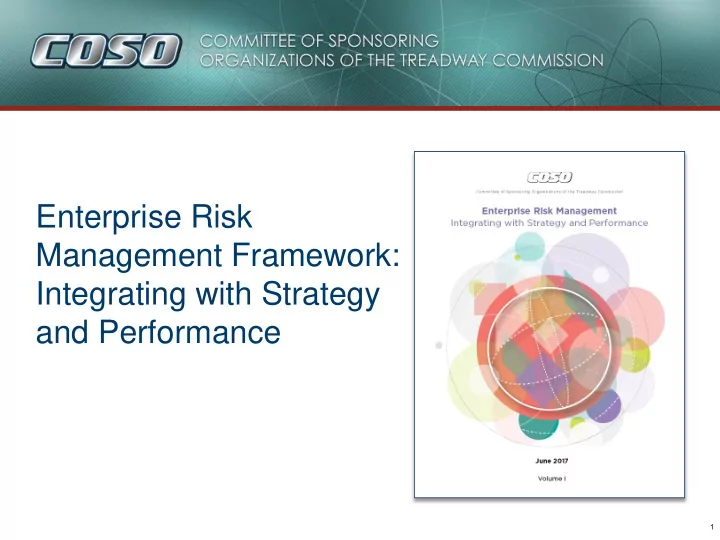
Enterprise Risk Management Framework: Integrating with Strategy and Performance

slide-2
SLIDE 2

2

Mission

  • COSO’s Mission is “To provide thought leadership through the

development of comprehensive frameworks and guidance on enterprise risk management, internal control and fraud deterrence designed to improve organizational performance and governance and to reduce the extent of fraud in organizations.”

COSO’s Fundamental Principle

  • Good risk management and internal control are necessary for long

term success of all organizations

slide-3
SLIDE 3

3

COSO Project to Update the Enterprise Risk Management Framework

  • The COSO Board released in September 2017 an update to the

2004 Enterprise Risk Management–Integrated Framework

  • That framework is used widely used by management to enhance an
  • rganization’s ability to manage uncertainty and to consider how

much risk to accept as it strives to increase value

  • This initiative enhanced the framework’s content and relevance in an

increasingly complex business environment so that organizations can attain better value from enterprise risk management

slide-4
SLIDE 4

4

About COSO…

> 600,000 professionals

Originally formed in 1985, COSO is a joint initiative of five private sector organizations and is dedicated to providing thought leadership through the development of frameworks and guidance on enterprise risk management (ERM) internal control and fraud deterrence

slide-5
SLIDE 5

5

Thought Leadership to Improve Your Organization

slide-6
SLIDE 6

6

Specific topics for discussion

  • Setting the Stage
  • Path to Publication
  • 10 Key Things to Know about the Framework
  • Public Exposure Process
  • Key Takeaways
slide-7
SLIDE 7

7

Setting the Stage

slide-8
SLIDE 8

8

Project Structure

PwC Project Team:

  • Served as the author and project

leader

  • Conducted research, interviews,

surveys, Advisory Council meetings, and one-on-one and group forums to capture feedback on the update

  • Captured feedback from across North

America, Central America, Europe, Asia, and Australia Advisory Council and Observers:

  • Consisted of over 25 professionals
  • Provided input, feedback, insight, and

ideas throughout the update

8

COSO Board PwC Project Team Advisory Council Observers

slide-9
SLIDE 9

9

A Key Introduction…

  • Our understanding of the nature of risk, the art and science of choice

lies at the core of our modern market economy

  • Every choice we make in the pursuit of objectives has its risks. From

day-to-day operational decisions to the fundamental trade-offs in the boardroom, dealing with uncertainly in these choices is a part of our

  • rganizational lives.
slide-10
SLIDE 10

10

A New Title

  • Retitled as Enterprise Risk

Management—Integrating with Strategy and Performance

  • Recognizes the importance
  • f strategy and entity

performance

  • Further delineates enterprise

risk management from internal control

slide-11
SLIDE 11

11

Path to Publication

slide-12
SLIDE 12

12

Key Efforts in Updating the Framework

  • Extensive research, including survey
  • Interaction with an Advisory Council and PwC Extended Team
  • Meetings held around the world to help envision the update
  • Public comment process
  • Meetings held around the world to capture feedback on update
slide-13
SLIDE 13

13

Summary of Public Comment Feedback: Survey

  • Over 200 responses – double that of

the internal control update

  • Over 70% of responses from individuals
  • Over 50% of participation outside of

North America

  • Almost 50% had affiliations beyond

COSO memberships

  • Almost 50% of respondents had 10 or

more years of risk management experience

  • Positive ratings outnumbered negative

ratings by 4.5:1

slide-14
SLIDE 14

14

Summary of Public Comment Feedback: Letters

  • 48 letters received – many of which

demonstrated considerable investment

  • Comments on concepts (flawed

missing, unnecessary) collectively represented less than 15% of the total number of comments received

  • Greatest number of comments

requested clarity of drafted content versus adding/deleting content

slide-15
SLIDE 15

15

10 Key Things to Know about the Framework

slide-16
SLIDE 16

16

1) Provides a New Document Structure

  • Framework focused on fewer components (five)
  • Uses focused call-out examples to emphasize key points (> 30)
  • Follows the business model versus an isolated risk management

process

slide-17
SLIDE 17

17

2) Introduces Principles

20 key principles within each of the five components

slide-18
SLIDE 18

18

3) Incorporates New Graphics

Graphic has stronger ties to the business model

slide-19
SLIDE 19

19

4) Focuses on integration

  • Integrating ERM with business practices results in
  • better information that supports improved
  • decision-making and leads to enhanced performance
  • It helps organizations to:

– Anticipate risks earlier or more explicitly, opening up more options for managing the risks – Identify and pursue existing and new opportunities – Respond to deviations in performance more quickly and consistently – Develop and report a more comprehensive and consistent portfolio view of risk – Improve collaboration, trust, and information sharing

slide-20
SLIDE 20

20

5) Emphasizes Value

  • Enhances the focus on value – how entities
  • create, preserve, and realize value
  • Embeds value throughout the framework, as evidenced by its:

–Prominence in the core definition of enterprise risk management –Extensive discussion in principles –Linkage to risk appetite –Focus on the ability to manage risk to acceptable levels

slide-21
SLIDE 21

21

6) Links to Strategy

  • Explores strategy from three different perspectives:

–The possibility of strategy and business objectives not aligning with mission, vision and values –The implications from the strategy chosen –Risk to executing the strategy

slide-22
SLIDE 22

22

7) Links to Performance

  • Enables the achievement of strategy by actively managing risk and

performance

  • Focuses on how risk is integral to performance by:

–Exploring how enterprise risk management practices support the identification and assessment of risks that impact performance –Discussing tolerance for variations in performance

  • Manages risk in the context of achieving strategy and business
  • bjectives – not as individual risks
slide-23
SLIDE 23

23

7) Links to Performance

  • Introduces a new depiction

referred to as a risk profile

  • Incorporates:

– Risk – Performance – Risk appetite – Risk capacity

  • Offers a comprehensive view of

risk and enables more risk- aware decision making

  • The framework provides a complete depiction of how to build a risk

profile in an appendix

slide-24
SLIDE 24

24

8) Recognizes Importance of Culture

  • Addresses the growing focus, attention and Importance of culture

within enterprise risk management

  • Influences all aspects of enterprise risk management
  • Explores culture within the broader context of overall core
  • Depicts culture behavior within a risk spectrum
  • Explores the possible effects of culture on decision making
  • Explores the alignment of culture between individual and entity

behavior

slide-25
SLIDE 25

25

9) Focuses on Decision-making

  • Explores how enterprise risk

management drives risk aware decision making

  • Highlights how risk awareness
  • ptimizes and aligns decisions

impacting performance

  • Explores how risk aware

decisions affect the risk profile

Risk Aware Decision Making Assumptions Risk Appetite Culture Strategy Business Context Risk Profile

slide-26
SLIDE 26

26

10) Builds links to internal control

  • The document does not replace

the Internal Control – Integrated Framework

  • The two frameworks are distinct

and complementary

  • Both use a components and

principles structure

  • Aspects of internal control common

to enterprise risk management are not repeated

  • Some aspects of internal control

are developed further in this framework

slide-27
SLIDE 27

27

Recap…

Document Structure Principles Graphics Integration Value Strategy Performance Culture Decision- making Internal control

slide-28
SLIDE 28

28

Compendium of Examples

  • A compendium of examples is also

being developed, illustrating: – All principles – A variety of entity sizes from global through to national, regional, and local entities – A variety of industry types – Actual company practices and be augmented with expected practices in select areas, as needed

  • Written from the perspective of

the business

Coming Soon….

slide-29
SLIDE 29

29

Key Takeaways

slide-30
SLIDE 30

30

A Suitable Model Everywhere…

slide-31
SLIDE 31

31

How to attain the Framework

  • Order on-line through either the

IIA or AICPA

  • IIA – offer print versions for sale
  • AICPA offers both print and

eBook versions for sale

  • Both can be accessed from the

COSO.ORG website

slide-32
SLIDE 32

32

Thank You