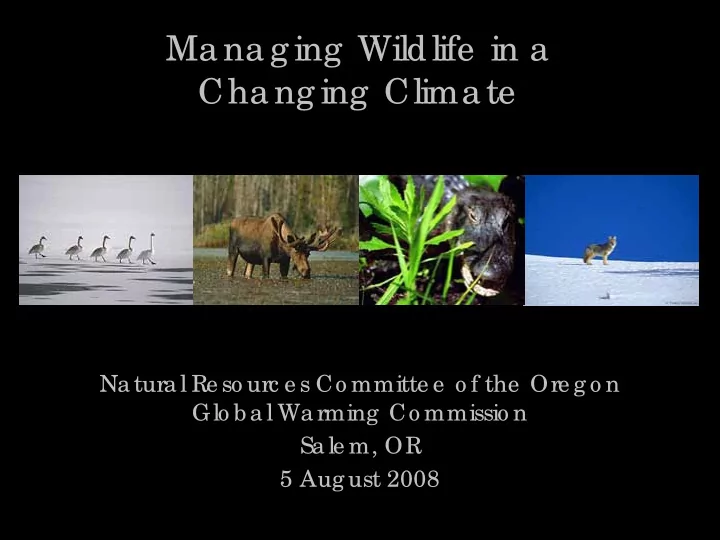
Manag ing Wildlife in a Chang ing Climate Natural Re so urc e s - - PowerPoint PPT Presentation
Manag ing Wildlife in a Chang ing Climate Natural Re so urc e s Co mmitte e o f the Ore g o n Glo bal Warming Co mmissio n Sale m, OR 5 Aug ust 2008 Climate Change PCC 2007 I e mpe rature tre nds 1979-2005 T U M Data, Chris Daly,
Climate Change
I PCC 2007
T e mpe rature tre nds 1979-2005
PRI S M Data, Chris Daly, OS U
I PCC 2007
PRI S M data, Chris Daly, OS U
F uture c limate pro je c tio ns
I PCC 2007
2020-2029 2090-2099 SRE S A2
Pro je c te d % c hang e in pre c ipitatio n 1980-1999 to 2090-2999 (I PCC)
I PCC 2007
Physic al e ffe c ts o f c limate c hang e
Figure 1. Linear trends in April 1 snow water equivalent (SWE) relative to the starting value for the linear fit (i.e., the 1950 value of the best-fit line), (a) at 824 snow course locations in the western U.S. and Canada for the period 1950-1997, with negative trends shown by red circles and positive by blue circles. Lines on the maps divide the West into four regions for analysis shown in subsequent figures. Mo te e t al., 2005, Bulle tin o f the Ame ric an Me te o ro lo g ic al So c ie ty.
T re nds in Sno wpac k 1950-1997
Re d = Obse rve d de c re ase s Blue = Obse rve d inc re ase s
Data from Westerling et al. 2006
Pho to : Dr. W. Glamo re
Se a-le ve l Rise
0.2 - 0.6 m by 2100
- I
PCC 2007
E c o lo g ic al e ffe c ts o f c limate c hang e
E arlie r spring e ve nts
Shifting rang e s
Parme san e t al. 1999. Nature 399: 579-583
Projected Climate-Induced Changes in Biota
No rthe rn Go shawk (HADCM3 A1B)
stable e xpansio n c o ntrac tio n
Po te ntial Spe c ie s Chang e in Badlands Natio nal Park
Chang e Maximum = 56% Minimum = 29%
T
- tal = 168 spp.
Po te ntial L
- sse s
We ste rn Gre b e Blac k T e rn No rthe rn Pintail* Ame ric an Wig e o n* L
- ng -e are d Owl*
Bre we r’ s Sparro w Mo untain Blue b ird* Ame ric an Re dstart E aste rn Pho e b e Ove nb ird L azuli Bunting Ce dar Waxwing
Po te ntial Gains
Cassisn’ s S parro w Gre e n He ro n Ho use F inc h Marsh Wre n No rthe rn Cardinal
Manag ing wildlife in a c hang ing c limate
pro te c te d are as
c o nne c tivity
inc re ase adaptive c apac ity
minimize o the r thre ats re sto re habitat re mo ve barrie rs to dispe rsal
translo c atio ns
Ac tive adaptive manag e me nt
c o upling manag e me nt ac tio ns with mo nito ring and e valuatio n to pro vide fe e dbac k lo o ps by whic h manag e me nt ac tio ns may be alte re d o r re dire c te d
Re se arc h ne e ds vulne rability asse ssme nts te sts o f adaptive manag e me nt appro ac he s unde rstanding o f re spo nse s to c limate c hang e
Craig Bie nz
I PCC 2007
T e mpe rature s pre dic te d to rise 1.1 – 6.4 °C o ve r the ne xt 100 ye ars (I PCC)
I PCC 2007
Climate Chang e I mpac ts
“We are no t talking any mo re abo ut what c limate mo de ls say mig ht happe n in the future . We are e xpe rie nc ing dang e ro us human disruptio n o f the g lo bal c limate and we are g o ing to e xpe rie nc e mo re .” – Jo hn Ho ldre n, Past Pre side nt, Ame ric an Asso c iatio n
fo r the Advanc e me nt o f Sc ie nc e (Harrabin, BBC, 8/ 31/ 06)
No rthe rn F lying Squirre l (HADCM3 A1B)
stable e xpansio n c o ntrac tio n
Environmental Change Research Group, Dept. of Geography, Univ. of Oregon. Climate data: CRU CL 1.0 (New et al. 1999); CRU data interpolation: P. J. Bartlein (Univ. of Oregon); HadCM2 (Mitchell and Johns 1997). Soil data: CONUS-SOIL (Miller and White 1998); Vegetation model: BIOME4 (Kaplan 2001), modified by S. Shafer (USGS).
Do ug las Squirre l (HADCM3 A1B)
stable e xpansio n c o ntrac tio n
I PCC 2007
I PCC 2007