European Participation in U.S. Funding p p g Programmes: Survey - - PDF document

european participation in u s funding p p g programmes
SMART_READER_LITE
LIVE PREVIEW

European Participation in U.S. Funding p p g Programmes: Survey - - PDF document

European Participation in U.S. Funding p p g Programmes: Survey of Researchers & Grants Administrators Tom C. Wang, Ph.D . Director for International Cooperation, American Association for the Advancement of Science (AAAS) Project


slide-1
SLIDE 1

1 European Participation in U.S. Funding p p g Programmes: Survey of Researchers & Grants Administrators

Tom C. Wang, Ph.D.

Director for International Cooperation, American Association for the Advancement of Science (AAAS) Project Coordinator Link2US Project Coordinator, Link2US 24 June 2011 EARMA Annual Conference Bragança, Portugal

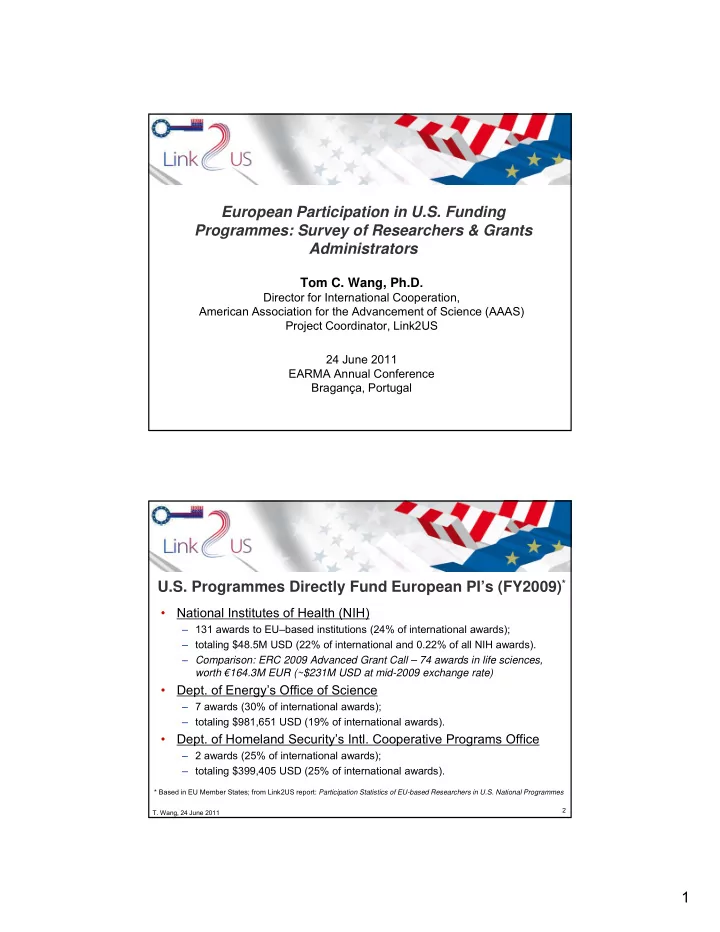
U.S. Programmes Directly Fund European PI’s (FY2009)*

  • National Institutes of Health (NIH)

– 131 awards to EU–based institutions (24% of international awards); – totaling $48.5M USD (22% of international and 0.22% of all NIH awards). – Comparison: ERC 2009 Advanced Grant Call – 74 awards in life sciences, worth €164.3M EUR (~$231M USD at mid-2009 exchange rate)

  • Dept. of Energy’s Office of Science

– 7 awards (30% of international awards);

  • T. Wang, 24 June 2011

( ) – totaling $981,651 USD (19% of international awards).

  • Dept. of Homeland Security’s Intl. Cooperative Programs Office

– 2 awards (25% of international awards); – totaling $399,405 USD (25% of international awards).

2 * Based in EU Member States; from Link2US report: Participation Statistics of EU-based Researchers in U.S. National Programmes

slide-2
SLIDE 2

2 Surveys of European Researchers and Institutions

  • Identify key issues that EU-based researchers/institutions face

when applying to and participating in U.S. funding programmes

– NIH – DOE

  • Outcomes used to inform stakeholders in the funding of

international cooperation (including the European Commission and U.S. funding bodies) regarding key issues to address in

  • T. Wang, 24 June 2011

and U.S. funding bodies) regarding key issues to address in improving these funding schemes.

Disclaimer: the information has been compiled from public sources and communications with U.S. funding entities; analyses and results do not necessarily reflect any official views of the U.S. federal government or of the organizations comprising the Link2US project. The

  • pinions and any errors are entirely the responsibility of the authors.

3

NIH Survey Findings

  • Programmes researcher-friendly but policy differences between

NIH and European granting agencies make grant administration challenging.

  • Funding system praised as transparent and highly respected

with helpful programme staff.

  • Suggestions focused on improving already open and efficient

programmes: clarity of eligibility/opportunities; support for

  • T. Wang, 24 June 2011

programmes: clarity of eligibility/opportunities; support for addressing administrative differences; U.S.-European specific funding; full indirect.

4

slide-3
SLIDE 3

3 Methodology

  • Online questionnaire to EU-based researchers and grants

administrators who received direct awards during U.S. fiscal year 2003-2010.

  • Conducted September, October 2010
  • Three categories of questions

– Demographic and background; Experience with funding entity and its programmes (e g awareness legal

  • T. Wang, 24 June 2011

– Experience with funding entity and its programmes (e.g., awareness, legal, policy, and administrative issues); – Recommendations for lessons and improvements

5

NIH Background

  • Primary U.S. federal entity for conducting (intramural) and

supporting (extramural) biomedical research (FY2011: $30.2B USD; approx. half for research project grants). NIH programmes fund the largest number of EU-based researchers and institutions of all U.S. civilian programmes.

  • In 2008, agreement between then Director of NIH Elias Zerhouni

and European Commissioner for Research Janez Potočnik on

  • T. Wang, 24 June 2011

and European Commissioner for Research Janez Potočnik on the mutual openness of NIH funding programmes and the Framework Programme for biomedical and health research (i.e., programmes can directly fund each other’s researchers).

6

slide-4
SLIDE 4

4 NIH Survey Demographics

  • NIH awarded 1,097 new grants to 326 individual EU-based

researchers from 191 institutions in FY2003-2010.

  • Response:

– 78 researchers (out of 308 contacted); – 18 grants administrators (GA’s) (out of 88)

  • T. Wang, 24 June 2011

7

NIH Survey Demographics

  • Majority from higher education institutions
  • Majority through R01 awards (GA’s reported ~ 3:1 Indirect:Direct

Awards)

  • Majority researchers had either previously studied or conducted

research in the U.S. before first NIH award

  • Majority researchers had collaborated with U.S. institutions

b f fi t NIH d

  • T. Wang, 24 June 2011

before first NIH award

8

slide-5
SLIDE 5

5 NIH General Issues

Researchers GA’s “High” “Medium” “Low”

  • T. Wang, 24 June 2011

9

Lack of admin. support from own

  • rganization

Communication and information awareness Lack of complementary funding Cultural differences Differences in U.S./European policy requirements Contractual issues and IP Lack of admin. support from U.S. funder Low Challenges

NIH Legal, Policy, and Administrative Aspects

Researchers GA’s “High” “Medium” “Low”

  • T. Wang, 24 June 2011

10

F&A cost recovery limits Audit requirements Budgeting requirements Other contractual requirements IP Low Challenges

slide-6
SLIDE 6

6 NIH Grants Policy Statement related to Grants to Non-U.S. Institutions

  • Additional review criteria:

– 1) whether the project presents special opportunities for furthering research programs through the use of unusual talents, resources, populations, or environmental conditions in other countries that are not readily available in the United States or that augment existing U.S. resources; and, – 2) whether the proposed project has specific relevance to the mission and

  • bjectives of the NIH Institute/Center (IC) and has the potential for

significantly advancing the health sciences in the United States and the

  • T. Wang, 24 June 2011

g y g health of the people of the United States.

  • Majority (65%) of researchers responded that the additional

criteria were not challenges.

  • Some noted having a U.S. collaborator eased the justification,

while others expressed a perceived bias against non-U.S. PI’s.

11

NIH Funding is a Significant Funding Source and Provides Credibility for Researchers Provides Credibility for Researchers

  • T. Wang, 24 June 2011

12

slide-7
SLIDE 7

7 Primary Sources for NIH Opportunities are NIH and Colleagues/Collaborators Colleagues/Collaborators

  • T. Wang, 24 June 2011

13

Addressing NIH Policy Requirements

  • T. Wang, 24 June 2011

14

slide-8
SLIDE 8

8 NIH Strengths and Lessons for Other Programmes

  • Quality, transparent review process with feedback mechanism
  • Less burdensome administration with detailed information

available

  • Supportive programme officers and other staff

primarily offered by researchers

  • T. Wang, 24 June 2011

15

Recommendations to Improve Collaboration

  • Improve clarity of eligibility criteria and opportunities for EU-

based researchers;

  • Increase support for addressing NIH and European differences

in administrative requirements and policies;

  • Develop specific funding for U.S.-European collaboration;
  • Allowing full F&A cost recovery.
  • T. Wang, 24 June 2011

16

slide-9
SLIDE 9

9 Questions

  • Experience of researchers who applied but never successfully

receive a grant.

  • Experience of researchers who have only received indirect

funding or those who do not receive any funding but collaborate

  • n NIH-funded projects.
  • Specific policy issues for improved international collaborations:

research misconduct; conflict of interest; data sharing; public

  • T. Wang, 24 June 2011

research misconduct; conflict of interest; data sharing; public access; animal welfare; etc.

17

Acknowledgments

  • Researchers and university grants administrators who

responded to this survey and provided their invaluable input.

  • Dr. Patriq Fagerstedt, Karolinska Institute’s Grant Office, for

input into the initial development of the questionnaires.

  • The Link2US project is co-funded by the EU 7th Framework

Programme on Research and Technological Cooperation’s Capacities Programme on International Cooperation under grant

  • T. Wang, 24 June 2011

Capacities Programme on International Cooperation under grant number 244371.

18

slide-10
SLIDE 10

10 More Information

  • www.EUUSScienceTechnology.eu/Link2US
  • www.euussciencetechnology.eu/link2us/funding-
  • pportunities.html
  • Link2US@aaas.org
  • T. Wang, 24 June 2011

19