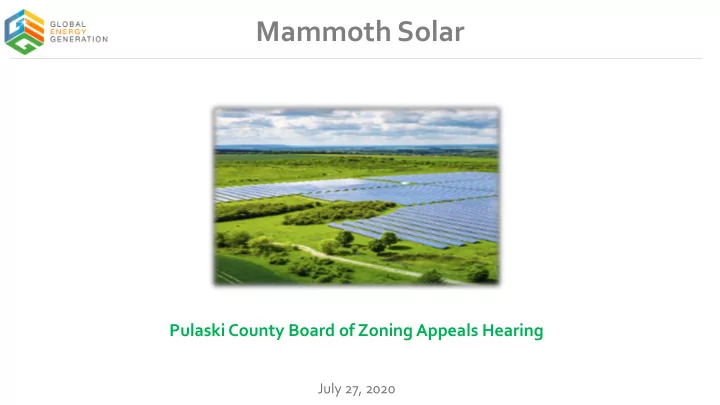
Mammoth Solar Pulaski County Board of Zoning Appeals Hearing July - - PowerPoint PPT Presentation

mammoth solar
SMART_READER_LITE
LIVE PREVIEW

Mammoth Solar Pulaski County Board of Zoning Appeals Hearing July - - PowerPoint PPT Presentation

Mammoth Solar Pulaski County Board of Zoning Appeals Hearing July 27, 2020 Mammoth Solar 500MW 1GW PV Solar Farm Estimated investment - over $500 Million A Photovoltaic (PV) Solar Farm in Pulaski County, Indiana Pulaski Presented by:


slide-1
SLIDE 1

Pulaski County Board of Zoning Appeals Hearing

July 27, 2020

Mammoth Solar

slide-2
SLIDE 2

Mammoth Solar

500MW – 1GW PV Solar Farm Estimated investment - over $500 Million A Photovoltaic (PV) Solar Farm in Pulaski County, Indiana Presented by: Global Energy Generation LLC

Nick Cohen, Global Energy Generation LLC 570-840-5835 | ncohen@GEGrenewables.com

Pulaski

slide-3
SLIDE 3

Contents

I. The Developer II. Project Summary III. Next Steps

  • IV. Ballot Items
slide-4
SLIDE 4
  • I. THE DEVELOPER - HISTORY & BACKGROUND

Joint venture to develop utility scale renewables in the U.S. – Global Energy Generation LLC

DORAL GROUP LTD.

  • Leading developer and owner-operator of
  • ver 400 energy facilities globally
  • First company to commercialize a solar

facility in Israel, 13 years ago

  • Publicly traded company
  • 3 GW project portfolio pipeline

CLEAN AIR GENERATION LLC

  • Developer of utility scale energy projects

in the U.S

  • Key principal, Nick Cohen, having 15 years
  • f experience in the market
slide-5
SLIDE 5

GLOBAL ENERGY GENERATION LLC

THE COMPANY

  • 1.5 GW of renewables in PJM/MISO
  • $2 billion construction portfolio
  • 21,000 acres of land control
  • Over 50-years combined energy

development experience of management team

  • Projects will serve over 1 million

households

slide-6
SLIDE 6

II. PROJECT SUMMARY - MAMMOTH SOLAR

GENERAL OVERVIEW

  • Optimal location where two grid systems

converge

  • Strong market demand from Indiana utilities
  • Helps County realize their investment in a

solar ordinance by attracting the project and its investment

  • Unlike many neighboring states, Indiana

does not provide a policy framework to subsidize solar projects and as a result, projects must have economies of scale

slide-7
SLIDE 7

Typical Rural Solar Facilities

slide-8
SLIDE 8

II. PROJECT SUMMARY – SOLAR LAYOUT PLAN

Winamac

Francesville

slide-9
SLIDE 9

COMMUNITY BENEFITS 1) Most valuable use of agriculture land resulting in: a) >$200 million construction workforce investment b) >$50 million local vendor contracts during construction c) Increased revenue to Pulaski d) Host community benefit opportunity to fund revitalization, historical attributes and other community and municipal needs e) >40 local jobs after construction f) >$10 million annually in local service/vendor contracts for the operating life of the project 2) Provides clean power to the grid, meeting state and federal regulations 3) Quiet neighbor with very low traffic and no impact on property values 4) Preserves farmland for future agricultural use (like an extended CRP program)

II. PROJECT SUMMARY - MAMMOTH SOLAR

slide-10
SLIDE 10

Once Special Exception is granted:

  • We must initiate several studies and analyses of the site including,

without limitation, extensive surveying, topography, sediment, erosion and drainage, wildlife and migration studies, delineation of flood plains and wetlands, and interconnection to the grid

  • Detailed depiction of project site, internal access drives, fencing,

landscaping, and construction prior to grant of building permit

  • Project still has to go through rigorous state and federal permitting
  • Requires economic development agreement, a decommissioning plan

and a road agreement with the county.

III. NEXT STEPS

slide-11
SLIDE 11

III. NEXT STEPS - PERMITTING

Before construction, projects must provide engineering and feasibility, including wildlife studies with mitigation plans, erosion and sediment plans, and more that get approved by government oversight authorities as may be applicable based on site conditions, including, but not limited to: Highly Regulated

  • Indiana Department of

Environmental Management (IDEM)

  • Indiana Department of Natural

Resources (IDNR)

  • Army Corps of Engineers (ACE)
  • Federal Emergency Management

Agency (FEMA)

  • U.S. Fish and Wildlife Service

(USFWS)

  • PJM Interconnection (RTO/the grid)
  • Indiana Utility Regulatory

Commission (IURC)

  • Pulaski County Drainage Board
  • Federal Aviation Administration

(FAA)

  • Pulaski County Highway

Department

  • Building Commissioner
slide-12
SLIDE 12

IV. Ballot Items

Compatibility with Pulaski County’s Comprehensive Plan Goals Met:

  • Establishes renewables and promotes solar energy
  • Diversifies the local economy
  • Invests in infrastructure to support economic and residential

growth

  • Provides additional short and long term job base
  • Protects farmland for future use
slide-13
SLIDE 13

IV. Ballot Items

Compatibility with the Current Conditions and Character of Vicinity

  • UDO development standards are designed to ensure

compatibility

  • Structures are smaller and less impactful than other Agricultural

uses - No Odor, No Off-site Noise, Limited Traffic, Passive, Environmentally Safe

  • The modules, similar to the ones installed on residential

rooftops, are constructed with inert (chemically inactive) polymers, and must pass the Environmental Protection Agency’s Toxic Leaching Characteristic Procedure (TCLP) test which certifies that the panels are nonhazardous

  • Developer’s commitments exceed ordinance - Setbacks,

Landscaping, Screening, and Preservation of Tiles

slide-14
SLIDE 14

IV. Ballot Items

A Solar project is the Most Desirable Use for this Land

  • Small portion of Agricultural Land
  • Strategically located near Transcontinental Power Lines (Ideal

Location)

  • Increased Investment and Tax Base
  • Higher revenue per acre
  • Compatible with surrounding area
slide-15
SLIDE 15

IV. Ballot Items

No Negative Impact on Property Values

  • Majority of surrounding parcels are active farms
  • Very few residences adjacent to the project - All residents more

than 100’ from any potential array

  • Studies demonstrate an increase in property value in some

cases

  • No significant impact, particularly when landscaped, Screened

and more than 100’ away from panels

slide-16
SLIDE 16

No Negative Impact on Property Values

Existing studies have found construction of solar farms to have either no affect or a slight positive affect on nearby home values.

Source Key Findings

Rai et al. "An Exploration

  • f Property-Value Impacts

Near Utility-Scale Solar Installations", University

  • f Texas, Austin, May

2018.

  • Studied 900+ solar installations and surveyed ~40 assessors

about the affects of solar PV plants on home values.

  • Study showed that "Results from our survey of residential

home assessors show that the majority of respondents believe that proximity to a solar installation has either no impact or a positive impact on home values." McGarr, Patricia. “Adjactent Property Value Solar Impact Study: A Study of Nine Existing Farms”, Nexia International, 20 March 2018.

  • Studied home sales nearby 9 constructed solar farms in

Illinois and Indiana, comparing them with home sales in the same county but located far away from solar farms.

  • Study showed that "no consistent negative impact has
  • ccurred to adjacent property that could be attributed to

proximity to the adjacent solar farm."

IV. Ballot Items

slide-17
SLIDE 17

IV. Ballot Items

This solar project allows for responsible development and growth

  • The participating parcels are near transmission lines
  • Very few residences adjacent to the project, all setback
  • Significant investment approximately $500,000,000
  • Increases availability of renewable energy
  • Safe, Clean, and Negligible impact on vicinity
  • No additional county resources required
  • Decommissioning Plan and Bond ensure preservation and

restoration

slide-18
SLIDE 18

Typical Rural Solar Facilities