Making the Most of a GTM Muting & unmuting Using chat function - - PDF document

making the most of a gtm
SMART_READER_LITE
LIVE PREVIEW

Making the Most of a GTM Muting & unmuting Using chat function - - PDF document

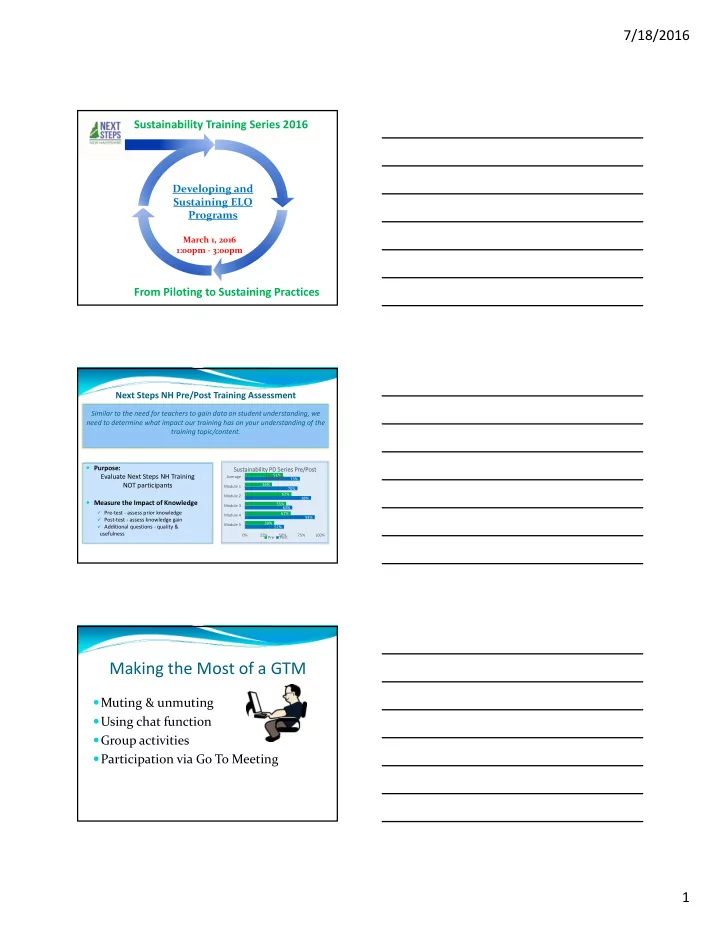
7/18/2016 Sustainability Training Series 2016 Developing and Sustaining ELO Programs March 1, 2016 1:00pm 3:00pm From Piloting to Sustaining Practices Next Steps NH Pre/Post Training Assessment Similar to the need for teachers to gain data on


slide-1
SLIDE 1

7/18/2016 1

Sustainability Training Series 2016 From Piloting to Sustaining Practices

March 1, 2016 1:00pm ‐ 3:00pm

Developing and Sustaining ELO Programs

Next Steps NH Pre/Post Training Assessment

Similar to the need for teachers to gain data on student understanding, we need to determine what impact our training has on your understanding of the training topic/content.

 Purpose: Evaluate Next Steps NH Training NOT participants  Measure the Impact of Knowledge

 Pre‐test ‐ assess prior knowledge  Post‐test ‐ assess knowledge gain  Additional questions ‐ quality &

usefulness

52% 93% 63% 88% 70% 73% 39% 61% 55% 62% 36% 51% 0% 25% 50% 75% 100% Module 5 Module 4 Module 3 Module 2 Module 1 Average

Sust stain ainability ility PD PD Seri Series Pre/P Pre/Pos

  • st

Re Results

Pre Post

Making the Most of a GTM

Muting & unmuting Using chat function Group activities Participation via Go To Meeting

slide-2
SLIDE 2

7/18/2016 2

NSNH Essentials

Next Steps NH offers training and coaching on embedding evidence‐informed transition practices in schools to increase the graduation rate of students with disabilities and students at‐risk of dropping out and prepare them for college, career and adult life.

Training introduces and illustrates the practice. Coaching supports putting the training to use.

NSNH Essentials

Transition practices include:  Enhanced transition planning, activities & opportunities, including RENEW  Best practice Extended Learning Opportunities (ELOs)  High level family‐school engagement Evidence shows that embedding new practices requires multi‐stage implementation.

Family ily En Engagement nt

Two‐way communication Shared decision making Transition‐related training

  • pportunities

Stud tudent De Developm pment

Best Practice ELOs Self‐Determination RENEW

Pr Program St Structur cture

Leadership Teams Ongoing Strategic Planning Policy and Procedure Transition Competencies for Staff Transition Coordinator ELO Board

Stud tudent-Focused Pl Planning ning

Student Led IEPs RENEW Transition Assessment

Inte Interagency y Colla Collaboration

Community Services Colleges/Universities ELO Partners

Transition- Focused Education Framework

Adapted from Taxonomy for Transition Programming, Kohler, P.D. (1996) & NH CoP Template for Secondary Transition & NH Standards for Family /School Partnerships

slide-3
SLIDE 3

7/18/2016 3

NSNH Essentials

Implementing practices with fidelity is a primary

  • focus. The use of planning tools ensures fidelity.

When implemented with fidelity these practices will increase the graduation rates of students with disabilities and students at‐risk of dropping out and prepare them for college, career and adult life.

Not In Place Partially In Place In Place

Critical Component of Practice X 3.1: There is an referral process for ELOs within the school that is easily available and known to students, parents, and all staff

SUSTAINABILITY

Leadership, ELO, RENEW , Family Engagement Teams & Program Structures

Putting the Pieces Together

  • 1. EXPLORATION
  • Develop & Meet w/ Project Teams

(Leadership – ELO – FEG – RENEW)

  • Complete Fidelity tools
  • 3. INITIAL

IMPLEMENTATION

  • Implement action plans
  • Identify & address

challenges

  • Scale up ELOs, RENEW &

Transition Practices

  • Integrate family‐school partnership

strategies

(Based on Dean Fixen et al & SWIFT)

  • 2. INSTALLATION
  • Develop action plans
  • Participate in foundational trainings
  • RENEW student mapping
  • Pilot a high quality ELO, EI

transition practices

  • Offer parent education
  • 4. FULL

IMPLEMENTATION

  • Processes &

procedures in place

  • System recalibrated to

accommodate & support new initiatives

Learning Objectives

Participants will be able to identify:

The essential components of an ELO

and a successful ELO program

Resources to support an ELO

program

Evaluation measurements/strategies

slide-4
SLIDE 4

7/18/2016 4

Agenda

 ELO overview

 Defining ELOs  Reviewing data points  ELO resources

 Sustaining the work

 Review of key support areas and needs

 Program evaluation

 Clarifying objectives  Identifying anticipated outcomes  Creating an action plan

Making the Connection to Students & Transition Planning

 ELOs are a tool for engaging students in their education by creating relevance and tapping into a students passion.  Community connections and concrete, hands‐

  • n learning provide support to reach

measureable post secondary goals.  ELOs are a means of assessment & can be part

  • f the course of study.

Activity 1: Quick Snap Shot

What does your school hope to accomplish by implementing ELOs? How does your school define an ELO? Who oversees them?

slide-5
SLIDE 5

7/18/2016 5

ELOs Can Be:

Individual or group Out of school or connected to a class Large scale or small scale Interdisciplinary or subject specific For any student In any subject

Source: www.beyondclassroom.org

NH DOE Definition of ELO’s

The primary acquisition of knowledge and skills through instruction or study outside of the traditional classroom methodology, including, but not limited, to:

 Apprenticeships  Independent study  Internships  Private instruction  Community service  Online courses  Performing groups

This image was developed by the Q.E.D. Foundation and is licensed under a Creative Commons Attribution‐NonCommercial‐ ShareAlike 4.0 International License. To view a copy of this license, visit http://creativecommons.org/licenses/by‐nc‐sa/4.0/

slide-6
SLIDE 6

7/18/2016 6

Example of a High Quality ELO

 Internship at Elementary School PE class  Supplemented with guidance, coaching and instruction  Based on Common Core English 10 Competencies  Research: Different genres and history of sports  Reflection: Journal  Product: children’s book and sports articles  Presentation: video recorded sports cast

Sports in Literature: 1 English 10 credit

Resources

 Beyond Classroom  Lebanon High School  Pittsfield Middle High School  Next Steps New Hampshire  New Hampshire ELO Network

slide-7
SLIDE 7

7/18/2016 7

Activity 2: Measuring Success

How are you measuring your ELO program’s success? What sources of data are you using? Who is providing/overseeing progress monitoring?

ELO Data Points Data Elements to Consider

In tracking your ELO’s consider the

following data points:

Number of ELO’s‐ yearly or by semester Number of ELO’s for students at risk,

and with IEP’s

slide-8
SLIDE 8

7/18/2016 8

Data Elements to Consider

Subject areas‐ core classes or electives Type of ELO‐ internship, sports team,

community service

Credits awarded Student & Teacher

satisfaction

ELO Fidelity Tool Sustaining the Work

We want it to be like this: Not like this:

slide-9
SLIDE 9

7/18/2016 9

Typical Successful Areas

Written policy Planning team development &

facilitation

Faculty/staff support Assessments Student centered planning

Challenging Areas

ELO plan development and monitoring Referral process Program goals Inclusion of parents/families ELO program quality

Activity 3: Stages of Implementation

 Where are you in the stages of implementation?

slide-10
SLIDE 10

7/18/2016 10

ELO Plan Development and Monitoring

What is your ELO policy?

Areas to consider: # of ELO’s, when they

take place, grading, transportation, expenses Is your policy put into practice?

How do staff learn about it?

ELO Implementation

Within the School

 Staff knowledge of ELO referral and system  ELO documentation (design template, rubrics)

With Students & Families

 How do they know about ELOs?  Program of studies

In the Community

 Business partners

Point Person for ELO’s

 ELO Coordinator? Internship Coordinator?  Work with educators, students, families and community partners to develop credit bearing educational opportunities outside of the traditional classroom setting  Ensure compliance with all federal, state and school rules and regulations  Confirm competencies and programmatic requirements are met

 Source: NH Extended Learning Opportunity Program Design Handbook

slide-11
SLIDE 11

7/18/2016 11

ELO Coordinators

ELO Collaborative Ring Meets monthly to discuss ELO’s, to share best practices, discuss policies and practices. Have developed a handbook that provides guidance and resources for your ELO program

Recruitment & Application

Ability for students, families & staff

to learn about ELO’s

Ease in developing

an ELO

ELO Program Monitoring

Planning Team Development & Facilitation

 Creating a team to support ELO implementation in

the school

Inclusion of Parents and Families

 Inviting family members to support a student’s plan

and ELO

 Tapping into the network of families to support

ELOs in the school and community?

slide-12
SLIDE 12

7/18/2016 12

ELO Program Quality

 What ELO program oversight is currently in

place?

 What is the process for collecting data on the

  • utcomes of the ELOs being implemented?

 Evaluation of the overall success of the ELO

program.

Activity 4: Action Plan

Based on the discussion today…

What action steps are you going to take to support and strengthen your ELO program?

Wrap Up

Thoughts? Questions?  Feedback? Interest in

sharing contact information between schools?