Making Sense of Contemporary Geopolitics: Historical Analogies and - - PowerPoint PPT Presentation

making sense of contemporary geopolitics historical
SMART_READER_LITE
LIVE PREVIEW

Making Sense of Contemporary Geopolitics: Historical Analogies and - - PowerPoint PPT Presentation

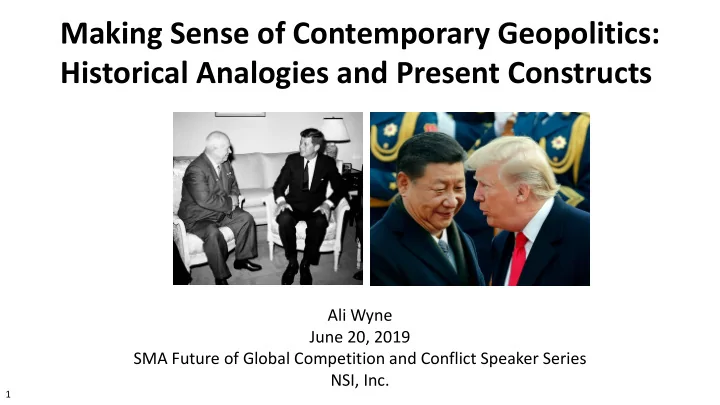
Making Sense of Contemporary Geopolitics: Historical Analogies and Present Constructs Ali Wyne June 20, 2019 SMA Future of Global Competition and Conflict Speaker Series NSI, Inc. 1 1930s R Redux? ( (I) I) 1930s Redux? ( (II)

slide-1
SLIDE 1

Making Sense of Contemporary Geopolitics: Historical Analogies and Present Constructs

Ali Wyne June 20, 2019 SMA Future of Global Competition and Conflict Speaker Series NSI, Inc.

1

slide-2
SLIDE 2

1930s R Redux? ( (I) I)

slide-3
SLIDE 3
  • Observers generally cite three concerns when invoking the 1930s: (1)

democratic stagnation, (2) the prospect of de-globalization, and (3) the return of great-power competition.

  • Both democracy and globalization, though, are far more

entrenched than they were in the 1930s. In addition, while the postwar order is under great duress from within and without, there is at least an order of which to speak.

1930s Redux? ( (II)

slide-4
SLIDE 4

A New C Cold ld W War? ( (I)

slide-5
SLIDE 5
  • The United States faces a skilled opportunist in a revanchist Russia

and a selective revisionist in a resurgent China.

  • It does not, however, confront a rival power with ambitions of

global dominance, pretensions to a universal ideology, and a willingness to employ territorial aggression, proxy warfare, and client states in the service of its strategic objectives.

  • Especially vis-à-vis China, moreover, the Cold War analogy both

exaggerates and understates the challenge to America’s role in the world.

A New C Cold ld W War? ( (II)

slide-6
SLIDE 6

“The central challenge to U.S. prosperity and security is the reemergence of long-term, strategic competition by…revisionist powers.” — Summary of the 2018 National Defense Strategy of the United States of America, p. 2

The N New F Framewor

  • rk
slide-7
SLIDE 7
  • Who is America’s principal competitor?
  • Over what specifically is the United States competing?
  • What is America’s ultimate objective?
  • Remain the world’s preeminent power?
  • Maintain a favorable global balance of power?
  • Uphold the postwar order?

How should observers concretize such abstractions?

  • If the United States is unable to identify a long-term objective and

attendant metrics for gauging its progress towards that end, how will it prepare its economy and its society for infinite competition of an indefinite nature?

Qu Ques esti tions A About Gr t Grea eat-Power C Competition

slide-8
SLIDE 8

“For over 60 years, the attention of our policymakers and public opinion was monopolized by the effort to respond to what appeared to be, and sometimes were, great and

  • verriding dangers—the Nazis, the Japanese militarists,

then Stalin’s Russia. “Our statesmen and our public are unaccustomed to reacting to a world situation that offers no such great and all-absorbing focal points for American policy. And it is not surprising that we should now be hearing demands for some sort of a single grand strategy of foreign policy, to replace our fixation on the Soviet Union, and to serve as a guide for our responses to all those troublesome situations.” — George Kennan, speech at the Council on Foreign Relations (February 15, 1994)

A Warning f from M

  • Mr. X

X

slide-9
SLIDE 9
  • There is great uncertainty over the role of the

United States, which is both a central pillar of today’s order and one of its principal challengers.

  • America’s putative successor has not yet

evinced a desire to displace it as the underwriter of a global order; two countries with conflicting exceptionalisms must achieve a long-term modus vivendi that permits increasing competition while sustaining a baseline of cooperation.

  • The progression of frontier technologies is

challenging democratic and authoritarian regimes alike, raising fundamental questions about sustainable models of political economy.

The S Singularit ity of Contempor

  • rary Ge

Geop

  • pol
  • liti

tics

slide-10
SLIDE 10

The R e Risk of

  • f Str

trategic ic D Disorie ientatio ion

slide-11
SLIDE 11

“If you do not know where you are going, any path will get you there.”

Counsel f l from Y Yogi B i Ber erra

slide-12
SLIDE 12

Ali Wyne Policy Analyst, RAND Corporation awyne@rand.org (540) 907-6150