Making Movies - Time Development Recall the rectangular initial wave - - PowerPoint PPT Presentation

making movies time development
SMART_READER_LITE
LIVE PREVIEW

Making Movies - Time Development Recall the rectangular initial wave - - PowerPoint PPT Presentation

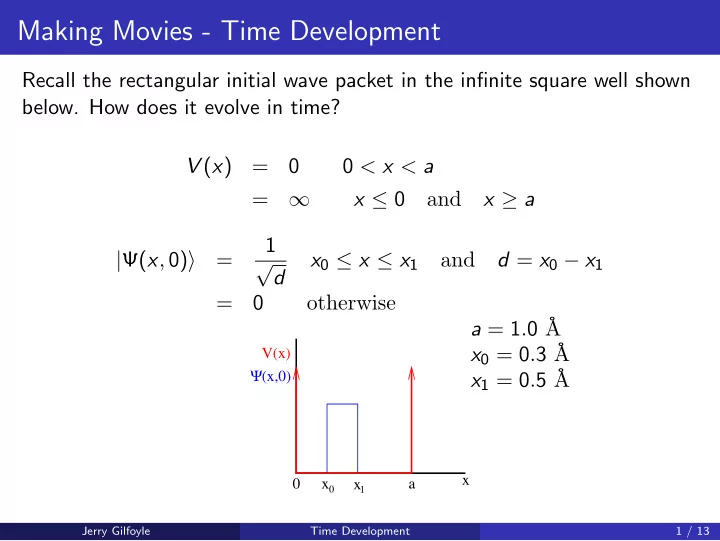
Making Movies - Time Development Recall the rectangular initial wave packet in the infinite square well shown below. How does it evolve in time? V ( x ) = 0 0 < x < a = x 0 and x a 1 | ( x , 0) = x 0 x x


slide-1
SLIDE 1

Making Movies - Time Development

Recall the rectangular initial wave packet in the infinite square well shown

  • below. How does it evolve in time?

V (x) = 0 < x < a = ∞ x ≤ 0 and x ≥ a |Ψ(x, 0) = 1 √ d x0 ≤ x ≤ x1 and d = x0 − x1 =

  • therwise

x0 x1 V(x) Ψ(x,0) a x

a = 1.0 ˚ A x0 = 0.3 ˚ A x1 = 0.5 ˚ A

Jerry Gilfoyle Time Development 1 / 13

slide-2
SLIDE 2

Probabilities of Different States

a = 1.0 Å x0 = 0.3 Å x1 = 0.5 Å 500 1000 1500 2000 2500 3000 0.0 0.1 0.2 0.3 0.4 Energy (eV) Probability Rectangular Wave in a Square Well

Jerry Gilfoyle Time Development 2 / 13

slide-3
SLIDE 3

Time Development of a Square Wave

0.0 0.2 0.4 0.6 0.8 1.0 2 4 6 8 x Probability Density time=0.0000⨯10-16s. 0.0 0.2 0.4 0.6 0.8 1.0 2 4 6 8 x Probability Density time=0.0040⨯10-16s. 0.0 0.2 0.4 0.6 0.8 1.0 2 4 6 8 x Probability Density time=0.0080⨯10-16s. 0.0 0.2 0.4 0.6 0.8 1.0 2 4 6 8 x Probability Density time=0.0120⨯10-16s. Jerry Gilfoyle Time Development 3 / 13

slide-4
SLIDE 4

Comparison of Bound and Free Particles

Particle in a Box The potential V =0 0 < x < a =∞

  • therwise

Eigenfunctions and eigenvalues |φn =

  • 2

a sin nπx a

  • En = n2 2π2

2ma2 Superposition |ψ =

  • n=1

bn|φn φm|φn = δm,n Getting the coefficients bn = φn|ψ Pn = |bn|2 Free Particle The potential V = 0 Eigenfunctions and eigenvalues |φ(k) = 1 √ 2π e±ikx E = 2k2 2m Superposition |ψ = ∞

−∞

b(k)φ(k)dk φ(k′)|φ(k) =δ(k − k′) Getting the coefficients b(k) = φ(k)|ψ Pn = |b(k)|2

Jerry Gilfoyle Time Development 4 / 13

slide-5
SLIDE 5

Time Development of the Initial Gaussian

Recall the Gaussian initial wave packet for the free particle shown below. How does it evolve in time? V (x) = 0 |Ψ(x, 0) = 1 (2πσ2)1/4 e−x2/4σ2

  • 4
  • 2

2 4 0.0 0.1 0.2 0.3 0.4 0.5 x ψ

Jerry Gilfoyle Time Development 5 / 13

slide-6
SLIDE 6

Time Development of the Initial Gaussian

1 2 3 4 5 6 1 2 3 4 5 x |ψ

2

t=0 1 2 3 4 5 6 1 2 3 4 5 x |ψ

2

t=1.5 1 2 3 4 5 6 1 2 3 4 5 x |ψ

2

t=3. 1 2 3 4 5 6 1 2 3 4 5 x |ψ

2

t=4.5 Jerry Gilfoyle Time Development 6 / 13

slide-7
SLIDE 7

Time Development of Nuclear Fusion

Consider a case of one dimensional nuclear ‘fusion’. A neutron is in the potential well of a nucleus that we will approximate with an infinite square well with walls at x = 0 and x = L. The eigenfunctions and eigenvalues are En = n22π2 2ma2 φn =

  • 2

a sin nπx a

  • 0 ≤ x ≤ a

= x < 0 and x > a . The neutron is in the n = 4 state when it fuses with another nucleus that is the same size, instantly putting the neutron in a new infinite square well with walls at x = 0 and x = 2a.

1 What are the new eigenfunctions and eigenvalues of the fused system? 2 How will the initial wave packet evolve in time? Jerry Gilfoyle Time Development 7 / 13

slide-8
SLIDE 8

Time Development of Nuclear Fusion

5 10 15 20 0.00 0.05 0.10 0.15 0.20 x(fm) |ψ

2

t=0×10-21 s 5 10 15 20 0.00 0.05 0.10 0.15 0.20 x(fm) |ψ

2

t=0.3×10⁻²¹ s 5 10 15 20 0.00 0.05 0.10 0.15 0.20 x(fm) |ψ

2

t=0.6×10⁻²¹ s 5 10 15 20 0.00 0.05 0.10 0.15 0.20 x(fm) |ψ

2

t=0.9×10⁻²¹ s

Jerry Gilfoyle Time Development 8 / 13

slide-9
SLIDE 9

Comparison of Bound and Free Particles

Particle in a Box The potential V =0 0 < x < a =∞

  • therwise

Eigenfunctions and eigenvalues |φn =

  • 2

a sin nπx a

  • En = n2 2π2

2ma2 Superposition |ψ =

  • n=1

bn|φn φm|φn = δm,n Getting the coefficients bn = φn|ψ Pn = |bn|2 Time Dependence Ψ(x, t) =

  • n=1

bn|φn(x)e−iωnt Free Particle The potential V = 0 Eigenfunctions and eigenvalues |φ(k) = 1 √ 2π e±ikx E = 2k2 2m Superposition |ψ = ∞

−∞

b(k)φ(k)dk φ(k′)|φ(k) =δ(k − k′) Getting the coefficients b(k) = φ(k)|ψ Pn = |b(k)|2 Time Dependence Ψ(x, t) = ∞

−∞

b(k)φk(x)e−iω(k)tdk

Jerry Gilfoyle Time Development 9 / 13

slide-10
SLIDE 10

Liboff 6.4 - 1

Jerry Gilfoyle Time Development 10 / 13

slide-11
SLIDE 11

Liboff 6.4 - 2

Jerry Gilfoyle Time Development 11 / 13

slide-12
SLIDE 12

Liboff 6.4 - 3

Mathematica result

Jerry Gilfoyle Time Development 12 / 13

slide-13
SLIDE 13

Liboff 6.4 - 4

Mathematica result

Jerry Gilfoyle Time Development 13 / 13

slide-14
SLIDE 14

Liboff 6.4 - 5

Black Curve - Initial Probability Density. Red Curve - Probability Density at t = 10 s. Chance of being in the original box: 0.993 0.00 0.01 0.02 0.03 0.04 0.05 0.06 0.07 2 4 6 8 10 12 x (m) |ψ

2 (m-1)

Square Wave Time Development

Jerry Gilfoyle Time Development 14 / 13