Maintaining or Attacking Confidentiality Navigating Privilege - - PowerPoint PPT Presentation

maintaining or attacking confidentiality
SMART_READER_LITE
LIVE PREVIEW

Maintaining or Attacking Confidentiality Navigating Privilege - - PowerPoint PPT Presentation

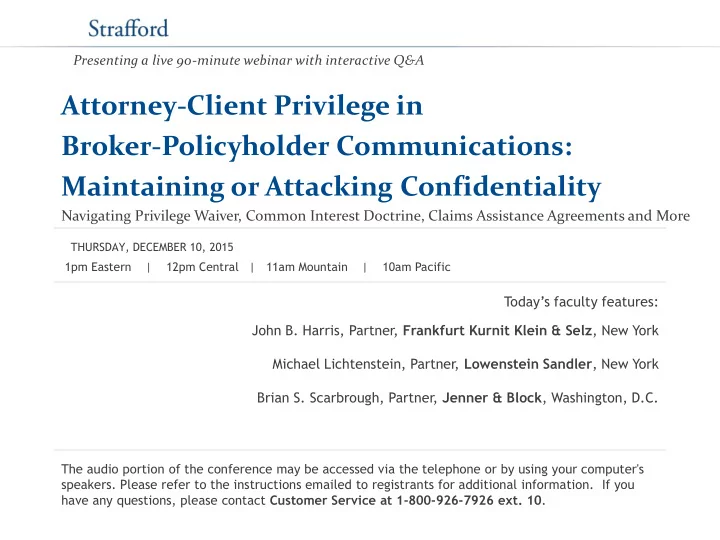
Presenting a live 90-minute webinar with interactive Q&A Attorney-Client Privilege in Broker-Policyholder Communications: Maintaining or Attacking Confidentiality Navigating Privilege Waiver, Common Interest Doctrine, Claims Assistance


slide-1
SLIDE 1

The audio portion of the conference may be accessed via the telephone or by using your computer's

  • speakers. Please refer to the instructions emailed to registrants for additional information. If you

have any questions, please contact Customer Service at 1-800-926-7926 ext. 10.

Presenting a live 90-minute webinar with interactive Q&A

Attorney-Client Privilege in Broker-Policyholder Communications: Maintaining or Attacking Confidentiality

Navigating Privilege Waiver, Common Interest Doctrine, Claims Assistance Agreements and More

Today’s faculty features:

1pm Eastern | 12pm Central | 11am Mountain | 10am Pacific THURSDAY, DECEMBER 10, 2015

John B. Harris, Partner, Frankfurt Kurnit Klein & Selz, New York Michael Lichtenstein, Partner, Lowenstein Sandler, New York Brian S. Scarbrough, Partner, Jenner & Block, Washington, D.C.

slide-2
SLIDE 2

Tips for Optimal Quality

Sound Quality If you are listening via your computer speakers, please note that the quality

  • f your sound will vary depending on the speed and quality of your internet

connection. If the sound quality is not satisfactory, you may listen via the phone: dial 1-866-755-4350 and enter your PIN when prompted. Otherwise, please send us a chat or e-mail sound@straffordpub.com immediately so we can address the problem. If you dialed in and have any difficulties during the call, press *0 for assistance. Viewing Quality To maximize your screen, press the F11 key on your keyboard. To exit full screen, press the F11 key again.

FOR LIVE EVENT ONLY

slide-3
SLIDE 3

Continuing Education Credits

In order for us to process your continuing education credit, you must confirm your participation in this webinar by completing and submitting the Attendance Affirmation/Evaluation after the webinar. A link to the Attendance Affirmation/Evaluation will be in the thank you email that you will receive immediately following the program. For additional information about continuing education, call us at 1-800-926-7926

  • ext. 35.

FOR LIVE EVENT ONLY

slide-4
SLIDE 4

Program Materials

If you have not printed the conference materials for this program, please complete the following steps:

  • Click on the ^ symbol next to “Conference Materials” in the middle of the left-

hand column on your screen.

  • Click on the tab labeled “Handouts” that appears, and there you will see a

PDF of the slides for today's program.

  • Double click on the PDF and a separate page will open.
  • Print the slides by clicking on the printer icon.

FOR LIVE EVENT ONLY

slide-5
SLIDE 5

December 10, 2015

Presented by:

Attorney Client Privilege in Broker-Policyholder Communications: Maintaining or Attacking Confidentiality

John B. Harris Partner Frankfurt Kurnit Klein & Selz PC

Stafford Publications’ Legal Webinar Group

Michael D. Lichtenstein Partner Lowenstein Sandler LLP Brian S. Scarbrough Partner Jenner & Block LLP

slide-6
SLIDE 6

Today’s Presenters

Page 6

Brian S. Scarbrough Partner Jenner & Block LLP John B. Harris

Partner Frankfurt Kurnit Klein & Selz PC

Michael D. Lichtenstein

Partner Lowenstein Sandler LLP

slide-7
SLIDE 7

Policyholder/Broker Relationship and Privilege

Page 7

  • Who is the broker and who do they represent?
  • What is the broker’s function?
  • Privilege/legal issues
  • Courts’ interpretation of privileged relationships
  • Notice and agency issues
  • Claims assistance agreements
  • Best practices
slide-8
SLIDE 8

Policyholder/Broker Relationship and Privilege

Page 8

Who is the broker and who do they represent?

Retail v. Wholesale (Excess/Surplus Lines) Brokers

  • Policyholder is client of retail broker
  • Retail broker is client of wholesale broker
  • Some risks require use of excess/surplus lines broker
  • Depending on which role the broker fulfills, this will impact the duties

and responsibilities of the broker

slide-9
SLIDE 9

Policyholder/Broker Relationship and Privilege

Page 9

  • Retail broker advocates for policyholder, but

are compensated by insurer-paid commissions. Who is the real client?

  • Retail brokers are paid commissions by the

insurers for the coverage they place

  • They also are sometimes paid contingent

commissions – or additional commissions – by insurers based on the volume or profitability of business placed

  • To the extent a broker has a contingent

commission agreement with an insurer, there may be the potential for a broker to be incentivized to act in such a way as to limit loss claims and recoveries

Who is the broker and who do they represent?

slide-10
SLIDE 10

Policyholder/Broker Relationship and Privilege

Page 10

Broker Functions

Term Negotiation

  • Standard
  • Manuscript

Policy Placement

  • Intermediary Role
  • Risk Identification
  • Risk Management

Claims

  • Notice
  • Advocacy
slide-11
SLIDE 11

Policyholder/Broker Relationship and Privilege

Page 11

Attorney-Client Privilege

  • Communications made in confidence between privileged

persons for the purpose of securing or providing legal advice

 Attorney and client in an attorney-client relationship  Legal advice is sought from an attorney in his or her capacity as such  Communications relate to that purpose (primarily/predominately)  Communications are made in confidence

  • While the privilege applies to communications, it does not

apply to facts

  • Privilege extends to agents assisting in the facilitation of the

legal representation

  • May be strictly applied and narrowly confined
slide-12
SLIDE 12

Policyholder/Broker Relationship and Privilege

Page 12

Burden of Proof

  • In most jurisdictions, the burden of proof is on the insured to show

that the communication is privileged

– The significance of this burden is that, if the insured fails to step forward with admissible evidence to support the privilege claim, protection will be denied.

  • Sony Computer Entertainment America v. Great American Ins. Co., et al., 229 F.R.D.

632 (N.D. Cal. 2005)

– This burden also requires the insured to demonstrate that the communications with the insured were principally for the purpose of seeking legal advice rather than business advice

  • Other courts have required that the insured show that the broker

served some specialized purpose in facilitating attorney-client communications and was indispensable in that regard (not merely necessary).

  • Cellco Partnership d/b/a Verizon Wireless v. Certain Underwriters at Lloyd’s, London,

et al., 2006 WL 1320067 (D.N.J. 2006)

slide-13
SLIDE 13

Policyholder/Broker Relationship and Privilege

Page 13

  • Generally no privileged relationship

between policyholder and broker

  • May eventually be adversaries if

coverage is not available

  • Can waive privilege by providing

coverage counsel and/or defense counsel generated documents, communications, mental impressions, settlement documents, etc.

  • Use of broker “claim advocates” (even

attorneys) may not create privileged relationship

Privilege/Legal Issues

slide-14
SLIDE 14

Policyholder/Broker Relationship and Privilege

Page 14

Types of broker-policyholder communications

  • Between broker and policyholder
  • Between broker and policyholder’s counsel
  • Between policyholder and its counsel and forwarded or

copied to broker

  • Between non-attorney employees of broker or policyholder

discussing requests or advice from insured’s counsel

slide-15
SLIDE 15

Policyholder/Broker Relationship and Privilege

Page 15

Is a broker a qualifying agent for privilege purposes?

  • Amtel Corp. v. St. Paul Fire & Marine Ins. Co., 409 F. Supp. 2d

1180 (N.D. Cal. 2005) (broker “necessary agent” of policyholder such that communications were within privilege)

  • In re Tetra Technologies Inc., 2010 WL 1335431 (S.D. Tex. Apr. 5,

2010) (if broker “facilitat[ed] the rendition of professional legal services,” privilege would apply to communications with policyholder even when policyholder was in a dispute with insurer)

  • Sony Computer Ent. America v. Great American Ins. Co., 229

F.R.D. 632 (N.D. Cal. 2005) (no privilege where policyholder provided insufficient evidence that broker was furthering the policyholder’s legal consultations or was necessary to accomplish legal consultations)

slide-16
SLIDE 16

Policyholder/Broker Relationship and Privilege

Page 16

Is the insured in better shape if the broker is also an attorney?

  • Although a broker’s status as a lawyer sounds like it should be

helpful, at least one court has held otherwise.

– Cellco Partnership d/b/a Verizon Wireless v. Certain Underwriters at Lloyd’s, London, et al., 2006 WL 1320067 (D.N.J. 2006)

  • The insured argued that it knew the brokerage employee responsible for

handling the claim submission in a coverage dispute was an attorney and asserted that the employee was concurrently giving legal advice and handling the claim.

  • Rejecting the argument, the court noted:

(a) the absence of a retainer agreement; (b) the absence of evidence that the broker was initially retained other than as an insurance broker; (c) the insured’s failure to show how the broker’s role transformed itself during the course of the matter; and (d) the broker/attorney’s concession that he was not intending to give legal advice.

  • Under these circumstances, neither the insured nor the broker/attorney could

have reasonably believed that a genuine attorney-client relationship existed.

slide-17
SLIDE 17

Policyholder/Broker Relationship and Privilege

Page 17

Generalizations regarding reliance by the insured may not be enough

  • Cardinal Aluminum Co. v. Cont’l Cas. Co., 2015 WL 4483991

(WD Ky. July 22, 2015)

– The insured specifically alleged that it used the broker as its agent to secure coverage, negotiate the policy and that the broker assured it that its legal interests would be protected. The insured also asserted that it relied on the broker to answer coverage and claims questions, advocate the claim and provide advice about potential legal claims. – The Supreme Court of Kentucky rejected the argument, finding that the attorney-client relationship was “uniquely personal” and differed from the broker-insured relationship, which “arises simply from a commercial transaction for the sale of insurance.”

slide-18
SLIDE 18

Policyholder/Broker Relationship and Privilege

Page 18

Work Product Doctrine

  • Documents or tangible things prepared in anticipation of litigation or

trial by or for a party or that party’s representative (need not be created at request of counsel)

  • Fact work product is factual material prepared in anticipation of

litigation or trial (but for test) and requires a showing of substantial need and that a party is unable without undue hardship to obtain the material by other means

  • Opinion work product is theories, mental impressions, tactics, or
  • pinions of a party or that party’s counsel and has nearly absolute

protection

  • Protection generally belongs to the attorney rather than the client
slide-19
SLIDE 19

Policyholder/Broker Relationship and Privilege

Page 19

Work Product Doctrine

  • TC Ravenswood, LLC v. National Union Fire Ins., 2013 WL 3199817

(N.Y. Sup. Ct. N.Y. County Jun. 20, 2013) (protecting privileged work product shared with broker where an expectation of confidentiality existed based on broker’s role as agent)

  • Amtel, 409 F. Supp. 2d at 1182 (work product protection applied between

policyholder and broker)

  • SR Int’l Business Ins. Co. v. World Trade Center Prop. LLC, 2002 WL

1334821 (limiting scope of work product protection for verbal communications involving broker and counsel for policyholder)

  • Where to draw the line in anticipating litigation in insurance disputes?

 Cordell v. Pac. Indem. Co., 2006 WL 3335128 (N.D. Ga. Nov. 13, 2006) (noting that insurance disputes “straddle[] both ends of this definition, because it is the ordinary course of business for an insurance company to investigate a claim with an eye toward litigation.”)

slide-20
SLIDE 20

Facts or earlier communications are not protected

Page 20

Caution about “paying for fact witness testimony”

Create privileged relationship if outside counsel hires broker for litigation assistance Policyholder/Broker Relationship and Privilege

slide-21
SLIDE 21

Policyholder/Broker Relationship and Privilege

Page 21

Common Interest Doctrine

  • Where parties share common legal interests and pursue a

common legal strategy

 How closely must interests and strategy be aligned? Identical legal interests?  Does it extend to pre-litigation collaboration?

  • Does not create privilege—merely permits sharing of already

privileged material without waiver

 SR Int’l, 2002 WL 1334821, at *2-4 (rejecting policyholder’s assertion of common interest with broker and finding joint defense agreement to be evidence that parties understood communications were not privileged)

slide-22
SLIDE 22

Policyholder/Broker Relationship and Privilege

Page 22

Authority to Waive

  • Holder of the privilege
  • Individual or entity acting with authority on behalf of the holder of the

privilege

Subject Matter Waiver

  • Waiver can extend to all privileged communications or documents

concerning the same subject matter

slide-23
SLIDE 23

Policyholder/Broker Relationship and Privilege

Page 23

Waiver in General

  • Disclosure to third-party does not automatically waive attorney-client
  • privilege. Rather, privilege remains intact if disclosure occurs only to

third-parties who are present to further the interest of the client or to whom disclosure is reasonably necessary for the transmission of the

  • information. Amtel, 409 F. Supp. 2d at 1181.
  • Look not to the employment or function of the third-party but rather

whether the client had a reasonable expectation of confidentiality under the circumstances. TC Ravenswood, LLC, 2013 WL 3199817 at *2.

  • Work product protection can be waived “when there is a likelihood

that that the material will be revealed to an adversary, under conditions that are inconsistent with a desire to maintain confidentiality.” Id.

slide-24
SLIDE 24

Policyholder/Broker Relationship and Privilege

Page 24

Express Waiver

  • Attorney-client communications disclosed to third-parties that do not need to

see the information to perform their duties  E.g., “need to know” standard

Implied Waiver

  • Privileged communications or documents that are placed “at issue” in the

litigation  E.g., policyholder asserts reliance on advice of broker as a defense

  • Relevance v. Reliance Standard

Inadvertent Waiver

  • Failure to exercise reasonable steps to prevent disclosure of privileged

communications or documents?  Failure to take reasonable steps to rectify an inadvertent disclosure?

slide-25
SLIDE 25

Policyholder/Broker Relationship and Privilege

Page 25

  • New York: SR Int’l Bus. Ins. Co. v. World Trade Ctr. Props. LLC, SUCV2010-

01252-C, 2002 U.S. Dist. LEXIS 10919 (S.D.N.Y. June 19, 2002) (broker’s conversations with policyholders’ attorneys during coverage litigation not protected because policyholders’ attorneys had no ethical obligation to maintain the confidentiality of the information received from broker and broker’s lawyers)

  • New York: TC Ravenswood LLC v. Nat’l Union Fire Ins., No. 400759/11, 2013

N.Y. Misc. LEXIS 2631 (N.Y. Sup. Ct. N.Y. Cty. June 20, 2013) (broker communications with policyholder and policyholder’s counsel protected because broker was hired by policyholder and its counsel to explain the complex insurance policies at issue in the coverage litigation)

  • New Jersey: Cellco P’ship v. Certain Underwriters at Lloyd’s London, No. 05-

3158, 2006 U.S. Dist. LEXIS 28877 (D.N.J. May 11, 2006) (broker’s communications with policyholder not protected by attorney-client privilege even though employee of the broker was a licensed attorney)

Courts’ interpretation of privileged relationships

slide-26
SLIDE 26

Policyholder/Broker Relationship and Privilege

Page 26

  • California: Atmel Corp. v. St. Paul Fire & Marine Ins. Co., 409

F.Supp.2d 1180 (N.D. Cal. 2005) (policyholder did not waive attorney- client privilege by disclosing documents to broker; common interest doctrine prevents waiver if disclosure occurred to “no third persons

  • ther than those who are present to further the interests of the client in

the consultation or those to whom disclosure is reasonably necessary for the transmission of the information”)

  • California: Sony Comput. Entm’t Am., Inc. v. Great Am. Ins. Co., 229

F.R.D. 632 (N.D. Cal. 2005) (communications between policyholder and its attorney in the presence of broker were not protected absent a showing that broker was present to further policyholder’s interest for which the lawyer was consulted)

Courts’ interpretation of privileged relationships

slide-27
SLIDE 27

Policyholder/Broker Relationship and Privilege

Page 27

  • Kentucky: Cardinal Aluminum Co. v. Cont'l Cas. Co., No. 3:14-CV-857,

2015 U.S. Dist. LEXIS 95361 (W.D. Ky. July 22, 2015) (communications between an insured and its broker were not privileged because the broker's communications related to the negotiation of the policy and not to facilitate professional legal services)

  • Pennsylvania: Miller v. Haulmark Transp. Sys., 104 F.R.D. 442, 445 (E.D.
  • Pa. 1984) (interoffice memorandum prepared by policyholder's attorneys in

the presence of policyholder and broker to prepare defense of lawsuit covered by attorney-client privilege and work product doctrine because broker’s presence was necessary to assist counsel in preparing answer)

  • Massachusetts: Ace Am. Ins. Co. v. Riley Bros., Inc., 30 Mass L. Rptr.

116 (Mass. Supp. 2002) (policyholder waived privilege by sending unsigned, undated memorandum prepared by in-house counsel to broker, because broker was not a necessary recipient of the document in order to facilitate communication with policyholder’s outside counsel, but work product not waived)

Courts’ interpretation of privileged relationships

slide-28
SLIDE 28

Policyholder/Broker Relationship and Privilege

Page 28

  • In response to inconsistency of court rulings,

brokers developed separate claims assistance agreements

  • Such agreements do not guarantee privilege

will be maintained

  • Agreements often benefit broker so

policyholder should make informed decisions

  • Agreements should:
  • State broker is retained by policyholder’s counsel in anticipation of litigation
  • Specify broker will maintain all information and communications in confidence

unless disclosure specifically authorized by policyholder

  • Delineate broker duties in terms of anticipated areas of insurer dispute

Claims Assistance Agreements

slide-29
SLIDE 29

Policyholder/Broker Relationship and Privilege

Page 29

Practical Considerations

  • Identify the broker’s role as agent:

 Participation in, or other contributions to, the communications and documents at issue?

  • Commercial versus legal

 Specialized expertise unique to the claim at issue?

  • ECDC Environmental v. New York General Ins. Co., 1998 WL 614478

(S.D.N.Y. Jun. 4, 1998) (particular consideration given to broker’s retention as policyholder’s agent based on expertise in maritime insurance in finding no waiver of attorney-client privilege)

 Evidence of expectation of confidentiality?  Evidence of a dual agent role (e.g., London Market)?

  • Joint Defense / Claims Assistance Agreements
  • Evidentiary Support

 E.g., affidavits or other declarations, in camera review of communications at issue, etc.

slide-30
SLIDE 30

Policyholder/Broker Relationship and Privilege

Page 30

  • Assume that no privileged relationship exists between policyholder and

broker – even if claims consultant is a lawyer

  • Do not share legal analysis or work product with broker
  • Consider having policyholder’s coverage or defense counsel hire broker

for litigation assistance (still will not protect facts or prior communications with broker)

  • Make sure claims assistance agreement is separate from any other

brokerage agreements and states that policyholder counsel retained broker

Best Practices

slide-31
SLIDE 31

Contact

Page 31

John B. Harris JHarris@fkks.com Frankfurt Kurnit Klein & Selz PC 488 Madison Avenue New York, NY 10022 (212) 705-4823 Michael D. Lichtenstein mlichtenstein@lowenstein.com Lowenstein Sandler LLP 65 Livingston Avenue Roseland, NJ 07068 (973) 597-2500 Brian S. Scarbrough BScarbrough@jenner.com Jenner & Block LLP 1099 New York Avenue, N.W. Suite 900 Washington, DC 20001 (202) 637-6306