Magnetic Behaviour of RM 5 Intermetallic Compounds where R is a Rare- - - PowerPoint PPT Presentation

magnetic behaviour of rm 5 intermetallic compounds where
SMART_READER_LITE
LIVE PREVIEW

Magnetic Behaviour of RM 5 Intermetallic Compounds where R is a Rare- - - PowerPoint PPT Presentation

Magnetic Behaviour of RM 5 Intermetallic Compounds where R is a Rare- Earth and M=Ni or Co E.Burzo Faculty of Physics, Babes-Bolyai University Cluj-Napoca, Romania 1. Technical Applications RNi 5 hydrogen storage RCo 5 permanent magnets


slide-1
SLIDE 1

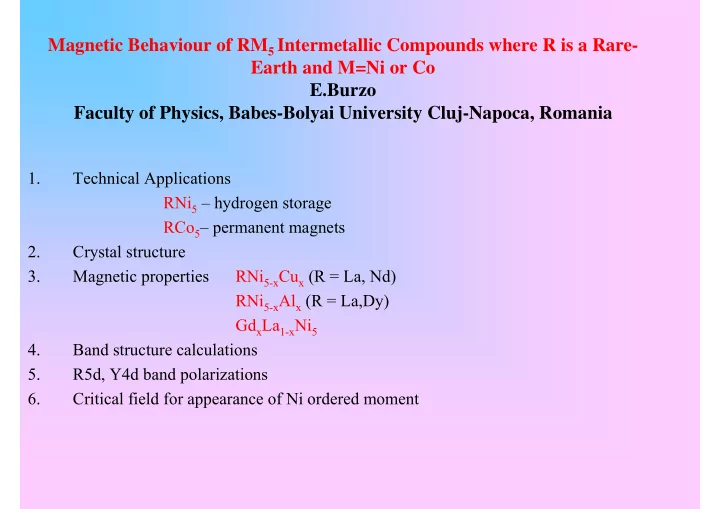
Magnetic Behaviour of RM5 Intermetallic Compounds where R is a Rare- Earth and M=Ni or Co E.Burzo Faculty of Physics, Babes-Bolyai University Cluj-Napoca, Romania

1. Technical Applications RNi5 – hydrogen storage RCo5– permanent magnets 2. Crystal structure 3. Magnetic properties RNi5-xCux (R = La, Nd) RNi5-xAlx (R = La,Dy) GdxLa1-xNi5 4. Band structure calculations 5. R5d, Y4d band polarizations 6. Critical field for appearance of Ni ordered moment

slide-2
SLIDE 2
slide-3
SLIDE 3
slide-4
SLIDE 4
slide-5
SLIDE 5
slide-6
SLIDE 6

Band structures NdNi5 MNi(3g)=0.24 µB, MNi(2c)=0.17 µB Different local environments Ni(2c):6Ni(3g); 3Ni(2c); 3Nd Ni(3g):4Ni(3g); 4Ni(2c); 4Nd Ni moments induced by the presence of Nd Magnetic moments of Nd and Ni parallely oriented MNd MNi NdNi5-xCux x≥1 MNi decrease with Cu content x = 1 MNi(3g)=0.006µB; MNi(2c)=0.06 x = 2 MNi(3g)=0.04µB; MNi(2c)=0.03µB High delocalized Ni states

slide-7
SLIDE 7
slide-8
SLIDE 8
slide-9
SLIDE 9
slide-10
SLIDE 10

Gd3Ni15 Gd2LaNi15 GdLa2Ni15

slide-11
SLIDE 11
slide-12
SLIDE 12

GdxLa1-xNi5

  • Magnetic data

general information on induced moments MNi=0 LaNi5 at 1.7 K GdNi5 at 1.7 K Ms=6.2µB/f.u. MGd=7.0µB; MNi≅0.17µB

  • Band structure calculations
  • gradual shift of Ni(2c), Ni(3g) spin up and down bands

(exchange splitting)

  • induced moments: Gd(5d); La(5d); Ni(2c); Ni(3g)

MNi(3g)>MNi(2c)

  • mean Ni moments depend on Eexch: Eexch,cr≅0.03 eV
  • magnetic moments per formula unit agree with experimental data
slide-13
SLIDE 13
slide-14
SLIDE 14

Brilouin zone for RNi5-structure

slide-15
SLIDE 15

Band structure and bonding LaNi5, GdNi5 Analysis method

  • in terms of projections of the bands onto orthogonal orbitals
  • “fat” band representation: each band is given a width proportional

to the (sum of the) weight(s) of corresponding orthonormal

  • rbital(s)
  • local coordinate system: Ni(2c), Ni(3g), R=La,Gd(1a)

z-axis || c-axis for all sites Ni(2c) x-axis along shortest Ni(2c)-Ni(2c) distance Ni(3g) y-axis || a-axis La site dominant 5d-5d interactions between orbitals with lobs pointed along c →decorated (fat) bands. The bands strongly dispersed in K-Γ, Γ-A directions

1 z 3

2

d

slide-16
SLIDE 16

LaNi5 La

1 z 3

2

d 5

La 5dxy La 5dxz La 5dyz

slide-17
SLIDE 17

Ni2c site LaNi5 dxy orbitals create “fat” bands at -1eV GdNi5 dxy(↓) orbitals create “fat” bands near EF dxy(↑) orbitals create “fat” bands at ≅ 0.4 eV above EF Ni3g site LaNi5 “fat” bands in particular are formed at the Fermi level for

  • rbitals along A-L direction and orbitals along Γ-A direction

GdNi5 “fat” bands are created at the Fermi level for (↓) orbitals along A-L direction and at 0.4 eV above EF for (↑) orbitals along A-L direction. For (↓) orbitals “fat” bands are formed at EF along Γ-A direction and at 0.4 eV above EF for (↑) orbitals along Γ-A direction Important interactions are between almost all projected orbitals of nickel

1 z 3

2

d

2 2

y x

d

2 2

y x

d

− 1 z 3

2

d

− 1 z 3

2

d

2 2

y x

d

slide-18
SLIDE 18

Ni(2c) 3dxy Ni(3g) 3dyz Ni(2c) 3dxz Ni(2c)

2 2

y x

d 3

LaNi5

slide-19
SLIDE 19

GdNi5 Ni(2c) (↓)

1 z 3

2

d 3

Ni(2c) 3dxz(↓) Ni(2c) (↑)

1 z 3

2

d 3

Ni(2c) 3dxz(↑)

slide-20
SLIDE 20

Ni(3g)

2 2

y x

d 3

Ni(3g) Ni(3g) 3dxz LaNi5

1 z 3

2

d 3

slide-21
SLIDE 21

GdNi5 Ni(3g) (↓) Ni(3g) (↑) Ni(3g) 3dxz(↓) Ni(3g) 3dxz(↑)

1 z 3

2

d 3

− 1 z 3

2

d 3

slide-22
SLIDE 22

GdNi5 Ni(2c) (↓) Ni(3g) (↑)

2 2

y x

d 3

2 2

y x

d 3

slide-23
SLIDE 23

The exchange interactions between nickel atoms were also computed by using the LDA+U approach. Using the Green function method to calculate the effective exchange interaction parameter, Jij, as second derivative of the ground state energy with respect to the magnetic rotation angle, was shown that the exchange interactions between i and j atoms may be described by: (2) where the spin dependent potentials, Ii, are expressed in terms of the single particle potential , while the effective inter-sublattice susceptibilities, χij, where defined in terms of the LDA+U eigen functions Ψ as: (3) We denoted by ni the orbital occupancy of d electrons, l the orbital quantum number and m the magnetic quantum number.

jlm"'* nk ilm' k n' ilm" nk * ilm nk knn' k n' nk k n' nk ij m"' m" mm'

ψ ψ ψ ψ ε ε n n χ

↓ ↓ ↑ ↑ ↓ ↑ ↓ ↑

− − =

=

{m} j ' m" m" ij ' m" m" mm' i mm' ij

I χ I J

↓ ↑ −

=

i mm' i mm' i mm' mm'

V V I : V

slide-24
SLIDE 24

GdLa2Ni15 GdNi5

slide-25
SLIDE 25

YCo4-xNixB

slide-26
SLIDE 26
slide-27
SLIDE 27

RA5 A=Co, Ni M5d=M5d(0)+α’G α’=1.4·10-2µB M5d(0) =0.32 Co =0.08 Ni M3d=M3d(0)+β’G β’=1·10-2 µB Co =1.6·10-2µB Ni M5d(0)/M3d(0)=0.045 RCo4B, RA5

∑ ∑ ∑ ∑

∝ ∝ ∆ ⇓ + =

= − = − i i i exch d 5 2 1 i d 5 d 5 d 5 d 5 n , d 3 n 2 1 i d 5 d 5 d 3

c i i i

M n H ) ( M S S J S ) ( S J H

slide-28
SLIDE 28

Critical field for appearance an ordered Ni moment:

  • magnetic measurements Hc=35 T
  • band structures Hc=48 T
slide-29
SLIDE 29

Thank you very much for your attentions.