Machine Reading todo From Wikipedia to the Web More on - - PDF document

machine reading
SMART_READER_LITE
LIVE PREVIEW

Machine Reading todo From Wikipedia to the Web More on - - PDF document

Machine Reading todo From Wikipedia to the Web More on bootstrapping to the web Retrain too brief Daniel S. Weld Results for shrinkage independent of Department of Computer Science & Engineering retraining University of


slide-1
SLIDE 1

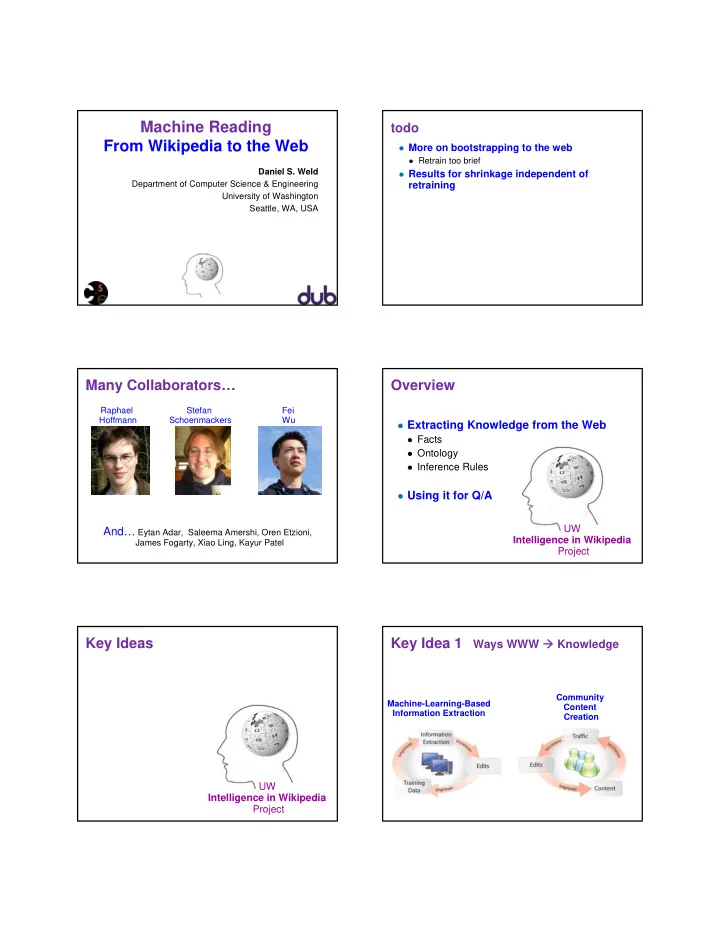
Machine Reading From Wikipedia to the Web

Daniel S. Weld Department of Computer Science & Engineering University of Washington Seattle, WA, USA

todo

More on bootstrapping to the web

Retrain too brief

Results for shrinkage independent of

retraining

Stefan Schoenmackers Fei Wu Raphael Hoffmann

Many Collaborators…

And… Eytan Adar, Saleema Amershi, Oren Etzioni,

James Fogarty, Xiao Ling, Kayur Patel

Overview

Extracting Knowledge from the Web

Facts Ontology Inference Rules

Using it for Q/A

UW Intelligence in Wikipedia Project

Key Ideas

UW Intelligence in Wikipedia Project

Key Idea 1 Ways WWW Knowledge

Community Content Creation Machine-Learning-Based Information Extraction

slide-2
SLIDE 2

Key Idea 1

Synergy (Positive Feedback)

Between ML Extraction & Community Content Creation

Key Idea 2

Synergy (Positive Feedback)

Between ML Extraction & Community Content Creation

Self Supervised Learning

Heuristics for Generating (Noisy) Training Data

Match

Key Idea 3

Synergy (Positive Feedback)

Between ML Extraction & Community Content Creation

Self Supervised Learning

Heuristics for Generating (Noisy) Training Data

Shrinkage (Ontological Smoothing) & Retraining

For Improving Extraction in Sparse Domains

performer actor comedian person

Key Idea 4

Synergy (Positive Feedback)

Between ML Extraction & Community Content Creation

Self Supervised Learning

Heuristics for Generating (Noisy) Training Data

Shrinkage (Ontological Smoothing) & Retraining

For Improving Extraction in Sparse Domains

Approximately Pseudo-Functional (APF) Relations

Efficient Inference Using Learned Rules

Motivating Vision

Next-Generation Search = Information Extraction + Ontology + Inference

Which German Scientists Taught at US Universities?

… Einstein was a guest lecturer at the Institute for Advanced Study in New Jersey …

Next-Generation Search

Information Extraction

<Einstein, Born-In, Germany> <Einstein, ISA, Physicist> <Einstein, Lectured-At, IAS> <IAS, In, New-Jersey> <New-Jersey, In, United-States>

Ontology

Physicist (x) Scientist(x)

Inference

Lectured-At(x, y) ∧ University(y) Taught-At(x, y) Einstein = Einstein

Scalable

Means

Self-Supervised

slide-3
SLIDE 3

Open Information Extraction TextRunner

For each sentence Apply POS Tagger For each pairs of noun phrases, NP1, NP2 If classifier confirms they are “Related?” Use CRF to extract relation from intervening text Return relation(NP1, , NP2) Train classifier & extractor on Penn Treebank data Mark Emmert was born in Fife and graduated from UW in 1975

} }

?

was-born-in Mark Emmert Fife ( , )

Why Wikipedia?

Pros

Comprehensive High Quality

[Giles Nature 05]

Useful Structure

Cons

Natural-Language Missing Data Inconsistent Low Redundancy

Comscore MediaMetrix – August 2007

Wikipedia Structure

Unique IDs & Links Infoboxes Categories & Lists First Sentence Redirection pages Disambiguation pages Revision History Multilingual

slide-4
SLIDE 4

Status Update

Outline

Motivation Extracting Facts from Wikipedia Ontology Generation Improving Fact Extraction Bootstrapping to the Web Validating Extractions Improving Recall with Inference Conclusions

Key Ideas

Synergy Self-Supervised Learning Shrinkage & Retraining APF Relations

Traditional, Supervised I.E.

Raw Data Labeled Training Data Learning Algorithm Extractor

Kirkland-based Microsoft is the largest software company. Boeing moved it’s headquarters to Chicago in 2003. Hank Levy was named chair of Computer Science & Engr.

… HeadquarterOf(<company>,<city>)

Kylin: Self-Supervised Information Extraction from Wikipedia

[Wu & Weld CIKM 2007] Its county seat is Clearfield. As of 2005, the population density was 28.2/km². Clearfield County was created in 1804 from parts

  • f Huntingdon and Lycoming Counties but was

administered as part of Centre County until 1812. 2,972 km² (1,147 mi²) of it is land and 17 km² (7 mi²) of it (0.56%) is water.

From infoboxes to a training set

Kylin Architecture The Precision / Recall Tradeoff

Precision Proportion of selected

items that are correct

Recall Proportion of target

items that were selected

Precision-Recall curve Shows tradeoff

tn fp tp fn Tuples returned by System Correct Tuples fp tp tp + fn tp tp + Recall Precision AuC

Preliminary Evaluation

Kylin Performed Well on Popular Classes:

Precision: mid 70% ~ high 90% Recall: low 50% ~ mid 90%

... But Floundered on Sparse Classes

(Too Little Training Data) Is this a Big Problem?

slide-5
SLIDE 5

Long Tail: Sparse Classes

Too Little Training Data 82% < 100 instances; 40% <10 instances

Long-Tail 2: Incomplete Articles

Desired Information Missing from Wikipedia

800,000/1,800,000 (44.2%) stub pages [Wikipedia July 2007]

Length ID

Shrinkage?

performer (44) .location actor (8738) comedian (106) .birthplace .birth_place .cityofbirth .origin person (1201) .birth_place

Status Update

Outline

Motivation Extracting Facts from Wikipedia Ontology Generation Improving Fact Extraction Bootstrapping to the Web Validating Extractions Improving Recall with Inference Conclusions

Key Ideas

Synergy Self-Supervised Learning Shrinkage & Retraining APF Relations

How Can We Get a Taxonomy for Wikipedia?

Do We Need to? What about Category Tags? Conjunctions Schema Mapping

Person Performer

birth_date birth_place name

  • ther_names

… birthdate location name

  • thername

KOG: Kylin Ontology Generator

[Wu & Weld, WWW08]

slide-6
SLIDE 6

Subsumption Detection

Person Scientist Physicist

6 / 7 : E i n s t e i n

Binary Classification Problem Nine Complex Features

E.g., String Features … IR Measures … Mapping to Wordnet … Hearst Pattern Matches … Class Transitions in Revision History

Learning Algorithm

SVM & MLN Joint Inference

KOG Architecture Schema Mapping

Heuristics

Edit History String Similarity

  • Experiments
  • Precision: 94% Recall: 87%
  • Future
  • Integrated Joint Inference

Person Performer

birth_date birth_place name

  • ther_names

… birthdate location name

  • thername

KOG: Kylin Ontology Generator

[Wu & Weld, WWW08] performer (44) .location actor (8738) comedian (106) .birthplace .birth_place .cityofbirth .origin person (1201) .birth_place

Status Update

Outline

Motivation Extracting Facts from Wikipedia Ontology Generation Improving Fact Extraction Bootstrapping to the Web Validating Extractions Improving Recall with Inference Conclusions

Key Ideas

Synergy Self-Supervised Learning Shrinkage & Retraining APF Relations

Improving Recall on Sparse Classes

[Wu et al. KDD-08]

Shrinkage

Extra Training Examples

from Related Classes

How Weight New Examples?

performer (44) actor (8738) comedian (106) person (1201)

slide-7
SLIDE 7

Improving Recall on Sparse Classes

[Wu et al. KDD-08]

Retraining

Compare Kylin Extractions with Tuples from Textrunner Additional Positive Examples Eliminate False Negatives

TextRunner [Banko et al. IJCAI-07, ACL-08]

Relation-Independent Extraction Exploits Grammatical Structure CRF Extractor with POS Tag Features

Recall after Shrinkage / Retraining…

Status Update

Outline

Motivation Extracting Facts from Wikipedia Ontology Generation Improving Fact Extraction Bootstrapping to the Web Validating Extractions Improving Recall with Inference Conclusions

Key Ideas

Synergy Self-Supervised Learning Shrinkage & Retraining APF Relations

Long-Tail 2: Incomplete Articles

Desired Information Missing from Wikipedia

800,000/1,800,000(44.2%) stub pages [July 2007 of Wikipedia ]

Length ID

Bootstrapping to the Web

[Wu et al. KDD-08]

Extractor Quality Irrelevant

If no information to extract… 44% of Wikipedia Pages = “stub”

Instead, … Extract from Broader Web Challenges

How maintain high precision?

Many Web pages noisy, Describe multiple objects

Extracting from the Broader Web

1) Send Query to Google

Object Name + Attribute Synonym

2) Find Best Region on the Page

Heuristics > Dependency Parse

3) Apply Extractor 4) Vote if Multiple Extractions

slide-8
SLIDE 8

Bootstrapping to the Web Problem

Information Extraction is Still Imprecise

Do Wikipedians Want 90% Precision?

How Improve Precision?

People!

Status Update

Outline

Motivation Extracting Facts from Wikipedia Ontology Generation Improving Fact Extraction Bootstrapping to the Web Validating Extractions Improving Recall with Inference Conclusions

Key Ideas

Synergy Self-Supervised Learning Shrinkage & Retraining APF Relations

Accelerate

Contributing as a Non-Primary Task

[Hoffman CHI-09]

Encourage contributions Without annoying or abusing readers

Designed Three Interfaces

Popup

(immediate interruption strategy)

Highlight

(negotiated interruption strategy)

Icon

(negotiated interruption strategy)

Popup Interface

slide-9
SLIDE 9

Highlight Interface h

  • v

e r Highlight Interface Highlight Interface h

  • v

e r Highlight Interface Icon Interface h

  • v

e r Icon Interface

slide-10
SLIDE 10

Icon Interface h

  • v

e r Icon Interface

How do you evaluate these UIs?

Contribution as a non‐primary task Can lab study show if interfaces increase spontaneous contributions?

Search Advertising Study

Deployed interfaces on Wikipedia proxy 2000 articles One ad per article

“ray bradbury”

Search Advertising Study

Select interface round‐robin Track session ID, time, all interactions Questionnaire pops up 60 sec after page

loads

logs

baseline popup highlight icon

proxy

Search Advertising Study

Used Yahoo and Google Deployment for ~ 7 days

~ 1M impressions 2473 visitors

slide-11
SLIDE 11

Contribution Rate > 8x Area under Precision/Recall curve with only existing infoboxes

Area under P/R curve birth_date birth_place death_date nationality

  • ccupation

Using 5 existing infoboxes per attribute

.12

Area under Precision/Recall curve after adding user contributions

.12

Area under P/R curve birth_date birth_place death_date nationality

  • ccupation

Using 5 existing infoboxes per attribute

Search Advertising Study

Used Yahoo and Google 2473 visitors Estimated cost: $1500

Hence ~$10 / contribution !!

Status Update

Outline

Motivation Extracting Facts from Wikipedia Ontology Generation Improving Fact Extraction Bootstrapping to the Web Validating Extractions Improving Recall with Inference Conclusions

Key Ideas

Synergy Self-Supervised Learning Shrinkage & Retraining APF Relations

Why Need Inference?

What Vegetables Prevent Osteoporosis? No Web Page Explicitly Says:

“Kale is a vegetable which prevents Osteoporosis” But some say

“Kale is a vegetable” … “Kale contains calcium” … “Calcium prevents osteoporosis”

slide-12
SLIDE 12

Three Part Program

1) Scalable Inference with Hand Rules

In small domains (5-10 entity classes)

2) Learning Rules for Small Domains 3) Scaling Learning to Larger Domains

E.g., 200 entity classes

Scalable Probabilistic Inference

Eight MLN Inference Rules

Transitivity of predicates, etc.

Knowledge-Based Model Construction Tested on 100 Million Tuples

Extracted by Textrunner from Web [Schoenmacker et al. 2008]

Effect of Limited Inference

Inference Appears Linear in |Corpus|

71

How Can This Be True?

Q(X,Y,Z) <= Married(X,Y) ∧ LivedIn(Y,Z) Worst Case: Some person y’ married

everyone, and lived in every place: |Q(X,y’,Z)| = |Married|*|LivedIn| = O(n2)

72

Q(X,Y,Z) <= Married(X,Y) ∧ LivedIn(Y,Z) Worst Case: Some person y’ married

everyone, and lived in every place:

|Q(X,y’,Z)| = |Married|*|LivedIn| = O(n2)

What makes inference expensive?

Person Num ber of Spouses

Common Case: Essentially functional A few spouses and a few locations. Ramesses II (100+). Elizabeth Taylor (7).

slide-13
SLIDE 13

73

Approximately Functional Relations

E.g. Married(X,Y) Most Y have only 1 spouse mentioned People in YG have at most a constant kM spouses each People in YB have at most kM*log |YG| spouses in total

Person Number of Spouses Function of y < kM (PF degree)

Pseudo- Theorem

74

Prevalence of APF relations

APF degrees of 500 random relations extracted from text

0% 20% 40% 60% 80% 100% 2000 4000 6000 Degree of Approximate Pseudo- Functionality Work in Progress

Tight Bias on Rule Templates Type Constraints on Shared Variables Mechanical Turk Validation

20% 90+% precision Learned Rules Beat Hand-Coded

On small domains

Now Scaling to 200 Entity Classes

Learning Rules Status Update

Outline

Motivation Extracting Facts from Wikipedia Ontology Generation Improving Fact Extraction Bootstrapping to the Web Validating Extractions Improving Recall with Inference Conclusions

Key Ideas

Synergy Self-Supervised Learning Shrinkage & Retraining APF Relations

Motivating Vision

Next-Generation Search = Information Extraction + Ontology + Inference

Which German Scientists Taught at US Universities?

… Einstein was a guest lecturer at the Institute for Advanced Study in New Jersey …

Conclusion

  • Self-Supervised Extraction from Wikipedia

Training on Infoboxes

Works well on popular classes

Improving Recall – Shrinkage, Retraining, Web Extraction

High precision & recall - even on sparse classes, stub articles

Community Content Creation

  • Automatic Ontology Generation

Probabilistic Joint Inference

  • Scalable Probabilistic Inference for Q/A

Simple Inference - Scales to Large Corpora Tested on 100 M Tuples

slide-14
SLIDE 14

Conclusion

Extraction of Facts from Wikipedia & Web

Self-Supervised Training on Infoboxes Improving Recall – Shrinkage, Retraining, Need for Humans to Validate

  • Automatic Ontology Generation

Probabilistic Joint Inference

Scalable Probabilistic Inference for Q/A

Simple Inference - Scales to Large Corpora Tested on 100 M Tuples

Key Ideas

Synergy (Positive Feedback)

Between ML Extraction & Community Content Creation

Self Supervised Learning

Heuristics for Generating (Noisy) Training Data

Shrinkage & Retraining

For Improving Extraction in Sparse Domains

Aproximately Pseudo-Functional Relations

Efficient Inference Using Learned Rules

Unsupervised Information Extraction

SNOWBALL [Agichtein & Gravano ICDL00] MULDER [Kwok et al. TOIS01] AskMSR [Brill et al. EMNLP02] KnowItAll [Etzioni et al. WWW04, ...] TextRunner [Banko et al. IJCAI07, ACL-08] KNEXT [VanDurme et al. COLING-08] WebTables [Cafarella et al. VLDB-08]

Ontology Driven Information Extraction

SemTag and Seeker [Dill WWW03] PANKOW [Cimiano WWW05] OntoSyphon [McDowell & Cafarella ISWC06]

Related Work Related Work II

Other Uses of Wikipedia

Semantic Distance Measure [Ponzetto&Strube07] Word-Sense Disambiguation [Bunescu&Pasca06,

Mihalcea07]

Coreference Resolution [Ponzetto&Strube06,

Yang&Su07]

Ontology / Taxonomy [Suchanek07, Muchnik07] Multi-Lingual Alignment [Adafre&Rijke06] Question Answering [Ahn et al.05, Kaisser08] Basis of Huge KB [Auer et al.07]

Thanks!

In Collaboration with

Eytan Adar Saleema Amershi Oren Etzioni James Fogarty Raphael Hoffmann Shawn Ling Kayur Patel Stef Schoenmackers Fei Wu

Funding Support

NSF, ONR, DARPA, WRF TJ Cable Professorship, Google, Yahoo