SLIDE 1
MA111: Contemporary mathematics
Entrance Slip (due 5 min past the hour):
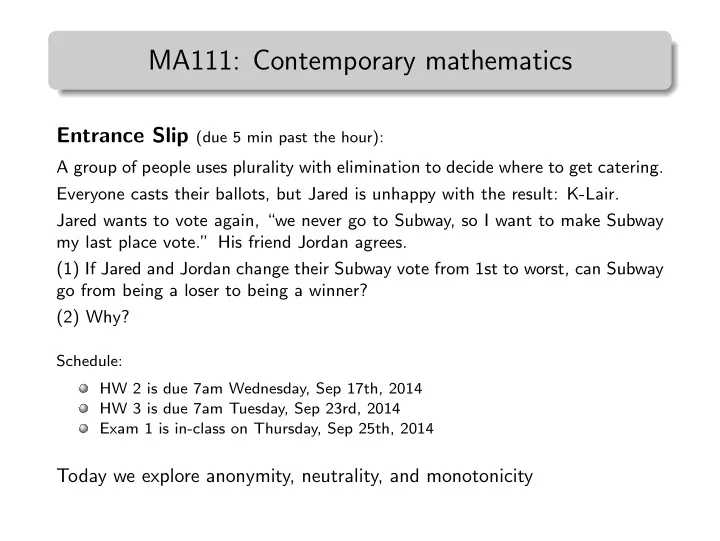
A group of people uses plurality with elimination to decide where to get catering. Everyone casts their ballots, but Jared is unhappy with the result: K-Lair. Jared wants to vote again, “we never go to Subway, so I want to make Subway my last place vote.” His friend Jordan agrees. (1) If Jared and Jordan change their Subway vote from 1st to worst, can Subway go from being a loser to being a winner? (2) Why?
Schedule: HW 2 is due 7am Wednesday, Sep 17th, 2014 HW 3 is due 7am Tuesday, Sep 23rd, 2014 Exam 1 is in-class on Thursday, Sep 25th, 2014
Today we explore anonymity, neutrality, and monotonicity
SLIDE 2
While we are passing out the worksheet...
Please turn in your entrance slips. We will do this every non-exam day.
Please bring your own 3x5 index cards.
To be fair: votes should count. Everyone’s votes should count Everyone’s votes should count equally [ Anonymity ] Monotonicity is the idea that votes should count the right direction If people hate on Subway and Subway already lost, then why should Subway win?
SLIDE 3
Old words
ballot, preference schedule, voting method, majority winner, plurality method, soccer rule, Borda count = Thomas’s rule, Daisia’s rule standard elimination (plurality with elimination) pairwise comparison, Condorcet candidate, bracket method, agenda/seed, shape Anonymous, Neutral
SLIDE 4 New words: Neutral
Jared proposes the rule: Subway gets two points for every first place vote, K-Lair and Ovid’s get one point for every first place
This is not neutral since one restaurant is treated differently, but it is anonymous and monotone A rule that is not neutral is pretty obviously unfair. The most unfair version is “imposed rule” – “Subway always wins, no matter how anyone votes” This is anonymous (everyone’s votes count equally, that is, not at all) This is monotone (changing your vote cannot change the outcome the wrong way, because it doesn’t change the outcome at all) But this is not neutral
SLIDE 5 New words: Monotone
Jared proposes the rule: A restaurant gets one point per last place
This is anonymous – everyone’s vote counts equally This is neutral – each restaurant is treated equally This is silly – if people vote how they feel, then they will always be unhappy Monotone says that changing your vote from a loser to a winner should not have any effect (winner should still win) Another version is “changing your ranking of Subway from first to last shouldn’t make Subway win”
SLIDE 6
May’s theorem
Kenneth May, 1952: The only anonymous, neutral, monotone voting method on two restaurants is plurality = majority rule Anonymous, so we don’t need ballots, just a preference schedule Only two restaurants (say Ovid’s and K-Lair), so only need to know how many total voters (say 5) and how many vote for Ovid’s Neutral, so there must be a number where Ovid’s wins and where K-Lair wins Monotone, so higher numbers should be better for Ovid’s So 5 = Ovid’s wins, and 0 = K-Lair wins Neutral, so switching 4 and 1 (or 3 and 2) should switch who wins So 5,4,3 are Ovid’s wins, and 2,1,0 are K-Lair wins Majority rule
SLIDE 7
Monotone for more candidates
Monotone means “if K-Lair wins with one set of Ballots, then K-Lair should still win, even if one ballot is changed so that K-Lair ranks higher” (And the same thing for any restaurant) Simple version “votes are good” Point systems (plurality, Borda count, Soccer, Daisia’s rule) are monotone (assuming the points go the right way; “most last place” is not monotone) Head-to-head systems (pairwise comparison, bracket, Smith, Beahtpath) are monotone Elimination systems (plurality with elimination, survivor) are NOT monotone
SLIDE 8
Exit quiz
A group wants to decide between four restaurants Jordan’s method is to count only second and third place votes; 1 point for each 2nd or 3rd place vote; most points wins Is Jordan’s method anonymous? Neutral? Monotone? Give an example group of people (by Ballots) where Jordan’s method doesn’t work well; explain why its answer is wrong