MA111: Contemporary mathematics Jack Schmidt 40% 60% Candidate C - - PowerPoint PPT Presentation

ma111 contemporary mathematics
SMART_READER_LITE
LIVE PREVIEW

MA111: Contemporary mathematics Jack Schmidt 40% 60% Candidate C - - PowerPoint PPT Presentation

MA111: Contemporary mathematics Jack Schmidt 40% 60% Candidate C enters the election late. A B 1st (1) Which candidate does the plurality voting B A 2nd method choose as the winner in each election? (2) Why are the 60% = 35%+25%


slide-1
SLIDE 1

MA111: Contemporary mathematics

Jack Schmidt 40% 60%

1st

A B

2nd

B A ↓ 40% 35% 25%

1st

A B C

2nd

B C B

3rd
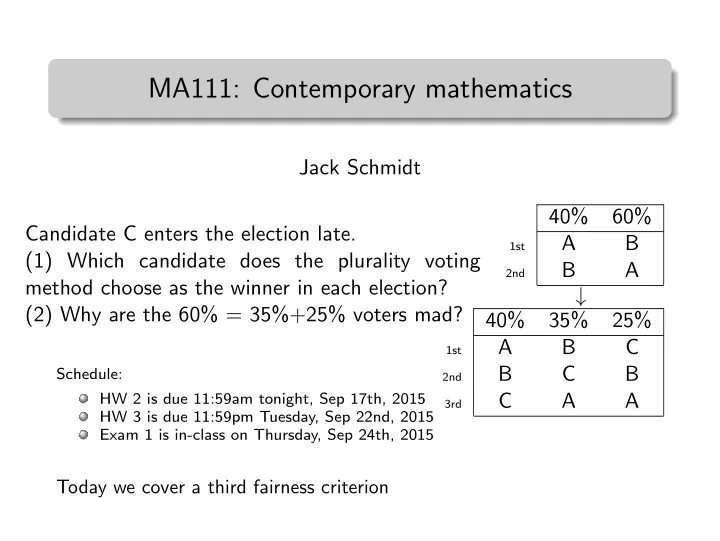
C A A Candidate C enters the election late. (1) Which candidate does the plurality voting method choose as the winner in each election? (2) Why are the 60% = 35%+25% voters mad?

Schedule: HW 2 is due 11:59am tonight, Sep 17th, 2015 HW 3 is due 11:59pm Tuesday, Sep 22nd, 2015 Exam 1 is in-class on Thursday, Sep 24th, 2015

Today we cover a third fairness criterion

slide-2
SLIDE 2

Spoilers

40% 60%

1st

A B

2nd

B A ↓ 40% 35% 25%

1st

A B C

2nd

B C B

3rd

C A A Before C: B wins 60% to 40% After C: A wins 40% to 35% to 25% If the 60% had agreed on B, then B would have won Even the 25% would be happier C didn’t win, but by entering they changed the winner C is called a spoiler

slide-3
SLIDE 3

Plurality with elimination

PwE is also called “single transferrable vote” (you get one vote, but you can change it if your candidate loses) That way if there is a spoiler (that loses) you can change your vote to your next most favorite 40% 60%

1st

A B

2nd

B A ↓ 40% 35% 25%

1st

A C B

2nd

B B A

3rd

C A C Who wins with PwE in this election? Who had the majority of last place votes? Who would win if we eliminated them instead?

slide-4
SLIDE 4

IIA fairness criterion

the IIA fairness criterion requires that a voting method never have spoilers Jack thinks that is a bit much to ask, but at least asks that a majority loser cannot be a spoiler. The JJA. Plurality can have spoilers, so it violates the IIA (and JJA) Plurality with elimination can have spoilers, so it violates IIA (and JJA) 60%

1st

A B C

2nd

B C B

3rd

C A A What about Borda count?

slide-5
SLIDE 5

Changing voters

35% 33% 32%

1st

A B C

2nd

B C A

3rd

C A B → 37% 31% 32%

1st

A B C

2nd

B C A

3rd

C A B Who does plurality with elimination say wins the left election? The 33% is pissed and asks for a recount. 2% decide to vote for the winner. Who does plurality with elimination say wins the right election? Did the 2% who lied improve things for the 33%? What is the name of this strategy?

slide-6
SLIDE 6

Monotonicity

In the previous election, 2% of the voters changed their vote to the

  • ld winner (leaving the other candidates in the same order)

This made the winner lose (and their second favorite win) At the beginning of the chapter we called 1st place votes “good” and last place votes bad But in plurality with elimination, first place votes can be bad! Monotonicity is the fairness criterion that says that is an awful way to decide an election. If some voters leave their ranking the same except for moving the winner up to the top, then the voting method should not change the winner