
SLIDE 1
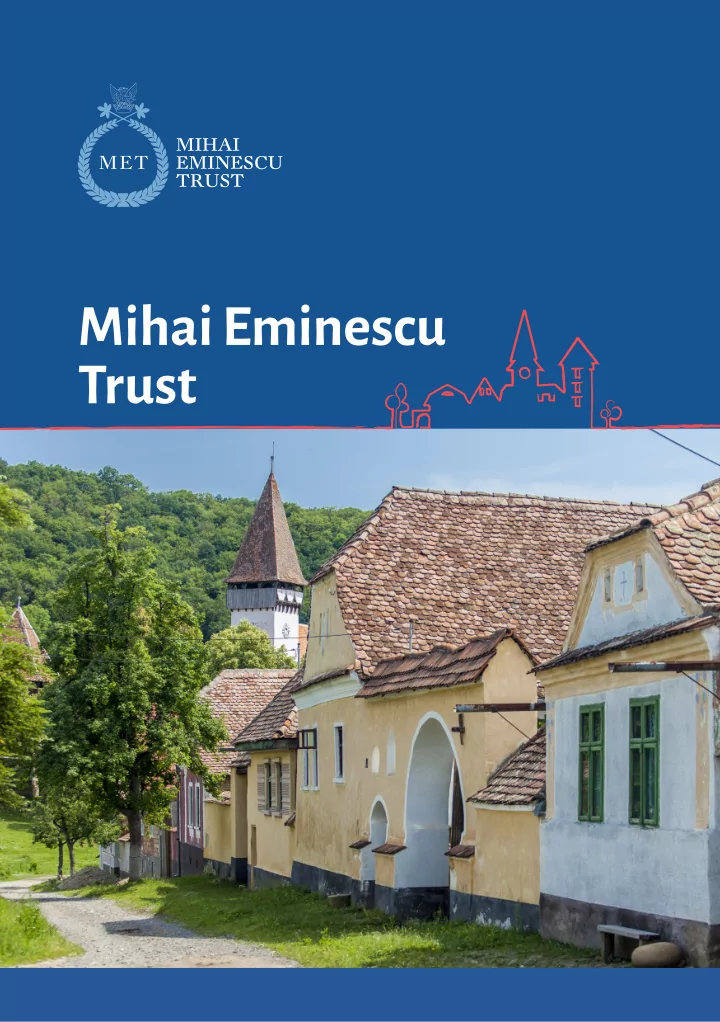
M ihai Eminescu Trust (MET) was established in 1987 in London. At - - PDF document
Evolution M ihai Eminescu Trust (MET) was established in 1987 in London. At that time MET helped Romanian intellectuals who were oppressed by the communist regime stay in touch with their peers in Wes- tern Europe, especially in Oxford and
ihai Eminescu Trust (MET) was established in 1987 in
Romanian intellectuals who were
stay in touch with their peers in Wes- tern Europe, especially in Oxford and Cambridge. In 1989, when Nicolae Ceauşescu planned to demo- lish thousands of historical villages, the Foundation stepped in and took action for the first time asking for the support of His Royal Highness the Prince of Wales.
The support was granted and
after several visits to Romania, Mihai Eminescu Trust London’s focus shifued towards the conservation and regeneration of villages in Transylvania and Maramures. I n 2 0 0 0 t h e R o m a n i a n Branch of Mihai Eminescu Trust w a s e s t a b l i s h e d . To d a y Caroline Fernolend is the president
Price of Wales’ patronage for 14 years. Across the years MET has continuously implemented more than 1200 projects focusing on the preservation and revitalisation of Transylvania’s cultural and natural heritage bringing the values forward. MET’s work was awarded on seve- ral occasions. A few of the awards are Europa Nostra award received in 2006, several awards from Civil Society Gala and awards from or- ganisations that evaluate the most significant social contributions in Romania.
ET focuses its activities in the Saxon villages of South-Eas- tern Transylvania representing an area of rich historical, cultural and natural heritage. Although the Foundation is strongly involved in Transylva- nia, MET’s expertise and projects focusing on heritage value were implemented and most welcomed in other areas such as Maramureş. All of the projects implemented by MET are designed to preserve and enhance the value of the local heritage as a contribution to the development
interconnected and sustainable plans meant to function on a long term. Tie manner in which MET conducted work has been constantly improving and proved itself to be sustainable and efficient over time. Today, Mihai Eminescu Trust’s activities are renowned and appreciated as an example of good practice. The recognition comes from bodies at all levels such as Romania’s Ministry of Culture, the European Coun- cil and national and international Organisations. MET aims to make an impact
its communities. The focus is based on the fact that our authenticity lays within us and it is not a thing
MET focuses on the revitalisation
fjrstly by using traditional techniques in restoring key historical monuments, identifying ecological soluti-
Transylvanian elements in order to improve the quality of life among the members of the community. In the same time, MET focuses on the em- powerment of communities through the revival and support of ancient craft and trades, the development
conservation of nature. This way, MET encourages people to keep their traditional way of life in harmony with nature and local customs.
ne of the basic princi- ples that leads the Foun- dation’s work is the thorough analysis of the project selection. Before getting involved in any acti-
MET’s team will first discuss and identify what represents a priority for the community members. Tie understanding of priorities will help in knowing and preparing the type of response and actions that are needed and will be tailored to each
will be implemented by MET with the help of the community that will benefit from the actions. The involvement of locals who are directly interested in the success
to the long-term sustainability of the project. In the same time, the community members will be- come more responsible with an impact on the long-term success of the finalised project. From day one, all communities in which MET activates are encouraged to participate in shaping their own
communities and use traditional construction techniques solely. Tie materials used in restorations are the ones that were always used in Transylvania for hundreds of years. Tiis way, the building’s architectural authenticity is kept and extra jobs are created in the area. Furthermore, the manner in which MET works, contributes to the preservation as well as the revival of Transylvania’s traditional craft. Another im- portant line that MET is fo- cusing on is encouraging and motivating people to continue im- plementing traditional agricultural
where the Foundation is present are encouraged to keep their traditional farms and households while other members are encouraged to start small rural businesses whe- re they can do the work they know best. Within this context, local tourism based on cultural and historical heritage is one of the Foundations’ priorities. In this regard, MET supports tourism growth in these communities by
and English courses for local people as well as by offering relevant advice based on the team’s know-how and expertise. MET constantly promotes the authentic destinations both nationally and internationally throu- gh tour operator partnerships and specialised websites.
lma Vii is a well-hidden jewel and one of the few villages that was founded by Saxons, hundreds of years ago. Today, the village still has an active population and a well pre- served cultural and natural heritage. MET started to get involved in the village in 2008 when 9 wooden bridges were repaired with the support of the council and the contribution of local craftsmen. In the years to follow, several facades
the local shop and the local medi- cal practice were consolidated, fjxed and equipped. MET also organised professional training and offered support through consultancy to locals who wanted to start small businesses. In April 2015, MET and its partner Tie Norwegian Institute for Cultural Heritage Research started a ma- jor revitalisation project called Interpretation Centre of Traditional Culture-Alma Vii- the Rehabilitati-
was approximately 6,3 million RON and it was funded through a SEE Grant with the co-fjnancial support
Tie project started as a result of va- rious studies and a natural follow- up of all meetings and discussions with the community members of Alma Vii. It turned out that the locals value the Evangelical Chur- ch greatly and it proved to be a strong pillar of this community. The Church was built in the XV Century and it was extended and fortified 200 years later. During this project, the fortification went through various and complex restoration works focusing on the fortified wall and its towers. The interior parts of the fortifjed wall were also restored and transformed into a local cultural centre able to host spe- cial events, community celebrations. When restoration works were com- pleted, the project entered a very important phase: the harmonious integration of the project in the life
red interior spaces were decorated with traditional, authentic objects donated by members of the community transforming these
spaces into an exhibition for the visitors to understand the multicultu- rality of the place. Visitors also have the opportunity to buy beautifully crafted local objects and try the traditional food both created and pre- pared by members of the community. One of the main objectives was to generate a sustainable economic development and strengthen a community that would continue thriving after the project is over. Therefore, frequent meetings with representatives of the 400 people li- ving in Alma Vii were organised. The purpose was to strengthen the social cohesion and motivate peo- ple to work together in improving their current quality of life while keeping their traditional lifestyle. In order to make local tourism fmou- rish, MET organised hospitality and English courses for the locals of Alma
Mihai Eminescu Trust had started encouraging tourism by promoting the architectural and cultural herita- ge of Alma Vii on various specialised websites, through travel partners and by promoting 10 short movies crea- ted during the implementation of the project in Alma Vii.
he fresh air that we breath is part of our Transylvanian heri- tage and since 2009 MET has been happy to be part of the long-term partnership with the Accor-Orbis
is Plant for the Planet and its im- plementation focuses on two direc- tions: a massive reforestation cam- paign planned across many years and the revival of school orchards.
etween 2009 and 2019, 2.2 mi- llion trees were planted Braşov, Covasna, Harghita, Mureş and Si- biu counties. Tree number 1 mi- llion was planted by His Royal Highness The Prince of Wales along with Caroline Fernolend the President of Mihai Eminescu Trust. Besides the reforestation actions, 6
ty of Sibiu, Braşov, Harghita and Covasna, in Moşna, Biertan, Şoarş, Casinul Nou, Brăduţ and Vârghiş. Tie project was created in order to pre- serve the traditional fruit varieties of
6th, 7th and 8th grade are involved in this activity while year afuer year, the children in the 6th grade are the
the trees that were planted. Tiis way the project’s sustainability and success is secured long term. Tie project in- cluded various workshops and tree pruning courses for students and
members of the communities. The reforestation process included large areas where 8 types of native trees were planted, especially Oak trees. Plant for the Planet was mainly designed for rural schools and large numbers of students responded posi- tively and happily took part in all ac- tions under the guidance of teachers, forestation specialists and MET team. Tie students and teachers participa- ted in all stages of this project from planning to planting and in the pre- sent all schools are maintaining their
environmental problems look like and how to address them but they also built an emotional connecti-
After taking part in the Plant for the Planet activities, each school received a mobile ecology labora- tory in order to encourage the stu- dent’s interest in natural sciences and the practical part of ecology. The reforestation actions want to combat climate changes, stabilise the ground, prevent floods and the de- sertifjcation of the soil. In the same time, the project’s aim was to balance the efgects of complex infrastructure works, intensifjed agricultural prac- tices and other urban development projects taking place throughout the area so as to minimise the changes afgecting the environment. Plant for Planet was awarded the 3rd place at the Civil Society Gala Awards in 2010- the Environmental section, Tie 1st Place at the Environment and Impact section in 2014 and the 1st place for Impact in 2015.
ulticulturality- Engine for a Sustainable Community Development- The project started in July 2014 and it was implemented together with the Social Development Centre CEDES, financed through the SEE Grants 2009-2014 within the NGO Trust Programme in Romania. Multi Culti was implemented in 6 villages inhabited by mul- ti-ethnic communities across the communes of Moşna and Bier- tan in Sibiu county. The purpose
inequalities and increase the cohesion among these communi- ties where 4 ethnic groups coexist. Afuer several meetings between MET and the community, a local Plan for Sustainable Interethnic Commu- nities Development was created. By the end of the project, in December 2015, the team worked its way towards reaching the proposed
members’ ability to make decisions together, strengthen the local identity and develop entrepreneurial abilities among members of the commu- nity through professional training. Across 18 months, MET or- ganised creative and recicling workshops along with the schools of Biertan and Moşna in
importance of keeping our environ- ment clean. As many as 77 locals took part in professional training to upgrade their knowledge in agrito- urism and project management. As part of the objectives, MET orga- nised a health and lifestyle works- hop teaching locals how to main- tain a healthy and good lifestyle as well as a volunteering programme where 200 people took part in various activities benefjting the community. In the same time, the locals in the 6 villages happily took part in multicultural artistic events where local singers and dancing groups
created to bond the community and brought together 5.925 locals who benefited directly from the events brought forward by the Multicultu- rality - Engine for Sustainable Com- munity Development programme. Besides a direct impact on the members of these communities, the
project also had a positive efgect on
with its work. In the same time, the very important indirect benefici- aries of the project are the 24.000 tourists visiting Transylvania every year and who enjoy the quality in the services offered in this area. As a result of the project, Discover Rural Transylvania association was established and its role is to promo- te cultural tourism. All the activities created around MultiCulti had as a common ground the interest in building solidarity at a local level and received back the success of rai- sing the confjdence and self esteem among the interethnic communities.
project promoting the tradition
decorations on wood in Transylva-
May and November 2014 and its purpose was to educate the pu- blic with regards to the value and the preservation methods of the painted wooden objects that are part of Transylvania’s heritage. Tie project was funded by the Ad- ministration of the National Cul- tural Fund and was implemented by MET along with the Schools
and Braşov county, respectively. The Flowers of Transylvania in- cluded a workshop about the history of painted wooden
furniture were restored and the participants identified and docu- mented the painted wood objects. Students also visited the Astra Museum in Sibiu where they had the opportunity to see the way wood restoration specialists work in real
reunited 30 students from the 5th and 8th grade. Their participation
had an impact on the increase of awa- reness with regards to the authentic cultural values, the heritage found in their villages as well as the impor- tance of maintaining and saving it. Tie students then painted a variety
succeeded in transforming them into colourful, decorated works of art with Transylvanian fmowers motives. The project challenged children’ s interest in local objects of cultural va- lue creating an important precedent for the development of their cultural interests in the future.
n 2010, Viscri became the villa- ge with the first ecological was- tewater system in Romania. The ingenious system works as follows: the used water coming from 147 households in the village enters a system of 3 artifjcial lakes where it is purifjed due to existing bacteria and
it goes back into its natural circuit. This solution is highly efficient from an ecological and economical point of view. Tie three lakes were dug deep next to the village’s ri-
water spills further from one lake to the other creating a waterfall system. Tiis way there is no need to install pumps or to consume electricity. The locals’ contribution came through volunteer work across all phases of the project, especi- ally the construction phase. Today they still contribute by maintai- ning the system and ensuring that harmful substances do not get in the water used in their households. This system helps in keeping the environment clean and has a strong
impact in improving the health and lifestyle of the community. Fur- thermore, this solution helps Viscri maintain its traditional aspect. Tie system is strong and sustainable and its construction and running costs are low. The maintenance is rather simple; therefore, this model can be taken on by any rural community. This project was awarded the First Prize for Economic and Social De- velopment and the Prize for Sustai- nability at the Civil Society Gala in 2012.
he cultural route “Mălâncrav- a Living Multiethnic Heritage” was created by Mihai Eminescu Trust in March 2015 with a focus on the sustainable development of the community in the county of Sibiu. Tie project was fjnanced through a grant ofgered by Island, Liechtenstein and Norway and was looking to enhance the local cultural heritage. By following the cultural route, tourists will be able to visit great his- torical monuments and wonderful places of interest such as the three churches in the village, showing the religious variety and tolerance spe- cific to this area: The Evangelical Fortifjed Church dating back to the XIV century decorated with murals unique in Transylvania, the Ortho- dox Church built in the late 1600 and the Roman-Catholic Church dating back to the 1865. Tie route will then go along the majestic Apafj Manor brought back to life by the Foundati-
tional Fruit Varieties” thematic path. Visitors will also have the chance to get to know this place in a personal and creative
way by taking part in various interactive traditional workshops. Tie route ofgers live demonstrations such as sewing, traditional costumes embroidery, unique weaving me- thods using traditional machineries, shaping clay bricks and tiles, wood carving, plaited wicker baskets and traditional food in local guest houses. House number 139 is an exhi- bition space as well as the star- ting point of the cultural rou-
brochures, maps and post cards promoting Transylvania’s heritage. The activities within this project have generated various entreprene- urial opportunities for members of the community, including the Roma ethnic group. These opportunities and practices continue to exist afuer the completion of the project con- tributing to the village’s s sustainable economic development.
n order to successfully continue implementing our projects and progress, we need support and im- plication from all of our partners. Everything starts and ends with the members of the communities who we decide to start a project with. They are the first ones we talk to in order to understand their prio- rities and address them by using a set of efficient and sustainable so-
where we implement projects are
they are very important. We would not be able to help them without the support of our financiers who help us bring our plans to life. An important part of the funds needed to implement our project come from various institutions. Some are specialised in assisting these kinds of programs, other simply want to get involved and contribute to our efforts either as part of their Corporate So- cial Responsibility programme
Our experience showed us that most
become long term friends and part- ners of MET. Time has shown us that by working together with the right partners, our projects are most likely to become a success. We believe in the power
hen it comes down to kee- ping our cultural heritage alive, Mihai Eminescu Trust follows a clear strategy with well-defined medium and long terms plans. As all the plans and projects involve consistent efgorts and important re- sources, MET counts on the contri- butions coming from organisations and companies that want to support the Foundation in its process of re- vitalising rural communities, res- toring and valuing the architec- tural, historic and cultural legacy. Whether we talk about the way in which traditional houses on the main street of a historic village look like, the way in which heritage was revita- lised and kept, the way communities are empowered, or the ability of locals to represent their culture and to ca- ter for the needs of visitors spending some time in Transylvania, all of the success stories depend on resources. Mihai Eminescu Trust’s actions and projects can be sustained in various ways by those interested in getting
a key source of financing and the Foundation is as always grateful to all who decide to make a financial
can continue to grow and turn into wonderful things. For those living in Romania, donating 2% of your taxes you can become a pillar in our work towards revitalising and preserving
completing the taxes at your local administration and it only take a few minutes; the results, however will be incredibly effective. This financial support is essential for co-fjnancing
which we will continue our work. In the same time, those who want to get a closer look at our work and want to participate or volunteer, will fjnd in Mihai Eminescu Trust a valu- able mentor. MET manages several projects in parallel; therefore, those interested will most certainly fjnd a pleasant and suitable way for them to contribute and become part of our story. To contact us, send us an email at contact@mihaieminescutrust.ro or give us a call: +40 (0)265 506 024. Tiank you.
Romania’s cultural and natural heritage have joined us in wor- king together on various projects. Local authorities play an important role in our projects too. Whenever we implement a project such as co-
we know we can rely on the specia- lised natural and cultural support of the involved committees support. MET’s activity would not be the same without the implication of city halls, local schools and authorities that we work with.
Mihai Eminescu Trust
10 Cojocarilor Street, Sighişoara 545400, Mureş County Tel/ fax: +40 265 50 60 24 E-mail: contact@mihaieminescutrust.ro www.mihaieminescutrust.ro www.experiencetransylvania.ro Established in 2000, Mihai Eminescu Trust’s (MET) aims to bring forward and cultivate the emotional connection between communities and the valuable local heritage. MET’s mission is to develop and implement projects together with local communities in order to protect, value and revitalise the natural and cultural heritage of Romania. The Foundation focuses mainly on the communities of Transylvania as a place that holds a special status due to the richness of the cultural and natural heritage as well as due to challenges coming from the exodus of Saxons in 1990. Mihai Eminescu Trust had the chance to contribute towards rebuilding the new rural communities, defjning a new local identity and developing a strong sense of community. Mihai Eminescu Trust created the “Whole Village Project” representing a concept that aims to empower communities to treasure and cultivate their heritage sustainably. “The Whole Village Project” aims to revitalise and develop the rural communities sustainably through the preservation and valuing of the cultural and natural heritage as well as by supporting these communities in becoming self-suffjcient. In almost 20 years of activity, MET developed and implemented over 1200 projects, with a value of over 10 million Euros, across the counties of Braşov, Mureş, Sibiu, Ma- ramureş. Harghita and Covasna. From small projects on preservation of the natural and cultural heritage to large integrated projects all aiming towards a sustainable development of the Transylvanian communities. Today Mihai Eminescu Trust receives national and international recognition. The ‘’Whole Village Concept’’ is seen as an example of good practice and was included in the Europa Nostra Learning Kit for Heritage Civil Society
active members as well as a dialogue partner for European Commissioners and an important contact point for various embassies.