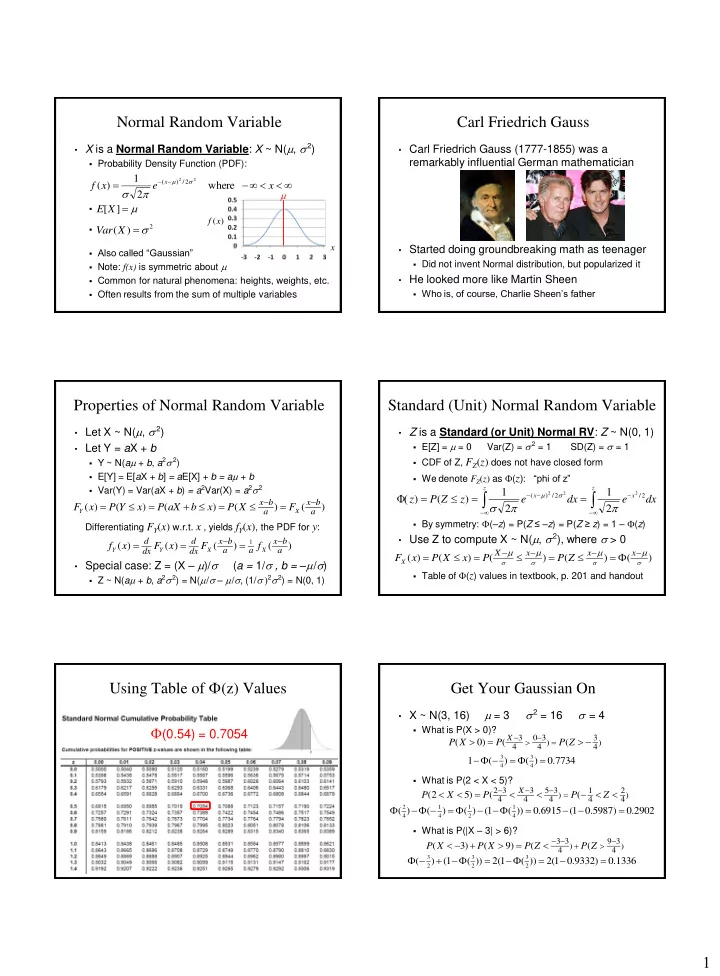

SLIDE 1
1 Normal Random Variable
- X is a Normal Random Variable: X ~ N(m, s 2)
- Probability Density Function (PDF):
- Also called “Gaussian”
- Note: f(x) is symmetric about m
- Common for natural phenomena: heights, weights, etc.
- Often results from the sum of multiple variables
x e x f
x
where 2 1 ) (
2 2 2
/ ) ( s m
s m ] [X E
2
) ( s X Var
) (x f x m
Carl Friedrich Gauss
- Carl Friedrich Gauss (1777-1855) was a
remarkably influential German mathematician
- Started doing groundbreaking math as teenager
- Did not invent Normal distribution, but popularized it
- He looked more like Martin Sheen
- Who is, of course, Charlie Sheen’s father
Properties of Normal Random Variable
- Let X ~ N(m, s 2)
- Let Y = aX + b
- Y ~ N(am + b, a2s 2)
- E[Y] = E[aX + b] = aE[X] + b = am + b
- Var(Y) = Var(aX + b) = a2Var(X) = a2s 2
Differentiating FY(x) w.r.t. x , yields fY(x), the PDF for y:
- Special case: Z = (X – m)/s
(a = 1/s , b = –m/s)
- Z ~ N(am + b, a2s 2) = N(m/s – m/s, (1/s )2s2) = N(0, 1)
) ( ) ( ) ( ) ( ) (
a b x a b x
X Y
F X P x b aX P x Y P x F
) ( ) ( ) ( ) (
1
a b x a a b x dx d dx d
X X Y Y
f F x F x f
Standard (Unit) Normal Random Variable
- Z is a Standard (or Unit) Normal RV: Z ~ N(0, 1)
- E[Z] = m = 0
Var(Z) = s 2 = 1 SD(Z) = s = 1
- CDF of Z, FZ(z) does not have closed form
- We denote FZ(z) as (z): “phi of z”
- By symmetry: (–z) = P(Z ≤ –z) = P(Z ≥ z) = 1 – (z)
- Use Z to compute X ~ N(m, s 2), where s > 0
- Table of (z) values in textbook, p. 201 and handout
dx e dx e z Z P z
z x z x
2 / 2 / ) (
2 2 2
2 1 2 1 ) ( ) Φ( s
s m
) ( ) ( ) ( ) ( ) (
s s s s
m m m m
x x x X
Z P P x X P x FX
Using Table of (z) Values
(0.54) = 0.7054
- X ~ N(3, 16)
m = 3 s 2 = 16 s = 4
- What is P(X > 0)?
- What is P(2 < X < 5)?
- What is P(|X – 3| > 6)?
Get Your Gaussian On
) 4 2 4 1 ) 4 3 5 4 3 4 3 2
( ( ) 5 2 (
Z P P X P
X
2902 . ) 5987 . 1 ( 6915 . )) ( 1 ( ) ( ) ( ) (
4 1 2 1 4 1 4 2
7734 . ) ( ) ( 1
4 3 4 3
) 4 3 ) 4 3 4 3
( ( ) (
Z P P X P
X ) 4 3 9 ) 4 3 3
( ( ) 9 ( ) 3 (
Z P Z P X P X P 1336 . ) 9332 . 1 ( 2 )) ( 1 ( 2 )) ( 1 ( ) (
2 3 2 3 2 3