SLIDE 1
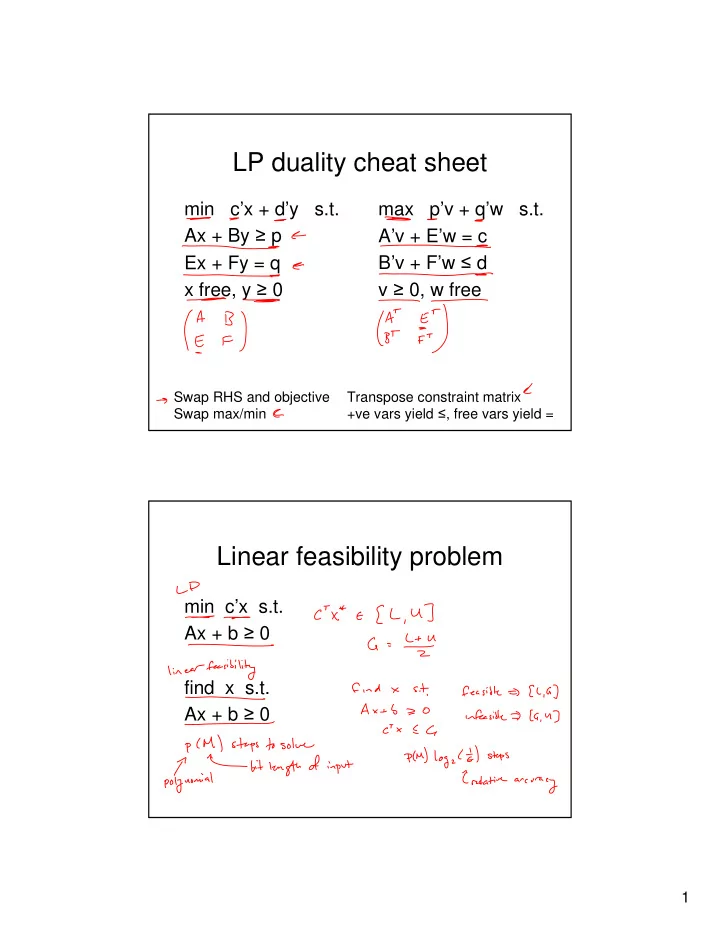
LP duality cheat sheet min cx + dy s.t. max pv + qw s.t. Ax - - PDF document
LP duality cheat sheet min cx + dy s.t. max pv + qw s.t. Ax + By p Av + Ew = c Bv + Fw d Ex + Fy = q x free, y 0 v 0, w free Swap RHS and objective Transpose constraint matrix +ve vars yield ,
SLIDE 2
SLIDE 3
3
Difficulties
- How do we get bounding sphere?
- How do we know when to stop?
- Bound region gets complicated–how do
we find its center?
Bounding a partial ellipsoid
- General ellipsoid w/ center xC, radius R:
- Halfspace: pTx + q ≤ 0
- Translate to origin, scale to be spherical
y = x =
SLIDE 4
4
Bounding a partial sphere
- Rotate so hyperplane is axis-normal
- New center xc:
- New shape A:
For example
SLIDE 5
5
Ellipsoid algorithm
- Want to find x s.t. Ax+b+η ≥ 0
- Pick R s.t. ||x*|| ≤ R
- E0 := { x | ||x|| ≤ R }
- Repeat:
– xt := center of Et – ask whether Axt + b ≥ 0
- yes: declare feasible!
- no: get separating hyperplane
– Et+1 := bound(Et ∩ { x | ptTx ≤ ptTxt }) – if vol(Et+1) ≤ εvol(E0): declare infeasible!
Getting bounds
- How big do L, U need to be?
- How big does R need to be?
- What should η be?
- How small does ε need to be?
SLIDE 6
6
Other algorithms
- Ellipsoid is polynomial, but slow
- Some other algorithms:
– simplex: exponential in worst case, but often fast in practice – randomized simplex: polynomial [Kelner & Spielman, 2006] – interior point: polynomial – subgradient descent: weakly polynomial, but really simple, and fast for some purposes
What’s a subgradient?
SLIDE 7
7
Subgradient descent for SVMs
- mins,w,b ||w||2 + C∑i si s.t.
yi(xi
Tw – b) ≥ 1 – si
si ≥ 0
- Equivalently,
Subgradient in SVM
- minw L(w) = ||w||^2 + C∑i h(yixi
Tw)
- Subgradient of h(z):
- Subgradient of L(w) wrt w: