Low Dose Discuss the history and pharmacology of ketamine - - PDF document

low dose
SMART_READER_LITE
LIVE PREVIEW

Low Dose Discuss the history and pharmacology of ketamine - - PDF document

1/30/2014 Objectives Low Dose Discuss the history and pharmacology of ketamine Differentiate anesthetic from subanesthetic doses of Ketamine...Everything? ketamine In what clinical scenarios might low dose ketamine be of Craig


slide-1
SLIDE 1

1/30/2014 1

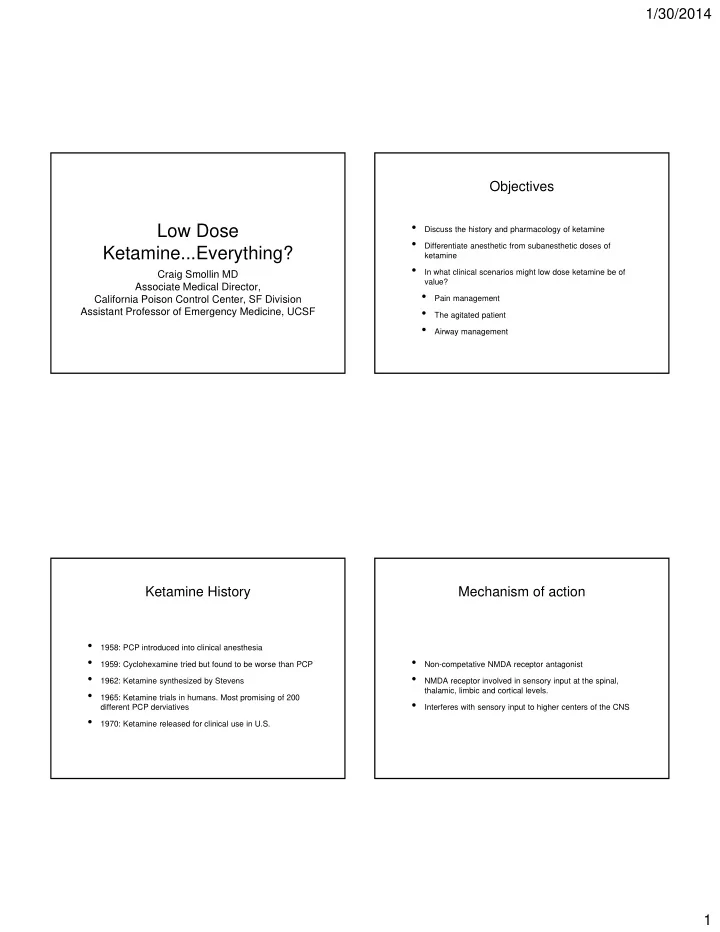
Low Dose Ketamine...Everything?

Craig Smollin MD Associate Medical Director, California Poison Control Center, SF Division Assistant Professor of Emergency Medicine, UCSF

Objectives

  • Discuss the history and pharmacology of ketamine
  • Differentiate anesthetic from subanesthetic doses of

ketamine

  • In what clinical scenarios might low dose ketamine be of

value?

  • Pain management
  • The agitated patient
  • Airway management

Ketamine History

  • 1958: PCP introduced into clinical anesthesia
  • 1959: Cyclohexamine tried but found to be worse than PCP
  • 1962: Ketamine synthesized by Stevens
  • 1965: Ketamine trials in humans. Most promising of 200

different PCP derviatives

  • 1970: Ketamine released for clinical use in U.S.

Mechanism of action

  • Non-competative NMDA receptor antagonist
  • NMDA receptor involved in sensory input at the spinal,

thalamic, limbic and cortical levels.

  • Interferes with sensory input to higher centers of the CNS
slide-2
SLIDE 2

1/30/2014 2

The role of NMDA receptors Definitions

  • Anesthetic or dissociative
  • Sub-dissociative

Sedation dosing

Route Dose Onset Time to peak effect Duration of action Intravenous 0.5-1.0 mg/kg < 1 min 3-5 min 5-10 min Intramuscular 2-4 mg/kg 2-5 min 20 min 30 min Nasal 5 mg/kg 10 min 20 min 1 hour Can also be administered via oral and rectal routes, however with signficantly greater time to onset and duration of action.

Low-dose Ketamine

  • Defined as the administration of 0.1 to 0.6 mg/kg IV
slide-3
SLIDE 3

1/30/2014 3

Clinical Scenarios

  • We will discuss the following clinical scenarios:
  • A patient with a history of IVDU and high opiate tolerance

with a large deltoid abscess requiring incision and drainage.

  • A child with a long bone fracture of the extremity.
  • A 35 year old male with extreme agitation requiring

aeromedical transport to another facility

  • A patient in respiratory distress on BIPAP

Clinical Scenario #1

  • A 35 year old male with h/o IV heroin abuse presents with a

left deltoid abscess. Exam sig for a 10 x 7 cm area of erythema, swelling, and fluctulence over the left lateral

  • deltoid. The patient complains of 10/10 pain and will barely

allow you to touch his arm. He is given a total of 4 mg of dilaudid without improvement in pain. How would you continue management of this patient given the need for an incision and drainage?

Opiate sparing effects

  • Management of severe acute pain in emergency settings:

ketamine reduces morphine consumption. Am J. Emerg Med 2007; 25:385-90

  • IV morphine injection of 0.1 mg/kg, followed by 3 mg

every 5 hours

  • Placebo (saline) or ketamine 0.2 mg/kg over 10 minutes
  • Ketamine group required much less morphine to achieve

same pain scale scores (<30/100)

Opiate sparing effects

  • Peri-operative ketamine for acute post-operative pain: a

quantitative and qualitative systematic review (Cochrane review) Acta Anaesthesiol Scand 2005;49:1405-142

  • 27/37 trials found that peri-operative ketamine

reduced rescue analgesic requirements or pain intensity, or both.

  • In the first 24 h after surgery, ketamine reduces

morphine requirements.

slide-4
SLIDE 4

1/30/2014 4

Ketamine and agitation Ketamine and agitation

  • Initial ketamine dosing range given was 0.5-1 mg/kg.
  • If two doses required within first 60 min of initiation of sedation

infusion started at initial rate of 1-1.5 mg/kg per hour.

  • The amount given was titrated to achieve a target sedation level that

was a calm, cooperative patient who could still respond to verbal commands.”