Looking for the old quantum-gravity theory - - PowerPoint PPT Presentation

looking for the old quantum gravity theory
SMART_READER_LITE
LIVE PREVIEW

Looking for the old quantum-gravity theory - - PowerPoint PPT Presentation

Looking for the old quantum-gravity theory with gamma rays and cosmic rays


slide-1
SLIDE 1

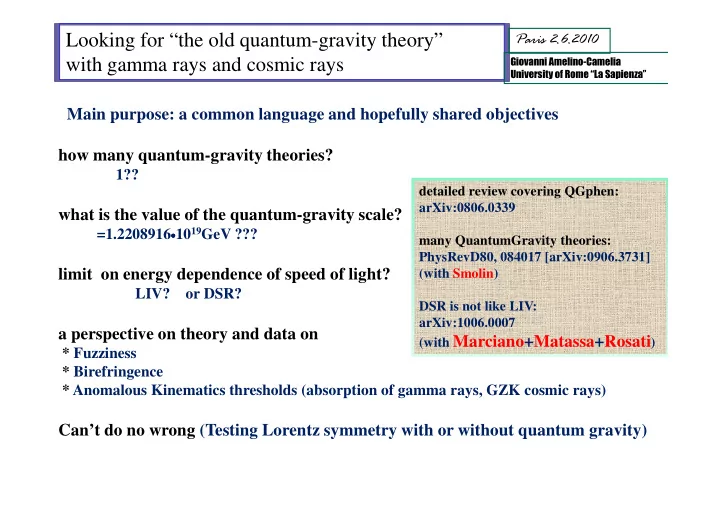
Looking for “the old quantum-gravity theory” with gamma rays and cosmic rays

Main purpose: a common language and hopefully shared objectives how many quantum-gravity theories?

1??

what is the value of the quantum-gravity scale?

=1.2208916•

  • 1019GeV ???
  • detailed review covering QGphen:

arXiv:0806.0339 many QuantumGravity theories: PhysRevD80, 084017 [arXiv:0906.3731]

  • limit on energy dependence of speed of light?

LIV? or DSR?

a perspective on theory and data on

* Fuzziness * Birefringence * Anomalous Kinematics thresholds (absorption of gamma rays, GZK cosmic rays)

Can’t do no wrong (Testing Lorentz symmetry with or without quantum gravity)

PhysRevD80, 084017 [arXiv:0906.3731] (with Smolin) DSR is not like LIV: arXiv:1006.0007 (with Marciano+Matassa+Rosati)

slide-2
SLIDE 2

quantum-gravity problem

traditional strategy “wanna be like Einstein”

(one big jump to get to GR)

we’ll get ourselves a

  • the “old quantum-gravity theory” strategy:

but probably QG requires a totally new paradigm... must come about more like Quantum Mechanics... necessarily first the old quantum theory....and think

  • f the century-long story of weak interactions....

brilliant partial solutions helped us along the way...

slide-3
SLIDE 3

∞: “youguys of QG research don’t even know what you’re talking about...

you are wasting taxpayer’s money!!!”

1: “QG is String Theory” (“Moses told me”...but which one?)

[∞ again.....]

1: “QG is a single theory combining the claims in all papers on the QG

how many QG theories are there?

1

problem, even though they used completely different formalisms”

[dispersion+birefringence+fuzziness+GUP+

  • ??definitely not!!!!]

several:“it could be EITHER string theory OR loopQG OR spacetime noncommutativity OR...” healthy perspective: we cannot look for QG right now.... we can look for “the old QG theory”... so we need several “QG theories of NOT everything”

slide-4
SLIDE 4

hopefully soon with data.... ...but for now: * analysis of the structure of the QG problem (see, e.g., comments on fuzziness, later) * and...hmmmm....well.... string theory, loopQG and spacetime noncommutativity (so “business as usual”.....only nearly....)

but how do we figure out which models are “good”?

(so “business as usual”.....only nearly....)

slide-5
SLIDE 5

mainstream string theory (critical, SUSY...)

could be one day turned into beautiful phenomenology of NOT everything, but presently not useful for Planck-scale-phenomenology (infinitely many theories...)

loop Quantum Gravity

probably predictive main feature is discreteness of spacetime observables... but presently unmanageable for phenomenology... still it does inspire some “quantum-gravity theories of NOT everything” (see below..semiheuristic arguments of Gambini+Pullin, Urrutia+...)

great!!! and what do they say???

(see below..semiheuristic arguments of Gambini+Pullin, Urrutia+...)

spacetime noncommutativity

N.B. “Connes noncommutativity” predicts...the Standard Model!!!! “quantum-group noncommutativity” is tangibly predictive, but not that much simpler than loopQG and far too many options [by the way....q-GNC is my preferred formalism...and it stinks!!!]

  • ut-of-mainstrem string theory(like model of QG foam of Ellis+Mavromatos+Nanopulos)

impossible to make computations....therefore not predictive...but suitable for beautiful semi-heuristic analyses with of course predictive (but “flexible”) outcome

slide-6
SLIDE 6

EQG =EPlanck=1.2208916•

  • 1019GeV (“we predict dispersion at the Planck scale...”)

EQG ∼ ∼ ∼ ∼ 103 GeV (large extra dimensions...) EQG ∼ ∼ ∼ ∼ 1019 GeV and it is only rough order-of-magnitude estimate at best mainly comes from observing that at the Planck scale

  • k, then just tell us the value of the Quantum-Gravity scale…

mainly comes from observing that at the Planck scale

λ λ λ λcompton ∼

∼ ∼ ∼ λ

λ λ λschwartzschild

and assumes that G does not run at all!!!!!!!!! but it runs!!! and it should run!!!!

slide-7
SLIDE 7
  • utline:

dispersion fuzziness

PART II

birefringence threshold anomalies{ γ γ γ γ γ γ γ γ → → → → e+ e- (TeV gamma rays, AGNs....) p γ γ γ γ → p π π π π (GZK, cosmic rays...)

slide-8
SLIDE 8

spacetime noncommutativity: in most (but not all) models loop QG: “expected” by many experts

  • ther models of spacetime foam: likely

in-vacuo dispersion

linear or quadratic but apparently not quartic (which would be otherwise feared)

slide-9
SLIDE 9

1998: where λ

λ λ λ is λ λ λ λLIV a preferred-frame picture (LIVpicture, i.e. LSB picture, i.e. preferred frame)

and it was formalized only for flat spacetime initially in-vacuo dispersion

GAC, arXiv:grqc0012051; IntJournModPhysD11,35; Nature418,34 GAC+Ellis+Mavromatos+Nanopoulos+Sarkar, Nature(1998)

2000:

Nature418,34

with λ

λ λ λDSR no preferred frame

but was formalized only for flat spacetime initially 2008: consensus emerges for formalization in expanding spacetimes of LIV case

Jacob+Piran , JCAP0801,031 Ellis+Mavromatos+Nanopoulos+ Sakharov+Sarkisyan, Astropart.Physics29,158

slide-10
SLIDE 10

a DSR theory compatible with spacetime expansion arXiv:1006.0007 GAC+Marciano+Matassa+Rosati)

slide-11
SLIDE 11

a DSR theory compatible with spacetime expansion

slide-12
SLIDE 12

in the “Minkowski limit of quantum gravity” (clearly a theory of not everything)

  • ne might have noncommuting spacetime coordinates
  • ne might have noncommuting spacetime coordinates

Let us consider the example of kappaMINKOWSKI spacetime

Lukierski+Nowicki+Ruegg+Tolstoy,PLB(1991) Nowicki+Sorace+Tarlini,PLB(1993) Majid+Ruegg,PLB (1994) Lukierski+Ruegg+Zakrzewski, AnnPhys(1995)

It would seem that translation and boost symmetries are lost….but our intuition

  • nly really reliable for “recognizing symmetries at first sight” when the algebra
  • f fields is commutative….
slide-13
SLIDE 13

( )

t ik ikx e

e k k d t x ) ( ) , (

4

ϕ

= Φ

Consider for example the following action for “kappa-Klein-Gordon fields”: where

( ) ( )

t ik ikx t ik ikx

e e k e e P

µ µ

=

many familiar “symmetry tests” are successful assuming Pµ

µ µ µ generate

translation symmetries and similar results found for candidate rotation/boost generators (see later) But is a “deformed box”, non-special-relativistic….

slide-14
SLIDE 14

Translation generators in kappa-Minkowski:

( ) ( )

t ik ikx t ik ikx

e e k e e P

µ µ

=

classical action t K k i x K e k i t iK iKx t ik ikx

e e e e e e

k

) ( ) ( + +

=

λ

PLB671(2009)298, PRD78(2008) 025005 ,MPLA22(2007)1779 (with Arzano,Gubitosi,Marciano’,Martinetti,Mercati)

Noether analysis of Hopf-algebra symmetries

  • f field theories in noncommutative spacetime

( )

( )

( )( ) [ ( )]( ) ( )

[ ] (

)

t iK iKx t ik ikx P t iK iKx t ik ikx t iK iKx t ik ikx k t K k i x K e k i t iK iKx t ik ikx

e e P e e e e e e e P e e e e K e k e e P e e e e P

k

) ( ) ( µ λ µ µ λ µ µ µ

λ

− − + +

+ = + = =

Nontrivial coproduct!! Translations are not classical in kappa-Minkowski

then

slide-15
SLIDE 15

It appeared to us that the most criticizeable assumption made in previous failed attempts of Noether analysis was

j j l j

i x x x λε ε ε ε

µ

= = = ] , [ ; ] , [ ; ] , [ df f f + → ) ( ) ( x f P ia x df

µ µ

=

with and transformation parameters aµ

µ µ µ that were “as usual” ordinary real numbers.

IDEA: transformation parameters ε ε ε εµ

µ µ µ must be based on the (noncommutative!)

differential calculus on the noncommutative spacetime

Sitarz, PhysLettB349(1995)42 Majid+Oeckl, math.QA/9811054

so that in particular xµ

µ µ µ+ε

ε ε εµ

µ µ µ obeys the kappa-Minkowski commutation relations.

) ( ) ( x f P i x df

µ µ

ε =

  • ne arrives at explicit form for the charges

For the mentioned example of action for kappa-Klein-Gordon fields whose t-independence (on solutions of the EoM) is easily verified so that in particular xµ

µ µ µ+ε

ε ε εµ

µ µ µ obeys the kappa-Minkowski commutation relations.

When we then used in the Noether analysis no further obstacles were encountered

slide-16
SLIDE 16

points are not “point-like”….. roughly like position in phase space….

  • very general prediction of QG problem….

more general than dispersion(!!)…. and “seen” in most QG formalisms… but how big is this fuzziness?? an ansatz

GAC+Smolin,PhysRevD(2009) Ng+VanDam,ModPhysLett(1994) GAC,ModPhysLettA(1994) Garay,IntJournModPhysA(1995) Ford,PhysRevD(1995)

N.B. dispersion fuzziness (but not necessarily same order) but fuzziness does not imply dispersion, so it is possible

GAC+Smolin,PhysRevD(2009)

surely testable with bursts of γ γ γ γ-rays… can’t say if it can compete with other bound-setting strategies

Lieu+Hillman, Astrophys.Journ.(2003) Ng+VanDam+Christiansen, Astrophys.Journ.(2003)

slide-17
SLIDE 17

birefringence nothing in QG problems points to birefringence but it is strikingly easy to get out of Quantum Field Theory [still….QFT prediction of cosmological constant is a bit off…and the prediction that there is no gravity is also questionable…]

birefringence

Gambini+Pullin,PhysRevD(1999) Myers+Pospelov, PhysRevLett(2003)

~loopQG is also questionable…] linear effect extremely well constrained it would be exciting if we could aim for quadratic effect

Gleiser+Kozameh,PhysRevD(2001) Mattingly, Living RevRel(2005) GAC, arXiv:0806.0339

slide-18
SLIDE 18

GAC, arXiv:grqc0012051; IntJournModPhysD11,35; Nature418,34

threshold anomalies

Protheroe+Meyer, PhysLettB493(2000)1 GAC+Piran, PhysRevD64(2001)036005 GAC, Nature408(2000)661 Kifune, AJL 518(1999)L21 Kluzniak, AP11(1999)117

example: IFF mod disp rel THEN appears to be inevitable in the LIV case but forbidden in the DSR case

(where energy-momentum charges must be consistently deformed)

......LIV scenario is now restricted to photons!!!!!??? N.B.: *MDR does not imply ThresholdAnomalies *ThresholdAnomalies do not require MDR using

  • ne finds that the process is only allowed if

analogous prediction for p γ γ γ γ → p π π π π is in trouble with GZK cutoff story... this is why LIV is being restricted to photons... for LIV case even quadratic in Planck length is starting to be in trouble with GZK story... but it is intriguing to think of all this in relation to observations

  • f γ

γ γ γ-rays from AGNs...

slide-19
SLIDE 19

absorption of TeV photons

Aharonian et al Nature 440, 1018 (2006)

slide-20
SLIDE 20

absorption of TeV photons

Albert et al, Science 320, 1752 (2008)

slide-21
SLIDE 21

testing Lorentz symmetry with or without QG

data IFF one adopts formalism of effective low-energy Quantum Field Theory (not obvious!!) THEN (from a QG perspective) situation of SR tests looks something like N.B.: DSR theory showed on previous slides is first ever test theory of SR without a preferred frame!! SME QGphen Quantum Gravity advantage of SME: many more possible effects violating SR monitored (now infinitely many parameters!!) disadvantage of SME: very many effects violating SR monitored scope of QGphen from the narrow SRtest perspective: *set priorities from QG perspective *expose lack of generality of searches (nonpowercountingREN, DSR, defHeisenberg…) warning: sometimes difficult to compare (focus still mostly on originalminimal SME…no Planck-scale effects in the sense of QGphen) …quadratic dispersion and linear birefringence are in the generalized SME

slide-22
SLIDE 22

CONCLUSIONS: we are in the (slow but certain) process of starting to understand noteverything

detailed review covering QGphen: arXiv:0806.0339 many QuantumGravity theories: PhysRevD80, 084017 [arXiv:0906.3731] (with Smolin) DSR is not like LIV: arXiv:1006.0007 (with Marciano+Matassa+Rosati)

Einstein’s theory-of-everything utopia : “I would like to state a theorem…: there are no arbitrary constants ... that is to say, nature is so constituted that it is possible logically to lay down such strongly determined laws that within these laws only rationally completely determined constants occur…”

starting to understand noteverything