Looking Back, Nurturing Emerging Sprouts and Pruning Unwelcome - - PowerPoint PPT Presentation

looking back nurturing emerging sprouts and pruning
SMART_READER_LITE
LIVE PREVIEW

Looking Back, Nurturing Emerging Sprouts and Pruning Unwelcome - - PowerPoint PPT Presentation

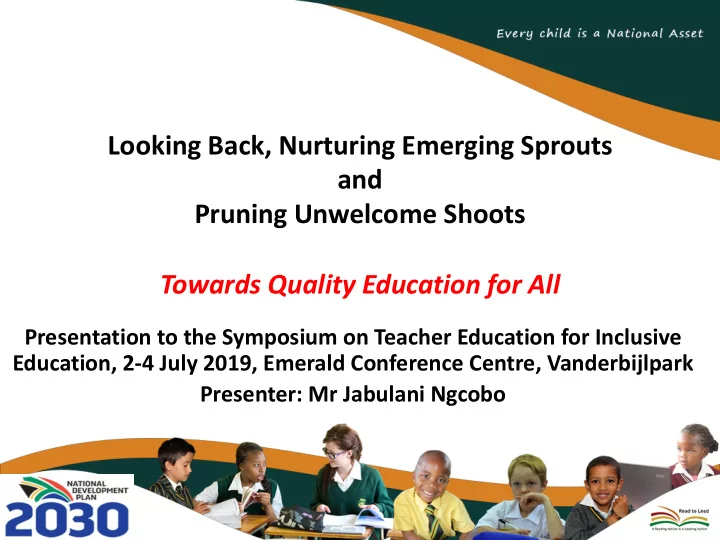
Looking Back, Nurturing Emerging Sprouts and Pruning Unwelcome Shoots Towards Quality Education for All Presentation to the Symposium on Teacher Education for Inclusive Education, 2-4 July 2019, Emerald Conference Centre, Vanderbijlpark


slide-1
SLIDE 1

Looking Back, Nurturing Emerging Sprouts and Pruning Unwelcome Shoots Towards Quality Education for All

Presentation to the Symposium on Teacher Education for Inclusive Education, 2-4 July 2019, Emerald Conference Centre, Vanderbijlpark Presenter: Mr Jabulani Ngcobo

slide-2
SLIDE 2

Presentation Outline

  • Purpose
  • Introduction
  • Envisaged Learner
  • Reflections on the Policy Promises
  • Concluding observations on the initial report of South

Africa

  • Understanding Meaningful Access
  • The Dominant View
  • Teacher Agency and Resilience
  • Key Questions
  • Reflections on Change Management
  • Recommendations
  • Conclusion

2

slide-3
SLIDE 3

Purpose

To present some key issues regarding the implementation of Education White Paper 6 to the Symposium

  • n

Teacher Education for Inclusive Education, for consideration and discussion.

3

slide-4
SLIDE 4

Introduction

  • Education

for All, is a seductive promise that seemed straightforward and simple to implement, but has still not been fully realised (e.g. 125 million children are not acquiring functional literacy or numeracy).

  • The National Development Plan (NDP): Vision 2030 envisions:

– a South Africa where everyone feels free yet bounded to others; where everyone embraces their full potential, a country where opportunity is determined not by birth, but by ability, education and hard work; and that – by 2030, all South Africans must have access to education and training

  • f the highest quality, leading to significantly improved learning
  • utcomes.
  • Action Plan 2019. Towards the Realisation of Schooling 2030,

contends that [making] sure that every young South African receives quality schooling is an urgent need.

  • This is what forms the core substance of our work as a system.

4

slide-5
SLIDE 5

Envisaged Learner

  • Identify and solve problems and make decisions using critical

and creative thinking;

  • Work effectively as individuals and with others as members of

a team;

  • Organise

and manage themselves and their activities responsibly and effectively;

  • Collect, analyse, organise and critically evaluate information;
  • Communicate

effectively using visual, symbolic and/or language skills in various modes;

  • Use science and technology effectively and critically showing

responsibility towards the environment and the health of

  • thers; and
  • Demonstrate an understanding of the world as a set of

related systems by recognising that problem solving contexts do not exist in isolation.

5

slide-6
SLIDE 6

Reflections on the Policy Promises

Policy Imperative Progress Remedial Action

Qualitative improvement of special schools

  • Qualitative improvement of infrastructure

and resources in special schools, including safety and accessibility issues. Phased conversion

  • f

special schools to resource centres

  • Develop a clear plan to build capacity to

support other schools as part of district support service.

  • Leverage on the Universal Services and

Access Obligations project (USAO). Institutionalisation

  • f

the Policy

  • n

Screening, Identification, Assessment and Support and curriculum differentiation.

  • Institutionalise

the Policy

  • n

SIAS across the system, starting with the Foundation Phase.

  • Move

to subject-specific curriculum differentiation as a mechanism to ensure curriculum access for all learners across the system.

6
slide-7
SLIDE 7

Reflections on the Policy Promises

Policy Imperative Progress Remedial Action

Mobilisation

  • f
  • ut-of-

school children

  • f

school-going age

  • Develop a clear management plan to ensure

that children in special care centres have access to publicly funded education – explore models.

  • Develop a clear mechanism for dealing with

the issue of waiting lists, fees in special schools and hostels - increase access to full-service schools. Building capacity in full- service schools

  • Develop a realistic, implementable programme

for building capacity in full-service schools.

  • Explore

provincial funding

  • ptions

(e.g. Programme 4.2) for strengthening

  • f

full- service schools.

  • Phased

admission

  • f

learners with disabilities in full-service schools. Strengthening management and governance in special schools

  • Integrate

special schools into existing management and governance programmes.

  • Effectively implement turnaround strategy for

special schools.

7

slide-8
SLIDE 8

Reflections on the Policy Promises

Policy Imperative Progress Remedial Action

Establishment of functional district support teams (DST)

  • Profile all district support teams and design

a rigorous support programme.

  • Explore

incremental introduction

  • f

the model of itinerant support teams. Stakeholder management – advocacy, communication and information

  • Develop a schedule and plan for regular

meetings with stakeholders – clear protocols for stakeholder invitation, participation and management. Improving access to the National Curriculum Statement

  • Finalise policy statements for the CAPS

Grade R-6 for SID.

  • Strengthen subject advisory services to

provide curriculum support to all schools, including special schools.

  • Leverage on existing work to ensure that

teachers have skills in specialised disability- specific areas.

8

slide-9
SLIDE 9

Reflections on the Policy Promises

Policy Imperative Progress Remedial Action

Building an inclusive education and training system

  • Review the implementation of Education

White Paper 6.

  • Rigorous, integrated and coherent policy

implementation at provincial, district and school levels

9

slide-10
SLIDE 10

Concluding observations on the initial report of South Africa

  • Barriers

against students with disabilities to access mainstream schools, including discrimination in admissions to school, long distances, poor transportation, lack of teachers trained on inclusive education and in sign language, Braille and Easy-Read skills, lack of accessible curricula, and negative societal attitudes opposing attendance of children with disabilities to regular and inclusive schools.

  • Intensify efforts at allocating sufficient financial and human

resources for reasonable accommodations that will enable children with disabilities, including children with intellectual disabilities, autism and deaf or hard of hearing, to receive inclusive and quality education, including engaging in systematic data collection, disaggregated by sex and type of impairment, on the number of children mainstreamed into regular and inclusive schools and dropouts.

10

slide-11
SLIDE 11

Understanding Meaningful Access

11

slide-12
SLIDE 12
  • Teachers often believe that

and/or are compelled to adopt one size fits all – one way is suitable for and benefits all learners.

  • Learners are often expected to

continue even if they are still uncertain about what has been covered, resulting in the accummulation

  • f

learning deficits.

  • The

cost

  • f

deficit accummulation is devastating.

The Dominant View

slide-13
SLIDE 13
  • The current situation requires

teachers who can act purposefully, constructively and professionally under difficult circumstances.

  • These

are teachers with a solutionist disposition, who will not give up on a learner.

  • These are teachers who will

pick up their learner a hundred times, who want to get it right for every child and never even

  • nce

think to themselves: “maybe this child was not made for it”.

Teacher Agency and Resilience

slide-14
SLIDE 14
  • There has recently been significant emphasis on the

importance of being an empowered teacher.

  • An empowered teacher is not the same as being

a powerful teacher.

  • While empowered teachers can have power and

powerful teachers can be empowered; it is possible to be powerful without being empowered.

  • Empowered teachers are those who can take the
  • pportunity

to exercise their

  • wn

professional judgment without fear of being politically incorrect.

  • Empowered teachers are those that are provided with

encouragement, space and support necessary to take risks and experiment.

Teacher Agency and Resilience

slide-15
SLIDE 15
  • Being an empowered teacher means having enough

resources (knowledge, skills, values and attitudes) and freedom to provide every student with the education that they deserve.

  • Teachers

who have not yet experienced empowerment are often unable to fully personalise their teaching to the needs of each student – they adopt a

  • ne-size-fits-all

approach in almost everything that they do.

  • Empowered teachers are themselves self-directed

learners and are capable of producing self-directed learners.

Teacher Agency and Resilience

slide-16
SLIDE 16
  • What conditions must be eliminated

and/or created to ensure a pedagogy of possibility that is underpinned by the principles

  • f

equitable access to education for all?

  • What cultures must be in place to build,

nurture and maintain teacher agency and resilience?

  • How can teacher development, in its

various forms, manipulate these cultures to give us such a teacher?

  • How

must continuing professional teacher development be configured to become an instrument

  • f

teacher education for inclusive education?

  • What levers are available for building an

inclusive education system?

Key Questions…

slide-17
SLIDE 17
  • Inclusive education is not a one-man

show; it comes about as a result of collaborative work – requires a ‘we are in this together’ attitude.

  • Individuals and organisations (often

with multiple interests) come together and contribute their expertise for the benefit of a shared objective, project,

  • r mission.
  • This implies that, in order for inclusion

to work, players need to learn how to collaborate, find their place in the chain, understand how to shape their actions and movements so that they produce what is good for all.

  • The quality and value of collective

effort will be measured and determined through improvements at the level of the school and classroom.

The Nature of Inclusive Education

slide-18
SLIDE 18

Reflections on Change Management

slide-19
SLIDE 19

Reflections on Change Management

  • Acknowledge

the existing situation, prepare yourself for a paradigm shift, ensure collective clarity of challenges, identify, acknowledge and accommodate concerns, fears and uncertainties, alignment of interests and expectations, develop collective mechanisms to replace it with a desired situation.

  • Identify incentives for collaboration, influence networks and

islands of effectiveness.

  • Identify good practice principles for the successful governance of

collective action (based on the aliances that bind them together) – multistakeholder governance.

  • Allow incremental implementation, tailored to the local context -

spaces for experimenting, learning from action and each other, adapting and moving forward, and regular communication – reality

  • f progress rather than illusion of progress.
  • Monitoring and evaluations mechanisms to provide a feedback

loop and strengthen implementation.

slide-20
SLIDE 20

Recommendation

It is recommended that the Symposium on Teacher Education for Inclusive Education consider the presentation for discussion.

20

slide-21
SLIDE 21

Conclusion

A teacher is not someone who has a qualification; it is someone who has a heart…and a qualification.

21

slide-22
SLIDE 22