
SLIDE 1
1
Alpha Alpha-
- beta pruning
beta pruning
- reduce the branching factor of nodes
reduce the branching factor of nodes
- alpha value
alpha value
- associated with
associated with MAX
MAX nodes
nodes
- represents the worst outcome
represents the worst outcome MAX
MAX can achieve
can achieve
- can never decrease
can never decrease
- beta value
beta value
- associated with
associated with MIN
MIN nodes
nodes
- represents the worst outcome
represents the worst outcome MIN
MIN can achieve
can achieve
- can never increase
can never increase
Example Example
- in a
in a MAX
MAX node,
node, α α = 4 = 4
- we know that
we know that MAX
MAX can make a move which will
can make a move which will result at least the value 4 result at least the value 4
- we can omit children whose value is less than or
we can omit children whose value is less than or equal to 4 equal to 4
- in a
in a MIN
MIN node,
node, β β = 4 = 4
- we know that
we know that MIN
MIN can make a move which will result
can make a move which will result at most the value 4 at most the value 4
- we can omit children whose value is greater than or
we can omit children whose value is greater than or equal to 4 equal to 4
Ancestors and Ancestors and α α & & β β
- alpha value of a node is never less than the alpha
alpha value of a node is never less than the alpha value of its ancestors value of its ancestors
- beta value of a node is never greater than the
beta value of a node is never greater than the beta value of its ancestors beta value of its ancestors
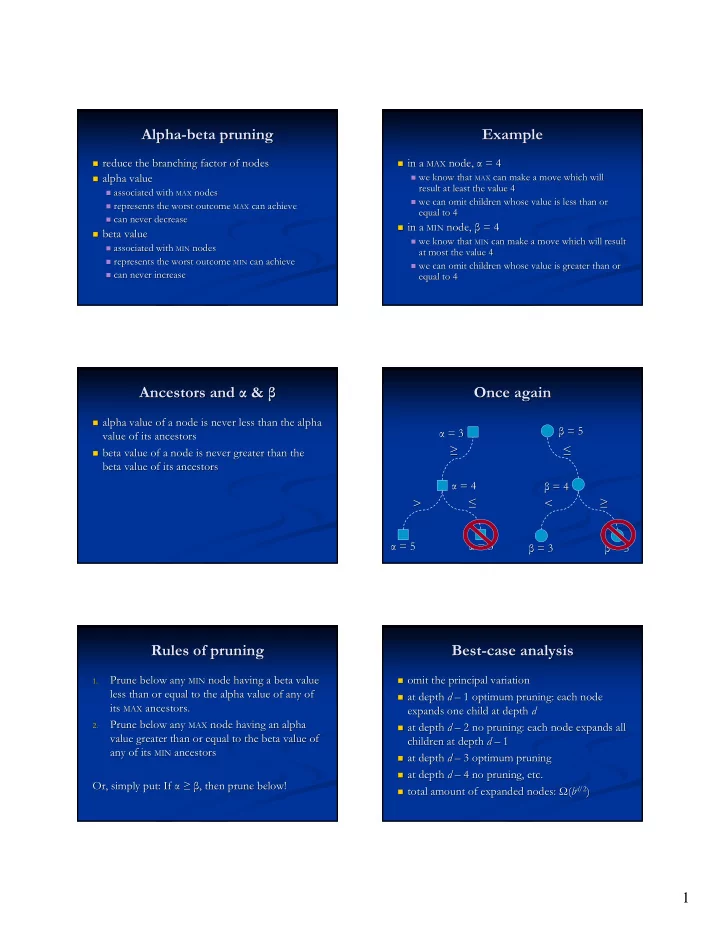
Once again Once again
α α = 4 = 4 β β = 4 = 4 α α = 3 = 3
≤ ≤ > >
α α = 5 = 5
≥ ≥
α α = 3 = 3 β β = 5 = 5
< < ≥ ≥
β β = 3 = 3
≤ ≤
β β = 5 = 5
Rules of pruning Rules of pruning
1. 1.
Prune below any Prune below any MIN
MIN node having a beta value
node having a beta value less than or equal to the alpha value of any of less than or equal to the alpha value of any of its its MAX
MAX ancestors.
ancestors.
2. 2.
Prune below any Prune below any MAX
MAX node having an alpha
node having an alpha value greater than or equal to the beta value of value greater than or equal to the beta value of any of its any of its MIN
MIN ancestors
ancestors Or, simply put: If Or, simply put: If α α ≥ ≥ β β, then prune below! , then prune below!
Best Best-
- case analysis
case analysis
- mit the principal variation
- mit the principal variation
- at depth
at depth d d – – 1 optimum pruning: each node 1 optimum pruning: each node expands one child at depth expands one child at depth d d
- at depth
at depth d d – – 2 no pruning: each node expands all 2 no pruning: each node expands all children at depth children at depth d d – – 1 1
- at depth
at depth d d – – 3 optimum pruning 3 optimum pruning
- at depth
at depth d d – – 4 no pruning, etc. 4 no pruning, etc.
- total amount of expanded nodes:
total amount of expanded nodes: Ω Ω( (b bd
d/2 /2)