Long-term Outcome of Patients with Acute Promyelocytic Leukemia - - PowerPoint PPT Presentation

long term outcome of patients with acute promyelocytic
SMART_READER_LITE
LIVE PREVIEW

Long-term Outcome of Patients with Acute Promyelocytic Leukemia - - PowerPoint PPT Presentation

Long-term Outcome of Patients with Acute Promyelocytic Leukemia Treated with All- Trans -Retinoic Acid, Arsenic Trioxide, and Gemtuzumab Ozogamicin Farhad Ravandi, Yasmin Abaza, Guillermo Garcia-Manero, Elihu Estey, Gautam Borthakur, Elias


slide-1
SLIDE 1

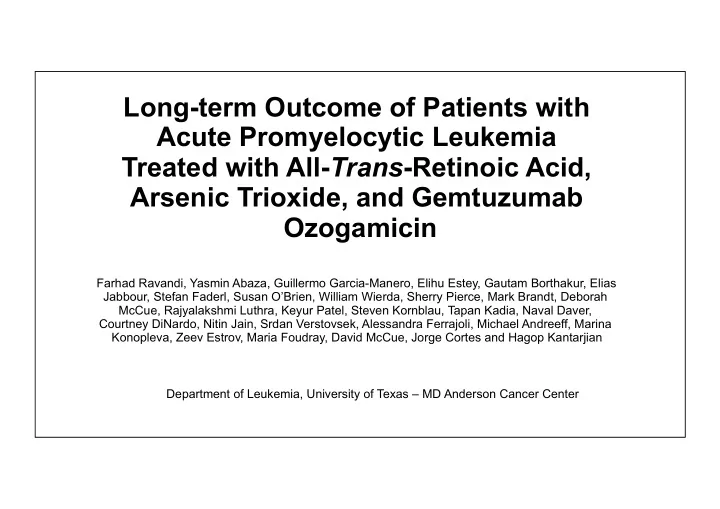
Long-term Outcome of Patients with Acute Promyelocytic Leukemia Treated with All-Trans-Retinoic Acid, Arsenic Trioxide, and Gemtuzumab Ozogamicin

Farhad Ravandi, Yasmin Abaza, Guillermo Garcia-Manero, Elihu Estey, Gautam Borthakur, Elias Jabbour, Stefan Faderl, Susan O’Brien, William Wierda, Sherry Pierce, Mark Brandt, Deborah McCue, Rajyalakshmi Luthra, Keyur Patel, Steven Kornblau, Tapan Kadia, Naval Daver, Courtney DiNardo, Nitin Jain, Srdan Verstovsek, Alessandra Ferrajoli, Michael Andreeff, Marina Konopleva, Zeev Estrov, Maria Foudray, David McCue, Jorge Cortes and Hagop Kantarjian Department of Leukemia, University of Texas – MD Anderson Cancer Center

slide-2
SLIDE 2

Lo-Coco F et al. N Engl J Med 2013;369:111-121.

ATRA + ATO – GIMEMA, AMLSG, SAL

slide-3
SLIDE 3

Lo-Coco F et al. N Engl J Med 2013;369:111-121.

ATRA + ATO: Outcomes .

slide-4
SLIDE 4

Platzbecker U, et al JCO 2017, 35, 605-612

ATRA + ATO: Long-Term Follow-up.

slide-5
SLIDE 5

Burnett AK, et al, Lancet Oncology, 2015, 16(13), 1295-1305

ATRA + ATO: UK NCRI

slide-6
SLIDE 6

ATRA + ATO ± GO: MDACC

  • Between July 2002 and May 2015, 239 patients with newly diagnosed APL

seen at MDACC

  • Three phase 2 studies : ID01-014, NCT01409161, NCT00413166
  • 187 patients enrolled
  • Reasons for excluding remaining 52 (22%)
  • Insurance/Socio-economic
  • Death within 48 hors of hospitalization
slide-7
SLIDE 7

ATRA + ATO ± GO: Treatment Regimen

Abaza Y, et al. Blood 2017;129:1275-1283

slide-8
SLIDE 8

ATRA + ATO ± GO: Patient Disposition

Abaza Y, et al. Blood 2017;129:1275-1283

slide-9
SLIDE 9

Characteristics (N = 187) Number (%) Median (range) Age, y 50 (14-84) ≥60

52 (28)

Sex Male 97 (52) Risk category High-risk

54 (29)

Low-risk 133 (71) Leukocyte count (×109/L) 2.2 (0.3-187.9) Platelet count (×109/L) 36 (3-261) Cytogenetics t(15;17) 122 (65) t(15;17) + other cytogenetic 45 (24) Diploid (RT-PCR +) 10 (5) ND/IM (RT-PCR+) 10 (5) FAB morphology M3 163 (87) M3v 22 (12) PML-RARA isoforms Short 78 (42) Long 105 (56) Both 4 (2)

  • Patient Characteristics
slide-10
SLIDE 10

Mutation Analysis

Molecular Feature Performed N Detected N(%) High Risk N(%) Standard Risk N(%) PML-RARA 187 187 FLT3-ITD 152 59 (39) (66) (28) FLT3-TKD 153 18 (12) (13) (11) RAS 145 7 (5) (2) (6) CEBPA 39 1 (3)

Abaza Y, et al. Blood 2017;129:1275-1283

slide-11
SLIDE 11

Details of Leucocytosis and Cytoreductive Therapy

  • 179 patients (96%) achieved CR after induction (Low risk 96%, high risk 96%)
  • 176 achieved complete molecular remission (2 withdrew consent; 1 lost to f/u)
  • 53 High risk patients received cytoreductive therapy;
  • 45 (83%) received GO,
  • 7 (13%) received Idarubicin,
  • 1 (2%) received both and
  • 1 did not receive any
  • 96 Low risk patients (72%) developed leukocytosis
  • Median WBC 19.8 x 10⁹/L, range 10.3-195 x 109/L
  • reached at a median of 10 days (range 2- 26 days)
  • Among them 60 received cytoreductive therapy
  • GO in 51, Idarubicin in 9
  • No patients received GO for molecular persistence or relapse
slide-12
SLIDE 12

Survival outcomes for the whole population

Abaza Y, et al. Blood 2017;129:1275-1283

Median F/U 47.6 months, Range 2.7 – 159.7 months

slide-13
SLIDE 13

Outcomes by risk subsets

Abaza Y, et al. Blood 2017;129:1275-1283

slide-14
SLIDE 14

Outcomes by age

Abaza Y, et al. Blood 2017;129:1275-1283

slide-15
SLIDE 15

Survival for specified subsets

Abaza Y, et al. Blood 2017;129:1275-1283

slide-16
SLIDE 16

Characteristics of Relapsed Patients

Patient no. Risk category Age (y) Sex Cytogenetics FLT3 status Time to first relapse (mo) Type of first relapse 1 High 52 F Diploid ND 9.2 Molecular* 2 Low 42 M 46XY t(15;17) [20] ND 79.5 Hematological/ molecular 3 High 38 M 46XY t(15;17) [19] ND 9 Hematological/ molecular 4 High 79 M 46XY t(15;17), der (17) i (17) (q10) [18]; 46 XY [2] Neg 12.4 Molecular* 5 High 18 M 46XY t(15;17) [19] ND 9.4 Molecular* 6 Low 19 F Diploid Neg 9.5 Hematological 7 High 35 M 46XY t(15;17) [16]; 46 idem, del 7 [1]; 46 XY [3] Neg 7.9 Hematological Abaza Y, et al. Blood 2017;129:1275-1283

7 patients relapsed including 3 with CNS relapse

slide-17
SLIDE 17

Causes of Death

Patient (N = 17) Age (y) CR duration (mo) Cause of death Response at time of death 1 69 69.9 Stage IV GIST CR 2 77 8 Prostate cancer CR 3 75 60 Prostate cancer CR 4 60 96.2 H&N cancer CR 5 47 4.9 Prostate cancer CR 6 64 77.5 Melanoma CR 7 74 73.4 Pancreatic cancer CR 8 70 16.5 Melanoma CR 9 69 58.4 ESRD on HD CR 10 75 15.7 ESRD on HD CR 11 38 9 Pneumococcal meningitis CR 12 64 0.9 Sepsis/pneumonia CR 13 21 9.3 Infection and pulmonary embolism CR 14 69 7 CHF and cardiac arrest CR 15 81 25.2 Unknown CR 16 81 106.8 Unknown CR 17 43 39.2 Unknown CR Abaza Y, et al. Blood 2017;129:1275-1283

  • 26 (14%) patients died:
  • 7 during induction, 2 refractory relapse, and 17 died in CR
slide-18
SLIDE 18

Grade 3-4 adverse events

Toxicity N (%) Infections 44 (23.5) QT prolongation 14 (7.5) Hemorrhage 10 (5) Hepatotoxicity 27 (14)

Abaza Y, et al. Blood 2017;129:1275-1283

Differentiation syndrome occurred in 21 patients (11%); managed successfully in all

slide-19
SLIDE 19

Conclusions

  • ATRA plus ATO is effective in frontline therapy of standard risk APL
  • Addition of GO in high risk patients and in low risk patients whose

WBC rises is safe

  • Excellent outcome in high risk patients
  • No incidence of veno-occlusive disease of liver
  • No significant cardiac arrhythmias with careful monitoring and

replacement of electrolytes

  • Most failures after the initial period related to death from other causes
  • Few late relapses after first year