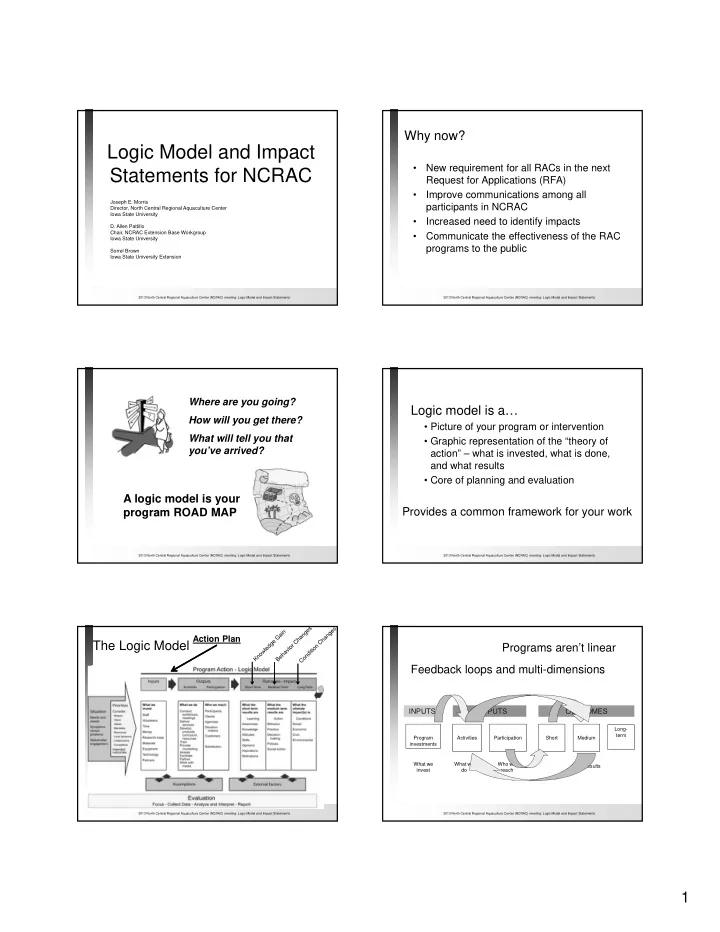
Logic Model and Impact New requirement for all RACs in the next - - PDF document

logic model and impact
SMART_READER_LITE
LIVE PREVIEW

Logic Model and Impact New requirement for all RACs in the next - - PDF document

Why now? Logic Model and Impact New requirement for all RACs in the next Statements for NCRAC Request for Applications (RFA) Improve communications among all Joseph E. Morris participants in NCRAC Director, North Central Regional


slide-1
SLIDE 1

1

University of Wisconsin - Extension, Cooperative Extension, Program Development and Evaluation 2013 North Central Regional Aquaculture Center (NCRAC) meeting: Logic Model and Impact Statements

Logic Model and Impact Statements for NCRAC

Joseph E. Morris Director, North Central Regional Aquaculture Center Iowa State University

  • D. Allen Pattillo

Chair, NCRAC Extension Base Workgroup Iowa State University Sorrel Brown Iowa State University Extension

University of Wisconsin - Extension, Cooperative Extension, Program Development and Evaluation 2013 North Central Regional Aquaculture Center (NCRAC) meeting: Logic Model and Impact Statements

Why now?

  • New requirement for all RACs in the next

Request for Applications (RFA)

  • Improve communications among all

participants in NCRAC

  • Increased need to identify impacts
  • Communicate the effectiveness of the RAC

programs to the public

University of Wisconsin - Extension, Cooperative Extension, Program Development and Evaluation 2013 North Central Regional Aquaculture Center (NCRAC) meeting: Logic Model and Impact Statements

A logic model is your program ROAD MAP

Where are you going? How will you get there? What will tell you that you’ve arrived?

University of Wisconsin - Extension, Cooperative Extension, Program Development and Evaluation 2013 North Central Regional Aquaculture Center (NCRAC) meeting: Logic Model and Impact Statements

Logic model is a…

  • Picture of your program or intervention
  • Graphic representation of the “theory of

action” – what is invested, what is done, and what results

  • Core of planning and evaluation

Provides a common framework for your work

University of Wisconsin - Extension, Cooperative Extension, Program Development and Evaluation 2013 North Central Regional Aquaculture Center (NCRAC) meeting: Logic Model and Impact Statements

The Logic Model

Action Plan

University of Wisconsin - Extension, Cooperative Extension, Program Development and Evaluation 2013 North Central Regional Aquaculture Center (NCRAC) meeting: Logic Model and Impact Statements

INPUTS OUTPUTS OUTCOMES

Program investments Activities Participation Short Medium What we invest What we do Who we reach What results Long- term

Programs aren’t linear Feedback loops and multi-dimensions

slide-2
SLIDE 2

2

University of Wisconsin - Extension, Cooperative Extension, Program Development and Evaluation 2013 North Central Regional Aquaculture Center (NCRAC) meeting: Logic Model and Impact Statements

Constructing logic models Begin with the end in mind… Build them from right to left

  • That way even if you don’t finish you have the

information for impact statements for every project

Build them for all your projects Build them before the project begins

  • That way you get the data you need

Re-evaluate over time

University of Wisconsin - Extension, Cooperative Extension, Program Development and Evaluation 2013 North Central Regional Aquaculture Center (NCRAC) meeting: Logic Model and Impact Statements

Summary View

INPUTS OUTPUTS OUTCOMES

Investments

What we put into the program to develop it

Activities

How we structure

  • ur

educational program

Participation

Who makes up the target audience for our activities?

Short

What will

  • ur target

audience learn?

Medium

What actions will they take as a result of

  • ur

program?

Long

What conditions will change as a result?

THE DIFFERENCE IS IN THE OUTCOMES

University of Wisconsin - Extension, Cooperative Extension, Program Development and Evaluation 2013 North Central Regional Aquaculture Center (NCRAC) meeting: Logic Model and Impact Statements

Cost-effective, alternative protein diets for rainbow trout that support optimal growth, health and product quality

OBJECTIVES: Our long-term goals are to (1) Develop cost effective alternative ingredient diet formulations that support maximal growth, health and product quality (2) Increase utilization of alternative ingredients in trout feeds by educating feed manufacturers regarding amino acid availabilities and retention efficiencies of synthetic amino acids.

University of Wisconsin - Extension, Cooperative Extension, Program Development and Evaluation 2013 North Central Regional Aquaculture Center (NCRAC) meeting: Logic Model and Impact Statements

Cost-effective, alternative protein diets for rainbow trout that support optimal growth, health and product quality

Toward these ends, our three-year goals are to (1) Identify commercially available alternate ingredient combinations that can meet the production needs of rainbow trout (2) Reduce interactive growth depressions when novel combinations of ingredients are utilized by refining amino acid balance. (3) Determine how formulations in fish grown to market size influence growth, fish health, product quality and consumer acceptance. (4) Meet stakeholders educational needs (which are?) through the development of an integrated outreach program including at least one WRAC Extension publication.

University of Wisconsin - Extension, Cooperative Extension, Program Development and Evaluation 2013 North Central Regional Aquaculture Center (NCRAC) meeting: Logic Model and Impact Statements

Action Plan Example

University of Wisconsin - Extension, Cooperative Extension, Program Development and Evaluation 2013 North Central Regional Aquaculture Center (NCRAC) meeting: Logic Model and Impact Statements

Proposed future RAC Proposal Guidelines

Are the following Outreach elements included and clearly identified?

❑ Outreach Representative within the NCR identified and consulted in the preparation of the Full Proposal?

For each Objective are the following identified:

❑ Target Audiences: Who will benefit from receiving project information ❑ Intended Learning Outcomes: What will be learned from this objective ❑ Intended Management and/or Behavioral Outcomes ❑ Procedures to Achieve Intended Outcomes

  • Inputs: Who will do what and at what cost?
  • Outputs: What products will be developed and at what cost?
  • What publications, workshops, demonstrations, etc., will be developed?

❑ Evaluation Plan

slide-3
SLIDE 3

3

The Importance of Impact Statements and How to Write Them

University of Wisconsin - Extension, Cooperative Extension, Program Development and Evaluation 2013 North Central Regional Aquaculture Center (NCRAC) meeting: Logic Model and Impact Statements

What’s all the fuss?

  • Cooperative Extension published a guide on

how to write useful impact statements in 1971

  • Fewer and fewer Americans involved in

production agriculture

  • This means that fewer and fewer legislators

have constituents in production agriculture

  • This means that public funding, both state

and federal, for the land-grant system is harder and harder to come by

University of Wisconsin - Extension, Cooperative Extension, Program Development and Evaluation 2013 North Central Regional Aquaculture Center (NCRAC) meeting: Logic Model and Impact Statements

What do we want?

Clearly defined changes as a direct result

  • f the research and extension projects

funded

  • Water saved
  • Reduction in pollution / carbon footprint
  • Human and ecosystem health benefits
  • bserved
  • Dollars saved / increased profit
  • Jobs created, etc…

University of Wisconsin - Extension, Cooperative Extension, Program Development and Evaluation 2013 North Central Regional Aquaculture Center (NCRAC) meeting: Logic Model and Impact Statements

How do we get there?

  • Water usage given researched methods
  • Chemical composition of effluents
  • Dollars and miles saved from locally sourced

products to markets

  • Comparison of BMPs used in research to

conventional methods, and resulting changes

  • Estimate increases in production, decreases in

fixed and variable costs, and acceptance of new procedures

  • Direct contact with fish farmers and monitoring

aquaculture unit license changes through state natural resource agencies

University of Wisconsin - Extension, Cooperative Extension, Program Development and Evaluation 2013 North Central Regional Aquaculture Center (NCRAC) meeting: Logic Model and Impact Statements

Tools for Creating Impact Statements

  • Surveys
  • SurveyMonkey
  • State aquaculture records
  • Agriculture census
  • USGS monitoring stations
  • Effluents

University of Wisconsin - Extension, Cooperative Extension, Program Development and Evaluation 2013 North Central Regional Aquaculture Center (NCRAC) meeting: Logic Model and Impact Statements

Tools for Creating Impact Statements

  • MarketMaker
  • Change in suppliers and retailers
  • Aquaculture community changes
  • Feed suppliers
  • Aquaculture associations
  • Fish processor
slide-4
SLIDE 4

4

University of Wisconsin - Extension, Cooperative Extension, Program Development and Evaluation 2013 North Central Regional Aquaculture Center (NCRAC) meeting: Logic Model and Impact Statements

Now that you’re convinced …

Writing good impact statements begins with having good logic model (stop rolling your eyes).

University of Wisconsin - Extension, Cooperative Extension, Program Development and Evaluation 2013 North Central Regional Aquaculture Center (NCRAC) meeting: Logic Model and Impact Statements

Make your message obvious

Version 1: for professional colleagues Version 2: for traditional stakeholders Version 3: for decision makers and the general public

University of Wisconsin - Extension, Cooperative Extension, Program Development and Evaluation 2013 North Central Regional Aquaculture Center (NCRAC) meeting: Logic Model and Impact Statements

Poor Impact Statement

The outputs of this project are expected to provide enhanced pest and disease scouting protocols, more rapid diagnostic confirmation, and more timely pest management strategies for implementation by growers throughout the United States.

University of Wisconsin - Extension, Cooperative Extension, Program Development and Evaluation 2013 North Central Regional Aquaculture Center (NCRAC) meeting: Logic Model and Impact Statements

Decent impact statement

By improving ornamental irrigation efficiency by 50%, we can save more than 42 gallons of water per person for each of the 310 million people in the US each year. This will help conserve the nation’s water resources.

Improved version

This project will save over 13 billion gallons of water per year or enough for the water needs

  • f over a half million people for an entire year.

University of Wisconsin - Extension, Cooperative Extension, Program Development and Evaluation 2013 North Central Regional Aquaculture Center (NCRAC) meeting: Logic Model and Impact Statements

Effective Impact Statements

Provide quantifiable evidence of change or difference the program made—money, health, environment, jobs) Give other evidence, e.g., trends, expectations, anecdotes, logical inference Realistically project potential benefit for work in progress or work whose impact is more long term Provide only enough detail to be easily understood Highlight public benefits, outcomes, payoffs

University of Wisconsin - Extension, Cooperative Extension, Program Development and Evaluation 2013 North Central Regional Aquaculture Center (NCRAC) meeting: Logic Model and Impact Statements

An Impact statement is NOT

Numbers of people reached, meetings held, acres served—these provide context, but don’t capture the element of change essential to a good impact

A list of grants, honors, recognition for organizers A detailed description of the process or what’s been done A long, detailed report Just more paperwork

slide-5
SLIDE 5

5

University of Wisconsin - Extension, Cooperative Extension, Program Development and Evaluation 2013 North Central Regional Aquaculture Center (NCRAC) meeting: Logic Model and Impact Statements

Final Thoughts

Goal for these changes is to improve communications among all participants in the NCRAC community while also assuring future funding opportunities.

University of Wisconsin - Extension, Cooperative Extension, Program Development and Evaluation 2013 North Central Regional Aquaculture Center (NCRAC) meeting: Logic Model and Impact Statements

Credits (used in part for this presentation)

Used in part for this presentation -

  • Ellen Taylor-Powel (University of Wisconsin Cooperative

Extension) “Logic Models to Enhance Program Performance”

  • Don Webster (University of Maryland Extension, Extension)

“Outreach and Public Relations: The Difference is in the Outcome”

  • USDA-NIFA “The Importance of Impact Statements and How

to Write Them”