LOCAL COMMITTEE FOR BARROW Paper No. 28 th February 2005 Meeting - - PDF document

local committee for barrow paper no 28 th february 2005
SMART_READER_LITE
LIVE PREVIEW

LOCAL COMMITTEE FOR BARROW Paper No. 28 th February 2005 Meeting - - PDF document

LOCAL COMMITTEE FOR BARROW Paper No. 28 th February 2005 Meeting date: From: CORPORATE DIRECTOR OF 21 COMMUNITY, ECONOMY & ENVIRONMENT B ARROW & DISTRICT COUNCIL FOR VOLUNTARY SERVICE E XECUTIVE S UMMARY 1.0 This report gives an


slide-1
SLIDE 1

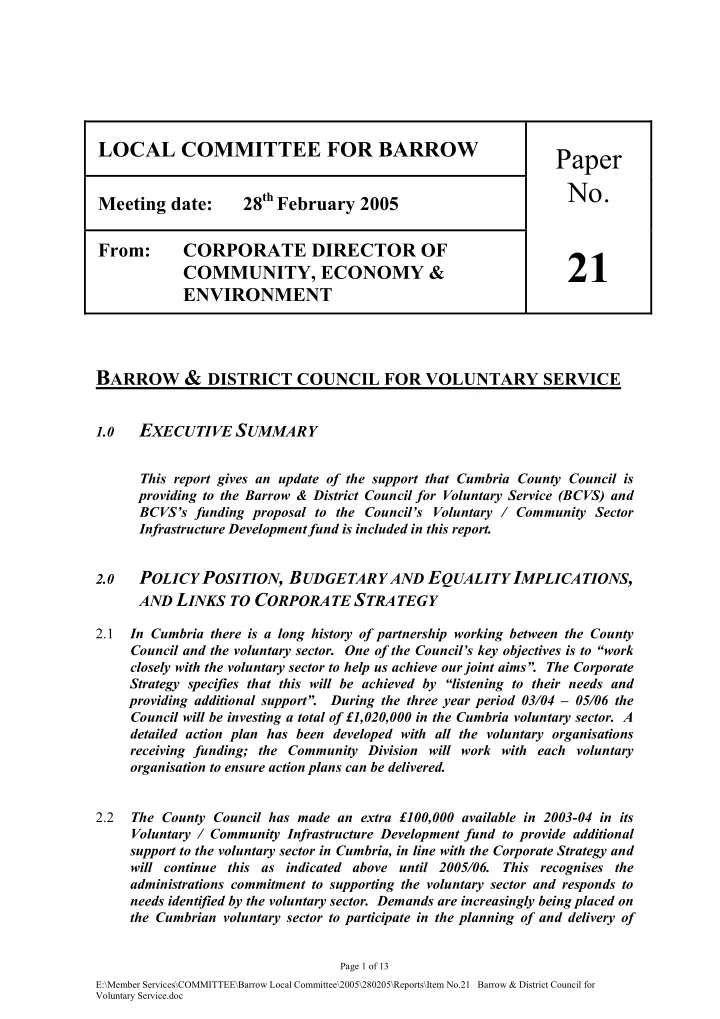
LOCAL COMMITTEE FOR BARROW

Meeting date: 28th February 2005 From: CORPORATE DIRECTOR OF COMMUNITY, ECONOMY & ENVIRONMENT

Paper No.

21

BARROW & DISTRICT COUNCIL FOR VOLUNTARY SERVICE

1.0

EXECUTIVE SUMMARY

This report gives an update of the support that Cumbria County Council is providing to the Barrow & District Council for Voluntary Service (BCVS) and BCVS’s funding proposal to the Council’s Voluntary / Community Sector Infrastructure Development fund is included in this report. 2.0

POLICY POSITION, BUDGETARY AND EQUALITY IMPLICATIONS,

AND LINKS TO CORPORATE STRATEGY

2.1 In Cumbria there is a long history of partnership working between the County Council and the voluntary sector. One of the Council’s key objectives is to “work closely with the voluntary sector to help us achieve our joint aims”. The Corporate Strategy specifies that this will be achieved by “listening to their needs and providing additional support”. During the three year period 03/04 – 05/06 the Council will be investing a total of £1,020,000 in the Cumbria voluntary sector. A detailed action plan has been developed with all the voluntary organisations receiving funding; the Community Division will work with each voluntary

  • rganisation to ensure action plans can be delivered.

2.2 The County Council has made an extra £100,000 available in 2003-04 in its Voluntary / Community Infrastructure Development fund to provide additional support to the voluntary sector in Cumbria, in line with the Corporate Strategy and will continue this as indicated above until 2005/06. This recognises the administrations commitment to supporting the voluntary sector and responds to needs identified by the voluntary sector. Demands are increasingly being placed on the Cumbrian voluntary sector to participate in the planning of and delivery of

Page 1 of 13 E:\Member Services\COMMITTEE\Barrow Local Committee\2005\280205\Reports\Item No.21 Barrow & District Council for Voluntary Service.doc

slide-2
SLIDE 2
  • services. The administration recognises that the voluntary sector needs to be

supported and developed to be able to carry out this role successfully. 2.3 The services delivered by BCVS are available to all. This project will continue to improve accessibility of those services. 3.0

RECOMMENDATION

3.1 Members note the information provided, about the support Cumbria County Council provides to BCVS. 4.0

BACKGROUND

4.1 Cumbria County Council provides financial support to BCVS through a three year contract (April 2003 – March 2006). CVASL receives £34,515 per year plus inflation, in long term core funding, (£106,153 over the next 3 years). 4.2 The County Council made £100,000 available in 2003-04 to provide additional support to the voluntary sector in Cumbria through its Voluntary / Community sector Infrastructure development fund. BCVS is eligible to submit bids to the fund

  • f up to £10,000 a year for a project that can last for a maximum of three years.

4.3 BCVS submitted a one year proposal; the project cost £9850 and to run from April 2004 – March 2005. The proposal was to set up three Action Learning sets of 6 – 8 people with similar roles in different organisations, Chief Officers, Volunteer Coordinators and Trustees. Benefits to individuals and organisations include mutual support and learning from each other, chance to offload/share experiences, extending networking opportunities, good introduction to advanced learning, strong relationships and networks are developed which are sustainable beyond the life of the programme. 4.4 BCVS has now submitted a two year follow on proposal; the project will cost £31,300 and run from April 2005 – March 2007. The proposal is to further develop the project to offer opportunities to a wider range of organisations and individuals. 5.0

OPTIONS

5.1 Comments on the BCVS bid for additional funding from the Council’s Voluntary / Community sector Infrastructure Development fund may or may not be made. 6.0

CONCLUSION

6.1 The Corporate Director – C,E&E (Ralph Howard) will take Local Committee’s views into consideration when using his delegated powers to consider this grant application expenditure in consultation with the Cabinet portfolio holder (Mike Ash).

Page 2 of 13 E:\Member Services\COMMITTEE\Barrow Local Committee\2005\280205\Reports\Item No.21 Barrow & District Council for Voluntary Service.doc

slide-3
SLIDE 3

Georgina Ternent Programme Manager–Voluntary&Parish Sector, Community,Economy&Environment 14th January 2005

Please ensure that every part of this section where there is an asterisk* is completed in accordance with the instructions before sending the report to Member Services, following which please delete this sentence.

APPENDICES

  • 1. Barrow & District Council for Voluntary Service – Action Learning Sets Project

Proposal

  • 2. Barrow & District Council for Voluntary Service – Action Learning Skills for Life

IMPLICATIONS Staffing: None Financial: Voluntary/Community Sector Infrastructure Development fund. 2005-06 £10,000, 2006-07 £10,000 Electoral Division(s): Dalton North, Dalton South, Hawcoat, Hindpool, Newbarns, Old Barns, Ormsgill, Parkside, Risedale, Roosecote, Walney North, Walney South Executive Decision

No

Key Decision

No*

If a Key Decision, is the proposal published in the current Forward Plan?

N/A*

Is the decision exempt from call-in on grounds of urgency?

No* N/A*

If exempt from call-in, has the agreement of the Chair of the relevant Overview and Scrutiny Committee been sought or obtained?

N.B. If an executive decision is made, then a decision cannot be implemented until the expiry of the eighth working day after the date of the meeting - unless the decision is urgent and exempt from call-in and the Head of Member Services has obtained the necessary approvals.

PREVIOUS RELEVANT COUNCIL OR EXECUTIVE DECISIONS [including Local Committees] Local Committee for Barrow 27th January 2004 BACKGROUND PAPERS The following information is available from Georgina Ternent on request:

Page 3 of 13 E:\Member Services\COMMITTEE\Barrow Local Committee\2005\280205\Reports\Item No.21 Barrow & District Council for Voluntary Service.doc

slide-4
SLIDE 4
  • Voluntary / Community sector Infrastructure Development fund: guidance notes for

use of fund 2003/04;

[Where reports concern Invest to Save and Improve projects, relevant papers for the Invest to Save and Improve Working Group should be listed as background papers. However, where such reports contain exempt information, this should also be noted here]

RESPONSIBLE CABINET MEMBER Mike Ash, Voluntary and Community Portfolio holder Contact: Georgina Ternent, 01768 242365, georgina.ternent@cumbriacc.gov.uk

Page 4 of 13 E:\Member Services\COMMITTEE\Barrow Local Committee\2005\280205\Reports\Item No.21 Barrow & District Council for Voluntary Service.doc

slide-5
SLIDE 5

APPENDIX 1

BARROW COUNCIL FOR VOLUNTARY SERVICE – PROJECT PROPOSAL Project Aim

To provide support to a wider range of individuals and organisations in the Voluntary & Community sector in the Barrow-in-Furness area by further developing the Actions Learning Sets Project, funded by Cumbria County Council’s Infrastructure Development Fund in 2004/05. This project aims to use the successful methodologies of the existing Action Learning project and use lessons learnt to improve the performance of the project as a whole. By supporting individuals’ needs the project highlights the organisations needs, which can then be addressed by the wider Barrow CVS Organisational Development Project. This report gives details of the project’s progress to January 2005 and requests continued support for 2005/06 and 2006/07

Objectives

The project will support the overall capacity of Barrow CVS to provide capacity building to voluntary organisations. It will achieve this by:

  • Continuing to provide a programme of Action Learning Sets for Chief

Officers/Managers, Managers of Volunteers, and Trustees.

  • Developing and promoting a new programme of Action Learning Sets which

focus on recruiting Information Officers, Advice and Guidance Workers, Administrative/Finance Workers in the VCS.

  • Using the lessons learned from the first year of this project to improve the

recruitment and retention of individual learners.

  • Extending the ability for VCS organisations to become more sustainable in

their funding strategies by setting up an Action Learning Set around a single ‘issue’, for example, Sustainable Funding. This will recruit from, and build upon the April 2005 Barrow ‘Sustainable Funding’ conference event being

  • rganised by Barrow CVS in partnership with the National Council for

Voluntary Organisations (NCVO)

Detail

Action Learning Sets are one discrete activity delivered within a much larger project

  • f Organisation Development for Voluntary and Community Organisations in

Barrow-in-Furness. Three Action Learning sets have been organised for different professional groups namely, Chief Officers, Volunteer Co-Coordinators and Trustees.

Page 5 of 13 E:\Member Services\COMMITTEE\Barrow Local Committee\2005\280205\Reports\Item No.21 Barrow & District Council for Voluntary Service.doc

slide-6
SLIDE 6

Organisations represented: Furness Carers Association STEPS Dalton Community Association Busy Bees Nursery Abbotsvale Community Association CADAS (exFDAC) WRVS Age Concern – Barrow CAF Barrow CAB Askham & Ireleth Dreamscheme Salvation Army Resolve Mediation Sure Start Basement Bar Barrow CVS BDDA Each set consists of 6 sessions, arranged at the convenience of delegates with the facilitator Margaret Siverns. (See Appendix 2 Action Learning skills for life for more information about Action Learning and the process it entails) The Chief Officer Set has held two sessions and the third is due to take place on January 27th2005. The first of these sessions was well attended with 6 people; however the second session had only three people. This was due to sickness and last minute commitments before the Christmas break. There has not been any formal feedback on evaluation forms as yet; these will be given to delegates after the third session. However, to quote feedback received from Christine Killip, Busy Bees Nursery, “The Chief Officers Active Learning Set was brilliant I have tried things that were suggested and they worked well”. The Volunteer Coordinators set has had one session, however again due to timing and staffing issues in participants’ organisations only three people out of 6 attended. Two people who were due to participate withdrew after discussion with their line managers, and one individual was not able to make the first session due to work pressures. Further participants have been recruited to take up the vacant places in this set, and the next session will take place on 25th January 2005 and the third session is scheduled for 15th February. The Trustee set has not yet taken place and the first session for this set is due to commence on 29th January 2005 with further dates being set with the agreement of the participants. Detailed monitoring will be in place to evaluate and review target outputs at six monthly review meetings.

Barriers to Participation and Initial Evaluation

There has been some ‘fall out’ of participants. Reasons stated are ‘pressure of work’ and line managers suggesting that it is not a priority for their staff member at

Page 6 of 13 E:\Member Services\COMMITTEE\Barrow Local Committee\2005\280205\Reports\Item No.21 Barrow & District Council for Voluntary Service.doc

slide-7
SLIDE 7

this time. This could mean the organisation has too much work to release their staff

  • r, more worryingly, it could mean that training is not seen as necessary or
  • desirable. Informal feedback (unfortunately non-attributable) from some staff of

smaller organisations suggests that Committee Members employ someone who they think can do the work and therefore there is no need for further training. From Chief Officers/Managers the feedback so far is that they see their own training and support as subservient to the immediate needs of their organisation. Often cancelling at short notice, their non-attendance is inevitably due to ‘pressure of work’, no time, a sudden crisis, funding bid to get in by a deadline etc. There is much work to be done to achieve a change from the culture of fire-fighting to one of longer term strategic planning and development in Voluntary and Community Organisations. The Organisation Development Officer works with VCS organisations to support them in their development and improvement. With the current focus of funders being to measure ‘outcomes’, the OD Officer is undertaking ‘Quality and Outcomes’ training in order to cascade the knowledge down to local VCS organisations. This will help VCS organisations to identify for themselves where their internal systems (including supporting and training their own staff and volunteers) are not robust enough to deliver the quality and effective outcomes required to secure future funding. Those Managers who have attended each Action Learning session have found them to be ‘excellent’ and of great benefit. This welcome feedback can now be used to attract commitment from other participants.

Sustainability of Networks Created

It is still early days for each of the sets and attendees will have the opportunity to build supportive, lasting relationships with their fellow participants. This will be monitored and the wider Organisational Development Project is now in a position to continue to support informal networks as they develop.

Future Plans

It is intended to continue with a rolling programme of Action Learning Sets for different groups of participants. Participants will continue to be recruited through CVS advertising and increasingly, word of mouth from past participants. Good stories are an excellent advertisement but take time to build up. Cumbria Voluntary Sector Training Unit will promote the Barrow CVS Action Learning Sets as a progression for Barrow area participants on their Management Development Training course.

Page 7 of 13 E:\Member Services\COMMITTEE\Barrow Local Committee\2005\280205\Reports\Item No.21 Barrow & District Council for Voluntary Service.doc

slide-8
SLIDE 8

It is intended to pilot a set with a single-issue focus. Feedback suggests that managers and staff who find it difficult to justify the time away from their desks for their own development may prefer to focus on one particular issue. Barrow CVS has secured the services of National Council for Voluntary Organisations (NCVO) Sustainable Funding Project to present a conference and workshops on Sustainable Funding for Voluntary and Community Organisations on 7 April 2005 at the Abbey House Hotel. This event will enable 35 – 50 participants from VCS organisations to learn more about developing a sustainable future for their organisations that less is reliant on short term grant funding. This will include more information and discussion of Futurebuilders. Following the event it is proposed to set up 2 Action Learning sets around the issue

  • f sustainable funding. A different facilitator will be recruited with skills in this

particular field.

Targets for 2005/06: Promotion of Project

March 2005 Advertising Conference in Focus/FCN Newsletters members Trustees Mailshot April 2005 Focus Newsletter article (Action Learning Skills for Life at appendix 2) May05 – March06 Promotion in Focus Newsletter April/July/Oct/Jan Advert in FCN weekly bulletin Sept 2005 1st Formal Evaluation Nov 2005/Feb 06 Publicise success as case studies Ongoing County Training Unit promotion/brochure

Events

April 05 Conference Event Barrow CVS/NCVO Sustainable Funding May – October 05 2 x Sustainable Funding Action Learning Sets/Networks (recruit 8 participants to each) Information and Advice Officers, Administrative and Finance Officers Action Learning Sets (min 2 sets x 6 participants x 6 meetings) Nov 05 – March 06 2 x Sustainable Funding Action Learning Sets/Networks (recruit 8 participants to each) Further Support ongoing As necessary to support developing networks (i.e. arranging meeting rooms/catering, speakers etc.)

Targets for 2006/07:

Page 8 of 13 E:\Member Services\COMMITTEE\Barrow Local Committee\2005\280205\Reports\Item No.21 Barrow & District Council for Voluntary Service.doc

slide-9
SLIDE 9

Promotion of Project

April 2006 Focus Newsletter article May 06 – March 07 Promotion in Focus Newsletter April/July/Oct/Jan Advert in FCN weekly bulletin Sept 2006 2nd (Full) Evaluation Ongoing Publicise success as case studies Ongoing County Training Unit promotion/brochure

Events

April – October 2006 3 x sets COs/Managers, Information and Advice Officers, Administrative and Finance Officers (6 Participants x 6 meetings each) June – November 2006 2 x sets Sustainable Funding Sets (8 participants x 6 meetings each) Sept 06 – Feb 07 3 x sets Trustees (6 participants x 6 meetings each). Sets to be held evenings/weekends if necessary Further Support ongoing As necessary to support developing networks (i.e. arranging meeting rooms/catering, speakers etc.)

Conclusion

It is early days yet for the Action Learning Set Project. There is some early success and positive feedback. Some barriers to participation have been identified. A strategy to assist in overcoming those barriers has been identified. A major success has been contributing to and supporting the draw down of a wider funding package. There is much more work to be done through the Organisational Development Project in promoting and building a commitment to training and support of the VCS workforce by organisations Committee Members and line managers.

Evaluation

An external evaluation will be commissioned to take place in September 2005 and again in September 2006.

Proposal

It is proposed that this project will continue and form part of the comprehensive Barrow CVS Organisational Development Service, employing 1 member of staff plus administrative support.

Timescale

Page 9 of 13 E:\Member Services\COMMITTEE\Barrow Local Committee\2005\280205\Reports\Item No.21 Barrow & District Council for Voluntary Service.doc

slide-10
SLIDE 10

Project to continue 2005/06 and 2006/07

Budget Year 2005/06

Budget Item Cost Requested from CCC Contribution from ERDF/NR Facilitators fees 5000 5000 Admin costs

  • incl. project Stny/Mats

5200 5200 Promotion/postage 2000 2000 Room hire/refreshments Including 7 April 2005 Conference costs 3000 3000 Evaluation 750 750 B/Fwd from 04/05

Budget Year 2006/07

Budget Item Cost Requested from CCC Contribution from ERDF/NRF Facilitators fees 5300 5300 Admin costs

  • incl. project Stny/Mats

5350 5350 Promotion/postage 2000 2000 Room hire/refreshments 1950 1950 Evaluation 750 750

Page 10 of 13 E:\Member Services\COMMITTEE\Barrow Local Committee\2005\280205\Reports\Item No.21 Barrow & District Council for Voluntary Service.doc

slide-11
SLIDE 11

APPENDIX 2

Action Learning skills for life

Listening Many of the participants in Action Learning comment that being listened to is one of the things they value the most. In Action Learning every participant has an

  • pportunity, as presenter, to talk about an issue they wish to raise in a safe and

uninterruptible space. Many people find describing the issue to others helps them to gain clarity. The rest of the set, as supporters, listen actively to gain a rounded view

  • f the problem and the presenter. This process helps to build the self-esteem and

levels of confidence of the presenter by demonstrating that people are interested in them, leading, over time, to the development of greater rapport, trust and empathy. As the supporters enhance their listening skills, they are able to pick up on hidden agendas, feelings and common themes. They can then formulate powerful questions that will help the presenter to move forward. Indeed some Action Learning participants describe listening as the first step to problem solving. Tips on good listening

  • Maintain eye contact and open body language
  • Check if you are unclear about what someone is saying
  • Try visualising what the person is describing
  • Pay attention to tone and emphasis not just the words
  • Focus on what is being said rather than your internal thoughts
  • Listen without judgements or assumptions

Questioning This is the skill that marks Action Learning out from other networking and support

  • systems. Supporters ask questions to help the presenter to find their own solutions

and offer challenging new perspectives, rather than jumping in with advice and

  • information. The set explores the issue presented and potential action points

through structured discussion. Sometimes questions assist the presenter to identify the ‘real’ issue or to approach it in a different way. Although questioning may seem straightforward, newcomers to Action Learning often find it a difficult skill to master. Perhaps we are so used to giving advice that it proves quite a challenge to allow people to develop their own answers. Tips on good questioning

  • Be sure of your motives for asking the question before you ask it
  • Use open questions for exploration and closed ones to gather facts
  • Avoid leading questions that suggest the answer you wish to receive

Page 11 of 13 E:\Member Services\COMMITTEE\Barrow Local Committee\2005\280205\Reports\Item No.21 Barrow & District Council for Voluntary Service.doc

slide-12
SLIDE 12
  • Allow the presenter the time and space to formulate their answer
  • Avoid multiple questions which confuse the presenter
  • Use caution when using ‘why?’ questions as these can intimidate

Questioning skills develop with practice. As levels of trust increase, set members can move into a degree of challenge. Challenging When challenging works well, it encourages the presenter to stop and think about things from different angles and reflect upon whether their actions were justifiable. It can also highlight the personal baggage that the presenter brings to a given

  • situation. This can lead to deep learning if the presenter is ready for a high level of

self-awareness. Presenters can be surprised to find others do not share their view

  • f a problem, which may lead them to consider alternatives.

Challenging is an important skill that requires careful use as it can cause offence and upset – it is a good argument for having a trained facilitator in place for the first few set meetings. Tips on good challenging

  • Ensure the presenter knows that you are being supportive
  • Avoid using words like ‘should’ and ‘must’
  • Challenge behaviour and thinking, not the person
  • Point out contradictions between words and actions
  • Check that the presenter feels comfortable enough to continue
  • Ask ‘what if?’

Presenting If a presenter is to get the best from Action Learning the key is to state clearly what is required from other set members. It can also guide supporters on the extent to which the presenter wishes to be challenged. It is also important to highlight any particular roles the supporters should take on, such as recording action points. Presenting clearly helps the supporters to understand the issue sufficiently to be able to question and challenge effectively. It may help them to see the bigger picture if the presenter explains how they feel about the issue. Tips for good presenting

  • Advance preparation helps you communicate clearly and concisely
  • Sometimes it is helpful to use a flipchart to write or draw and issue
  • Be honest – masking facts or feelings leads to less learning
  • Be willing to make progress on an issue and to consider a range of options
  • Show a commitment to the action points you agree and report back on them

Page 12 of 13 E:\Member Services\COMMITTEE\Barrow Local Committee\2005\280205\Reports\Item No.21 Barrow & District Council for Voluntary Service.doc

slide-13
SLIDE 13

Page 13 of 13 E:\Member Services\COMMITTEE\Barrow Local Committee\2005\280205\Reports\Item No.21 Barrow & District Council for Voluntary Service.doc

  • be open about your part in the issue to be discussed

Action Learning is a powerful tool that can lead to individual and organisational

  • development. Your involvement can also lead to enhanced listening, questioning

and presenting skills. These skills can be used to positive effect in your workplace and in your life. Take action and pursue Action Learning now!