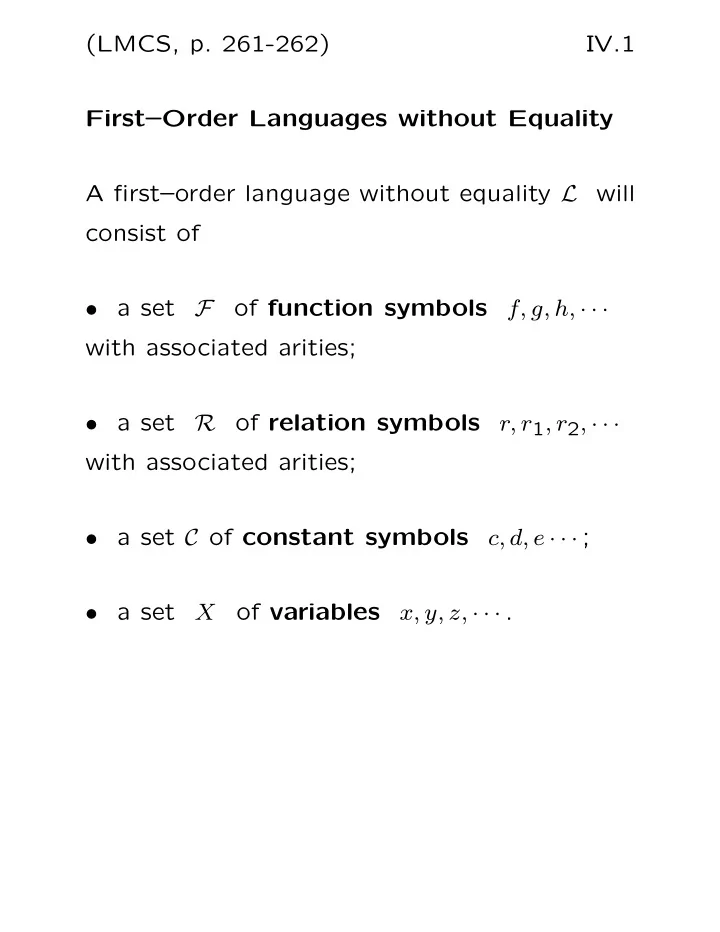
SLIDE 1 (LMCS, p. 261-262) IV.1 First–Order Languages without Equality A first–order language without equality L will consist of
F
f, g, h, · · · with associated arities;
R
r, r1, r2, · · · with associated arities;
- a set C of constant symbols
c, d, e · · · ;
X
x, y, z, · · · .
SLIDE 2
(LMCS, p. 262) IV.2 Each relation symbol r has a positive integer, called its arity, assigned to it. If the number is n, we say r is n–ary. For small n we use the same special names that we use for function symbols: unary, binary, ternary. The set L = R ∪ F ∪ C is called a first–order language. {+, ·, <, −, 0, 1} would be a natural choice of first-order language when working with the integers.
SLIDE 3 (LMCS, p. 262) IV.3 Interpretations and Structures The obvious interpretation of a relation symbol is as a relation on a set. If A is a set and n is a positive integer, then an n–ary relation r
A is a subset
An, that is, r consists of a collection of n–tuples (a1, . . . , an)
A.
SLIDE 4 (LMCS, p. 262) IV.4 An interpretation I
language L
S is a mapping with domain L such that
for each constant symbol c in C;
is an n–ary function on S for each n–ary function symbol f in F;
is an n–ary relation on S for each n–ary relation symbol r in R. An L-structure S is a pair (S, I), where I is an interpretation of L
S.
SLIDE 5
(LMCS, p. 262) IV.5 Preferred notation We prefer to write cS (or just c) for I(c) fS (or just f) for I(f) rS (or just r) for I(r) (S, F, R, C) for (S, I) Example The structure (R, +, ·, <, 0, 1), the reals with addition, multiplication, less than, and two specified constants has: F = {+, ·} R = {<} C = {0, 1}.
SLIDE 6
(LMCS, p. 263) IV.6 If r ∈ R is a unary predicate symbol, then in any L–structure S, the relation rS is a subset of S. We can picture this as:
S r
SLIDE 7 (LMCS, p. 263) IV.7 If L consists of a single binary relation symbol r, then we call an L–structure a directed graph. A small finite directed graph can be conveniently described in three different ways:
- List the ordered pairs in the relation
r. A simple example with S = {a, b, c} is r = {(a, a), (a, b), (b, c), (c, b), (c, a)}.
SLIDE 8 (LMCS, p. 263) IV.8
- Use a table. For the same example we
have r a b c a 1 1 b 1 c 1 1
(An entry of 1 in the table indicates a pair is in the relation.)
- Draw a picture. Again, using the same
example:
b c a
SLIDE 9 (LMCS, p. 263) IV.9 Example An interpretation of a language on a small set can be conveniently given by tables. Let L = {+, <} where + and < are binary. The following tables give an interpretation
L
S = {a, b}: + a b a a b b b a < a b a 1 b
SLIDE 10 (LMCS, p. 264-265) IV.10 A clause in the predicate logic uses atomic formulas instead of propositional variables.
- An atomic formula A is an expression
rt1 · · · tn , where the ti are terms, and r is an n–ary relation symbol. Examples
x < y (x + y) < (x · y) rfxgy0 where r and g are binary, f is unary.
SLIDE 11 (LMCS, p. 264-265) IV.11 Literals
an atomic formula
A
- r a negated atomic formula
¬ A Examples of literals x < y ¬ ((x + y) < (y · z)) ¬ rfxgxy An atomic formula is a positive literal. A negated atomic formula is a negative literal.
SLIDE 12 (LMCS, p. 264-265) IV.12 Clauses
- A clause C is a finite set of literals
{L1, . . . , Ln} . We also use the notation
L1 ∨ · · · ∨ Ln .
Examples of clauses: {¬ (x < y), ¬ (y < z), ¬ (x < z)} {rxx, rxg1y, ¬ rfxgyz}
SLIDE 13
(LMCS, p. 265-266) IV.13 The parsing algorithm for atomic formulas. Example r a binary relation symbol f a unary function symbol g a binary function symbol c a constant symbol Is rgxfyfc an atomic formula? If so find the two subterms t1, t2 such that rt1t2 = rgxfyfc. i 1 2 3 4 5 6 si r g x f y f c γi −1 1 1 2 ( ) ( )
SLIDE 14 (LMCS, p. 267-268) IV.14 Semantics Given a first-order structure S which tuples
a1, . . . , an make a literal
L(x1, . . . , xn)
true? If a is such a tuple for the literal L we say
a) holds (is true) in S
satisfies (models)
L(
a) and write S | = L( a). (For clauses C we have parallel concepts.)
SLIDE 15
(LMCS, p. 267-268) IV.15 The set of tuples from S that make
L(x1, . . . , xn)
true form an n-ary relation that we call LS. The set of tuples from S that make
C(x1, . . . , xn)
true form an n-ary relation that we call CS.
SLIDE 16
(LMCS, p. 268) IV.16 Example Let S be given by the tables: f a b a a a b a b r a b a 1 b Let L1 = rfxyfxx,
L2 = ¬ rfxyx, C =
{L1, L2}. A combined table for L1, L2, C is
L1 L2 C
x y fxy fxx rfxyfxx rfxyx ¬ rfxyx {rfxyfxx, ¬ rfxyx} a a a a 1 1 a b a a 1 1 b a a b 1 1 1 b b b b 1 1
SLIDE 17
(LMCS, p. 269) IV.17 Satisfiability
S |
= L(x1, . . . , xn) if for every a from S we have L( a) holds in S.
S |
= C(x1, . . . , xn) if for every choice of a from S we have
C(
a) holds in S. For S a set of clauses, we say
S |
= S provided S satisfies every clause C in S.
SLIDE 18
(LMCS, p. 269) IV.18 We say Sat(S), or S is satisfiable, if there is a structure S such that
S |
= S. If this is not the case, we say ¬ Sat(S), meaning S is not satisfiable. Predicate clause logic, like propositional clause logic, revolves around the study of not satisfiable .
SLIDE 19 (LMCS, p. 269) IV.19 Example Given two unary relation symbols r1, r2, {¬ r1x, ¬ r2x} is satisfied by a structure S iff for a ∈ S either ¬ r1a
¬ r2a holds, and this is the case iff the sets r1 and r2 are disjoint, that is, r1 ∩ r2 = Ø. We can picture this situation as follows:
S
1
r
2
r
SLIDE 20
(LMCS, p. 270) IV.20 Example Given two unary relation symbols r1, r2, {¬ r1x, r2x} is satisfied by a structure S iff the set r1 is a subset of r2. We can picture this situation as follows:
S
1
r r
2
SLIDE 21 (LMCS, p. 270) IV.21 Example Let S be a directed graph, with L = {r}.
will satisfy the clause {rxx} iff the binary relation r is reflexive.
will satisfy the clause {¬ rxx} iff the binary relation r is irreflexive.
will satisfy the clause {¬ rxy, ryx} iff the binary relation r is symmetric.
SLIDE 22 (LMCS, p. 270) IV.22
will satisfy the clause {¬ rxy, ¬ ryz, rxz} iff the binary relation r is transitive
- A graph is an irreflexive, symmetric
directed graph. Graphs are drawn without using directed edges, for example
c b e d a
SLIDE 23 (LMCS, p. 277) IV.23 The Herbrand Universe Given a first-order language L = R ∪ F ∪ C, the ground terms are terms that have no variables in them. The Herbrand Universe TC for L is the set
- f ground terms for the language
L. Example Suppose our language has a binary function symbol f and two constants 0, 1. Then the following ground terms will be in the Herbrand universe: 0, 1, f00, f01, f10, f11, f0f00, etc.
SLIDE 24 (LMCS, p. 278) IV.24 Now we create the algebra
TC
Herbrand universe TC as follows: I(c) = c I(f)(t1, . . . , tn) = ft1 · · · tn The Herbrand universe provides an analog of the two–element algebra in the propositional calculus. It provides a place to check for satisfiability.
SLIDE 25 (LMCS, p. 278) IV.25 We say that a set of clauses S is satisfiable
- ver the Herbrand universe if
it is possible to interpret the relation symbols
- n the Herbrand universe in such a way that
S becomes true in this structure. The basic theorem says that a set of clauses S is not satisfiable (in any structure) iff some finite set G
S is not satisfiable over the Herbrand universe.
SLIDE 26
(LMCS, p. 281) IV.26 To check that a finite set of ground clauses G is satisfiable over the Herbrand universe it suffices to check that G is propositionally satisfiable written p-satisfiable for short. To check that G is p-satisfiable means: consider all atomic formulas in G to be propositional variables and then check to see if the propositional clauses are satisfiable.
SLIDE 27
(LMCS, p. 281) IV.27 Example Consider the set of four ground clauses: {ra} {¬ ra, rfa} {¬ rfa, rffa} {¬ rffa} List the atomic formulas in these clauses with simple propositional variable names: atomic formula renamed ra P rfa Q rffa R The set of four ground clauses becomes {P} {¬ P, Q} {¬ Q, R} {¬ R}
SLIDE 28
(LMCS, p. 282) IV.28 Continuing with this example, we can now show that the set of three clauses {ra} {¬ rx, rfx} {¬ rffx} is not satisfiable as one has a set of ground instances {ra} {¬ ra, rfa} {¬ rfa, rffa} {¬ rffa} that is easily seen not to be p-satisfiable by the translation into {P} {¬ P, Q} {¬ Q, R} {¬ R}
SLIDE 29
(LMCS p. 284) IV.29 Substitution Given a substitution σ =
x1 ← t1 . . . xn ← tn
and a
literal L(x1, . . . , xn), we write σL, or L(t1, . . . , tn), for the result of applying the substitution σ to L. Given a clause
C = C(x1, . . . , xn) = {L1, · · · , Lk},
we write σC, or C(t1, . . . tn), for the clause {σL1, . . . , σLk}.
SLIDE 30 (LMCS p. 284) IV.30 Example Consider the clause C = {¬ rxfx, ¬ rfxy}. For σ =
y ← fgyx
we have σC = {¬ rgxfzfgxfz, ¬ rfgxfzfgyx}. Substitution Theorem If
S
is a structure and C is a clause, then for any substitution σ,
S |
= C implies
S |
= σC.
SLIDE 31
(LMCS p. 284-285) IV.31 The complement L of a literal L is defined much as it was in the propositional calculus, namely, we convert an atomic formula A to a negated atomic formula ¬ A, and vice versa. Resolution for clauses looks similar to that for propositional logic except that we can first use a substitution. If σ is applied to a clause C = {L1, . . . , Lk}, the resulting clause is σC = {σL1, . . . , σLk}. As a result of substitution, several literals may collapse into a single literal.
SLIDE 32 (LMCS p. 285) IV.32 Let C = {rxy, rxz, ¬ rzx}. Applying the substitution σ =
z ← y
σC = {rwy, rwy, ¬ ryw} = {rwy, ¬ ryw}. This gives an example where a substitution collapses three literals into two literals.
SLIDE 33 (LMCS p. 285) IV.33 An opp–unifier (opposite unifier) of a pair
- f clauses C′′, D′′ is a pair of substitutions
σ1, σ2 such that σ1C′′ = {L} σ2D′′ = {L}, where L is a literal. This says all the literals in C′′ become L under the substitution σ1, and all the literals in D′′ become L under σ2. If an opp–unifier exists, then we say the clauses are opp–unifiable.
SLIDE 34
(LMCS p. 285) IV.34 Example
C′′
= {rxfz, rxffy}
D′′
= {¬ rf0ffx} The pair σ1, σ2 given by σ1 =
x ← f0 z ← fy
and σ2 = (x ← y) gives an opp–unifier of C′′, D′′; indeed, σ1C′′ = {rf0ffy} σ2D′′ = {¬ rf0ffy}
SLIDE 35
(LMCS, p. 286 ) IV.35 Resolution For
C = C′ ∪ C′′
and
D = D′ ∪ D′′:
Resolution of Clauses
C′ ∪ C′′, D′ ∪ D′′
σ1C′ ∪ σ2D′ , where σ1, σ2 is an opp–unifier of
C′′, D′′,
i.e., σ1C′′ = {L} σ2D′′ = {L}, with L a literal and L its complement.
SLIDE 36 (LMCS, p. 286 ) IV.36 A derivation of a clause C from a set S
clauses by resolution is a sequence of clauses
C1, . . . , Cn
such that each Ci is either
S, or
- results from applying resolution to two
previous clauses in the sequence, and the last clause Cn is the clause C. We write S ⊢ C (read:
C
is derivable from S) if there is such a derivation.
SLIDE 37 (LMCS, p. 287, 293) IV.37 Theorem [J.A. Robinson 1965] Soundness and Completeness
A set S
- f clauses is not satisfiable iff
there is a derivation of the empty clause by resolution.
SLIDE 38 (LMCS, p. 286) IV.38 Example 1. {ra} given 2. {¬ rx, rfx} given 3. {¬ rffx} given 4. {¬ rfx} resolution 2,3 5. {¬ rx} resolution 2,4 6.
{ }
resolution 1,5. Step 4:
= (x ← fx) applied to (2) σ2 = (x ← x) applied to (3). Step 5:
= (x ← x) applied to (2) σ2 = (x ← x) applied to (4). Step 6:
= (x ← x) applied to (1) σ2 = (x ← a) applied to (5).
SLIDE 39
(LMCS, p. 293) IV.39 How to Find σ1 and σ2 First: Unification of pairs of literals Use the same algorithms as for pairs of terms. Example Consider rxfy and rgzyw: r r y x f g z y w ( ) x g z y y f g z y g z y r r w w f y ( )
SLIDE 40 (LMCS, p. 293) IV.40 y f g z y g z y y f r r µ = x g z y w f y The literals are unifiable, and the most general unifier is µ =
w ← fy
SLIDE 41
(LMCS, p. 297) IV.41 Example Apply the unification algorithm to the following three literals, where r is binary and f is unary: rffxfy rfyfffz rfffzffx r r f x y f f f f f f y r f f f x f z z f ( y f x)
SLIDE 42
(LMCS, p. 297) IV.42 f z f z f z f z f z µ = x f z y f f z x f x f f f f z x f r r f f r f f f f f f f f z f f f r r f f f r f f f x f z f x f z ( ) Thus the three literals are unifiable, and the most general unifier is µ.
SLIDE 43 (LMCS, p. 300-302) IV.43 Most General Opp-Unifiers If two clauses
C′′
and D′′ are opp-unifiable then it is possible to find most general
Example For r a binary relation symbol and f a unary function symbol let
C′′(x, y, z)
= {rfxfy, rzy, rfyfz}
D′′(x, y, z)
= {¬ rxfy, ¬ rfyx}. We want to analyze the unifiability of the five literals rfxfy rzy rfyfz rufv rfvu. Applying the unification algorithm for literals:
SLIDE 44
(LMCS, p. 300-302) IV.44 r f x f y r r y f f r u v r y f f y y ( ) u f v f f v u r f x f y r y r y f f z r f f v u u v r z ( ) z f y
SLIDE 45
(LMCS, p. 300-302) IV.45 x f y y f v y f y y f v v f v v y ( ) r f r r f r f r f f x f y y f y f y y f f y y y y ( ) x y
r f r r f r f r f f
SLIDE 46 (LMCS, p. 300-302) IV.46 f f y f f y y y y y y f y y y r f r r f r f r f f
NOT OPP-UNIFIABLE
Thus the clauses C′′, D′′ are not
SLIDE 47
(LMCS p. 302-303) IV.47 Another Example Now let
C′′(x, y, z)
= {rfxfy, rfyfz}
D′′(x, y, z)
= {¬ rxfy, ¬ rfyx}. We want to analyze the unifiability of the four literals: rfxfy rfyfz rufv rfvu. Applying the unification algorithm for literals:
SLIDE 48
(LMCS p. 302-303) IV.48 x f y ( ) r y v y r z r r v ( ) y y f z f v u v r f r f r f u r x f y f v f y f f f f f u f y
SLIDE 49
(LMCS p. 302-303) IV.49 r f y r f z r r f y y x f y ( ) f x y f f f y y r f r f z r f r f x x x ) ( z x x f f f f x x x
SLIDE 50
(LMCS p. 302-303) IV.50 r f x f r f f r f r f f f x x x x x x x = so µ = ( )
1 2
z x y x z x v x z x y x y x ) v y y x ) ( ( ( µ = µ = u f y) x f x u f x Thus the clauses C′′, D′′ are opp–unifiable, and the most general opp–unifier is given by µ1, µ2.
SLIDE 51 (LMCS, p. 305) IV.51 Main Theorem
Resolution Theorem Proving ( J.A. Robinson 1965) A set S
- f clauses is not satisfiable iff there
is a derivation of the empty clause by resolution using only most general
SLIDE 52 (LMCS, p. 308) IV.52 Handling Equality We will handle equality (≈) by giving some of its crucial properties stated as clauses, and then proceed to treat it like any other binary relation symbol. So let S be a set of clauses in the language L = R ∪ F ∪ C with equality. Let ≡ be a new binary relation symbol. First, we give axioms for ≡ so it behaves like equality. It will be convenient to write s ≡ t instead
¬ (s ≡ t).
SLIDE 53 (LMCS, p. 308) IV.53 Axiomatizing Equality Let Ax≡ be the set of clauses given by {x ≡ x} {x ≡ y, y ≡ x} {x ≡ y, y ≡ z, x ≡ z} {x1 ≡ y1, . . . , xn ≡ yn, f x ≡ f y} f n–ary in F {x1 ≡ y1, . . . , xn ≡ yn, ¬ r x, r y} r n–ary in R. A clause is a Horn clause if there is at most
- ne positive literal in the clause.
The clauses in Ax≡ are Horn clauses.
SLIDE 54
(LMCS, p. 309) IV.54 Example For the language L = {f, r}, where f is unary and r is binary, we can formulate Ax≡ as the five clauses {x ≡ x} {x ≡ y, y ≡ x} {x ≡ y, y ≡ z, x ≡ z} {x ≡ y, fx ≡ fy} {x1 ≡ y1, x2 ≡ y2, ¬ rx1x2, ry1y2}.
SLIDE 55 (LMCS, p. 309) IV.55 To eliminate ≈ we introduce the following:
Define the clause C≡ to be the result of replacing ≈ in C with ≡.
S of clauses: Define the set S≡
- f clauses to be the set of
C≡
for C ∈ S.
SLIDE 56 (LMCS, p. 312) IV.56 Theorem A set S
- f clauses is not satisfiable
iff the set of clauses S≡ ∪ Ax≡ is not satisfiable iff there is a derivation of the empty clause by resolution∗ from S≡ ∪ Ax≡.
∗Using only most general opp-unifiers!
SLIDE 57
(LMCS, p. 308) IV.57 Equational Arguments and Clauses Now we can adapt our work on clauses to study equational arguments. Theorem An equational argument S ∴ s ≈ t (that is, S | = s ≈ t) is valid iff ¬ Sat( S ∪ { s( c ) ≈ t( c ) } ), where c is a sequence of constant symbols that do not appear in the original argument.
SLIDE 58
(LMCS, p. 310-311) IV.58 Example We will show x · y ≈ x | = x · (y · z) ≈ (x · y) · z using clause logic. First translate the argument into the nonsatisfiability of a set of clauses: ¬ Sat( {x · y ≈ x}, {a · (b · c) ≈ (a · b) · c} ). We now want to replace the ≈ by ≡ .
SLIDE 59 (LMCS, p. 310-311) IV.59 The set S≡ ∪ Ax≡
{x · y ≡ x} {a · (b · c) ≡ (a · b) · c} {x ≡ x} {x ≡ y, y ≡ x} {x ≡ y, y ≡ z, x ≡ z} {x1 ≡ y1, x2 ≡ y2, x1 · x2 ≡ y1 · y2}. We want to show this set of clauses is not satisfiable. We can approach this two ways, via ground instances or via resolution.
SLIDE 60
(LMCS, p. 310-311) IV.60 For the ground instances method consider
Clause Ground instances {x · y ≡ x} {(a · b) · c ≡ a · b} {a · b ≡ a} {a · (b · c) ≡ a} {a · (b · c) ≡ (a · b) · c} {a · (b · c) ≡ (a · b) · c} {x ≡ y, y ≡ x} {(a · b) · c ≡ a, a ≡ (a · b) · c} {x ≡ y, y ≡ z, x ≡ z} {(a · b) · c ≡ a · b, a · b ≡ a, (a · b) · c ≡ a} {a · (b · c) ≡ a, a ≡ (a · b) · c, a · (b · c) ≡ (a · b) · c}
SLIDE 61
(LMCS, p. 310-311) IV.61 Rename the (ground) atomic formulas: P : (a · b) · c ≡ a · b Q : a · b ≡ a R : a · (b · c) ≡ a S : (a · b) · c ≡ a T : a ≡ (a · b) · c U : a · (b · c) ≡ (a · b) · c, The ground instances become {P} {Q} {R} {¬ U} {¬ S, T} {¬ P, ¬ Q, S} {¬ R, ¬ T, U}. This collection of propositional clauses is easily seen to be unsatisfiable.
SLIDE 62 (LMCS, p. 313) IV.62 And for the direct resolution method:
1. {x · y ≡ x} given 2. {a · (b · c) ≡ (a · b) · c} given 3. {x ≡ y, y ≡ x} given 4. {x ≡ y, y ≡ z, x ≡ z} given 5. {a · (b · c) ≡ y, y ≡ (a · b) · c} 2, 4 6. {a ≡ (a · b) · c} 1, 5 7. {(a · b) · c ≡ a} 3, 6 8. {(a · b) · c ≡ y, y ≡ a} 4, 7 9. {a · b ≡ a} 1, 8
1, 9.