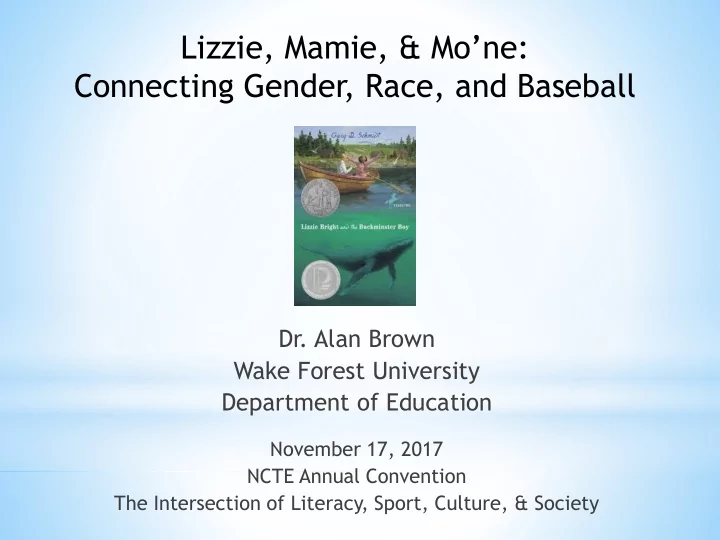
SLIDE 1
Wake Forest University Department of Education
November 17, 2017 NCTE Annual Convention The Intersection of Literacy, Sport, Culture, & Society
Lizzie, Mamie, & Mo’ne: Connecting Gender, Race, and Baseball
SLIDE 2
Hands Up Survey
✓ I like sports. ✓ Girls can do anything boys can do. ✓ Boys can do anything girls can do. ✓ Girls should be able to play sports traditionally played by boys
(e.g., baseball, football, wrestling).
✓ Boys should be able to play sports traditionally played by girls
(e.g., softball, volleyball). Pick one statement, turn to a neighbor, explain your rationale.
SLIDE 3
Audience Participation
➢ What role does baseball play in Lizzie Bright and the
Buckminster Boy?
➢ What can you tell me about Lizzie Bright Griffin? ➢ What can you tell me about Mo’ne Davis? ➢ What can you tell me about Mamie Johnson?
Reading: pp. 46-48
SLIDE 4 History of Women in Baseball
- Women’s baseball first started in the 1870s
- “Bloomer Girls” played baseball from the late 1800s into the
1930s, although men were often hired as pitchers.
Photo courtesy of the Library of Congress
SLIDE 5 Lizzie Arlington (Elizabeth Stroud)
- Pitcher for the Philadelphia Reserves in 1898
- Played one inning of minor league baseball
- Arrived in a horse-drawn carriage and wore a knee-length skirt
Photo courtesy of the Indianapolis Pharos-Tribune
SLIDE 6 Alta Weiss Hisrich
- Pitcher for the Vermilion Independents
- Played semi-professional exhibition games from 1907-1914
- Used money from baseball to pay for medical school
Photo Courtesy of Ball State University
SLIDE 7 Lizzie “Spike” Murphy (Queen of Baseball)
- Played first base from 1918-1935 for the Providence
Independents and the Boston All-Stars
- First woman to play an exhibition game for a major league team
- Sold postcards of herself between innings to make more money
Photo courtesy of Baseball Hall of Fame
SLIDE 8 Jackie Mitchell
- Pitcher for the Chattanooga Lookouts in 1931
- Played an exhibition game against the New York Yankees
- Struck out hall-of-famers Babe Ruth and Lou Gehrig
Photo courtesy of Library of Congress
SLIDE 9 Frances (Sonny) Dunlap
- Played third base for a Class D team in Fayetteville, AR, 1936
- First female to play an entire professional game
- Played in only one game
Photo courtesy of Arkansas Baseball Encyclopedia
SLIDE 10 All-American Girls Professional Baseball League 1943-1954 Rules were adapted from softball to look like baseball.
Photo courtesy of AAGPBL
Motto: “Look like women. Play like men.”
SLIDE 11 Dottie Kamenshek
- Played first base for the Rockford Peaches of the AAGPBL
- Won four league titles and led the league in hitting
- Turned down a contract with a professional team in Florida
Photo courtesy of the National Baseball Hall of Fame Library
SLIDE 12 All-American Girls Professional Baseball League 1943-1954
Title: AAGPBL https://www.youtube.com/watch?v=sHaI1djLrTs
SLIDE 13 Mamie “Peanut” Johnson
Mamie Johnson Nickname: Peanut Career: 1953-1955 Positions: P , UT Team: Indianapolis Clowns Bats: Right Throws: Right Height: 5' 4'' Weight: 120 Born: September 27, 1932, Long Branch, New Jersey
Negro Leagues Baseball Museum: Electronic Resources for Teachers https://coe.k-state.edu/annex/nlbemuseum/history/players/johnsonm.html
SLIDE 14 Mamie “Peanut” Johnson
“‘I showed up [to a AAGPBL tryout in Alexandria, VA, in the early 50s] with a friend of mine, Rita Jones,’ said Johnson. ‘They looked at me like I was crazy. They never even let me try out.’ Instead, Johnson would go on to play in the Negro Leagues -- with the
- men. She was actually one of three known women of the era to play in
the League, along with Toni Stone and Connie Morgan. Stone was the first of the three to make it. After barnstorming with minor league teams in the late 1940s, she was signed by the Indianapolis Clowns in 1953 to replace a second baseman named Hank Aaron…. ‘Truly, the incentive was to get fans,’ said Ray Doswell, curator of the Negro Leagues Museum in Kansas City. ‘But it's not like they could get just anyone off the street. They found a real athlete in Toni Stone.’ But the ace of this trio had to be Johnson. While Stone and Morgan both played second base, Johnson, who joined the Clowns as a starting pitcher in 1953, was part of the regular rotation. During three seasons, some records show Johnson with an overall 33-8 mark.”
(Silverman, MLB.com, “No League of Their Own”) http://mlb.mlb.com/mlb/history/mlb_negro_leagues_story.jsp?story=women
SLIDE 15
Mo’ne Davis
1st Little Leaguer ever on the cover of Sports Illustrated
SLIDE 16 Mo’ne Davis
- 5’4 eight grader who plays for Philadelphia’s Taney Dragons
- Inducted in baseball’s Hall of Fame at the age of 13
✓1st African American girl to play in the Little League World Series ✓ 1st girl to win a game in the Little League World Series ✓ 1st girl to throw a shutout in the Little League World Series ✓ 4th American girl to play in the Little League World Series ✓ 6th girl to collect a hit in the Little League World Series
SLIDE 17 Mo’ne Davis
Title: Sports Science Mone Davis https://www.youtube.com/watch?v=hlEg329p4Mc
SLIDE 18 Making Connections What similarities do you see between Lizzie Bright Griffin and the following baseball players?
- Lizzie Murphy
- Name: Lizzie
- Took the game of baseball seriously
- Compare 1922 All-Star Game to the reading on pp. 56-57
- Mamie “Peanut” Johnson
- Lived with her grandparents
- Grew up in a mixed-race community
- Encountered extreme racism
- Mo’ne Davis
- Age
- Played baseball with boys
- Had dreams much larger than baseball
SLIDE 19 Mo’ne Davis & Mamie “Peanut” Johnson
What would it mean for a woman to play professional baseball at the highest level?
Photo Courtesy of CNN
SLIDE 20
Lizzie Bright and the Buckminster Boy “Turner, you never can look at things straight. Look at me. No, look at me. Look at my skin. It’s black, Turner. No one in Phippsburg is going to let someone with skin as black as mine live with them. They’re not” (p. 167).
Mamie “Peanut” Johnson
SLIDE 21
Partner/Group Discussion Your task: Re-think the ending of the story. Imagine that gender, race, and class stereotypes did not exist and Lizzie had a chance to play baseball with Turner and Willis. How might all their lives have changed forever?
SLIDE 22
Hands Up/Stand Up Survey
✓ Girls can do anything boys can do. ✓ Boys can do anything girls can do. ✓ Girls should be able to play sports traditionally played by boys
(e.g., baseball, football, wrestling).
✓ Boys should be able to play sports traditionally played by girls
(e.g., softball, volleyball). Moral of the Lesson When you see someone being told he or she cannot participate, raise your hand and ask why not? If you don’t like the answer, do more than hands up: stand up.
SLIDE 23
SLIDE 24 For more resources: Alan Brown’s Sports Literacy Blog http://sportsliteracy.org/ Negro Leagues Baseball Museum: Electronic Resources for Teachers https://coe.k-state.edu/annex/nlbemuseum/resource/guide.html Questions / Comments:
Assistant Professor of English Education Wake Forest University brownma@wfu.edu