Litter picking and working on grass verges and roadsides - - PowerPoint PPT Presentation

litter picking and working on grass verges and roadsides
SMART_READER_LITE
LIVE PREVIEW

Litter picking and working on grass verges and roadsides - - PowerPoint PPT Presentation

Litter picking and working on grass verges and roadsides Streetscene Seminar Aston Villa FC - 27 Feb 2015 Alan Plom APSE Associate Trainer Current safety issues for LAs (& contractors) working roadside Relevant incidents,


slide-1
SLIDE 1

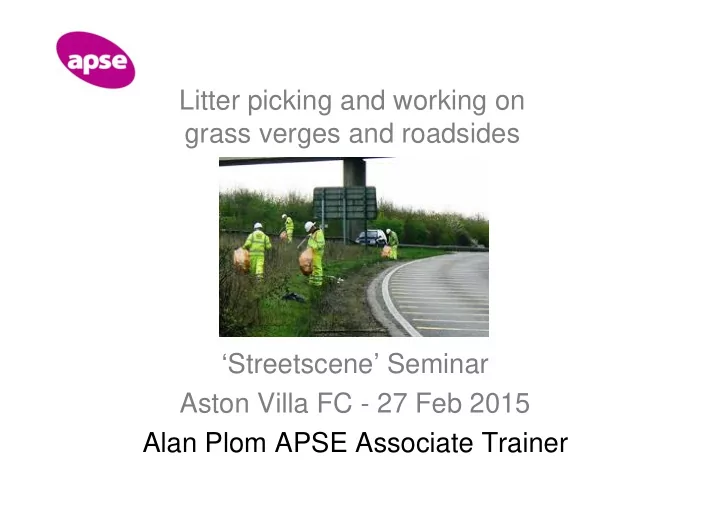
Litter picking and working on grass verges and roadsides ‘Streetscene’ Seminar Aston Villa FC - 27 Feb 2015 Alan Plom APSE Associate Trainer

slide-2
SLIDE 2

Current safety issues for LAs (& contractors) working roadside

  • Relevant incidents, prosecutions, fines and notices
  • Scope = verge maintenance, grass & hedge cutting,

slopes, litter picking, roadkill, etc;

  • Risks and hazards (mitigation and management) =

– Planning/risk assessment – signage & warnings – PPE & other precautions – training & competence - of operators + supervisors

  • Sources of advice, guidance & training
slide-3
SLIDE 3

Maintaining verges, paths, hedges & highways

slide-4
SLIDE 4

Working under extreme conditions

  • Poor visibility
  • Bad weather
  • Snow & ice
  • Fog
  • Dark,
  • Steep ground
  • Obstacles – road

signs, barriers, vegetation

slide-5
SLIDE 5

Hazards include:

  • Collision with passing vehicles = serious or fatal

injuries.

  • Slips, trips and falls (STF) – from minor cuts/bruising

to severe muscle or skeletal injuries BUT can lead to collisions.

  • (Severe) weather conditions - impact on personal

safety and the safety of others (incl. STF, driving).

  • Manual handling – musculo-skeletal injuries/’MSD’s’.
  • Violence or aggression (by animals, or their owners!).
  • Don’t forget health issues - Infections/diseases, eg

through contact with sharps, animals, plants, etc.

slide-6
SLIDE 6

Manchester case (1)

  • Manchester CC fined £15k +

~£4k costs on 24/9/14

  • 60-year-old litter picker

crossing busy 40mph speed limit road, struck by car 9/7/13.

  • Serious injuries, not worked

since, in ‘unbelievable pain’.

  • Lucky still alive - 4 broken ribs,

punctured lung, cut to liver, fractured right eye socket, fractures to face and broken pelvis – walks with stick + double vision.

  • HSE found: MCC had not

identified being struck by a car as a risk associated with litter picking work, so no signs or safe system of work in place.

  • Staff had not been given

information about controlling or informing traffic about them working on or near the road.

slide-7
SLIDE 7

Manchester case (2)

  • HSE issued Improvement Notice on MCC to review

risk assessment and control procedures [litter pickers maintain ~1,000 miles of roads].

  • MCC implemented further controls including:

– updating health and safety training [employees claimed ‘never seen’ 2012 risk assessment] – providing more signs – new monitoring and review process.

  • HSE guidance on improving safety for workers in or

near live traffic can be found at: http://www.hse.gov.uk/roadsafety/

slide-8
SLIDE 8

Manchester case (3) Chapter 8 Pt2

S15 ‘General’:

  • Crossing the carriageway on foot – “This is a

hazardous activity. It should be planned so that the location provides adequate sight lines and a place of safety at both sides of the carriageway”.

  • Car was ~2x speed limit - driver convicted of

dangerous driving.

  • Further HSE guidance: “Crossing high-speed

roads on foot during temporary traffic management works”. [Construction Information Sheet 53]

slide-9
SLIDE 9

Veolia Case (2007)

  • 20yr old agency worker killed in Kent 2/3/07.
  • Picking litter on grass verge of A228 - caged

vehicle alongside to collect the litter struck by HGV.

  • HSE: “work activity was not safe or properly

planned” & “other road users also put at risk”.

  • Veolia fined £225k + >£95K costs in Aug 2010.
slide-10
SLIDE 10

Badger kills lorry driver

  • A lorry driver died after

police slowed traffic to remove a dead badger from the A34 in Oxfordshire (Feb 2014).

  • Incident at approx 3am.
  • HGV collided with another

lorry.

  • 3 of 4 lanes closed for 9

hours while police investigated and wreckage cleared

slide-11
SLIDE 11
  • Awaiting ‘Best practice’ guidance note
  • Aimed at those responsible for design,

specification, operation, management and monitoring ‘cleansing’ operations

  • n the highway.
  • Reflects Chapter 8/Red Book advice on

safe systems of work, including use of temporary TMS.

  • BUT LAs concerned: eg varying

standards, want to clarify scope + provide reas prac solutions/scenarios.

  • Revised draft was due ~Dec 2014.

Comments being collated, now end

  • f March….

http://www.hse.gov.uk/waste/wish.htm

Waste24 “Safe highway cleansing”

slide-12
SLIDE 12

Waste 24 – Latest position LA comments/concerns

  • APSE Waste, Refuse Collection and Street Cleansing Advisory

Group + responses to LA’s Q (= variable standards used).

  • John Horton (S’oton CC) presentation on review of draft by

CASH [Hants LAs & contractors) ‘Litter Safety WG’.

  • DoT wrote to CE’s of all Highways Authorities (2/7/14):

“Red Book mandatory after 1st October 2014”.

  • Red Book (pg6): “failure to comply a criminal offence and may

lead to criminal prosecution”.

  • HSE view? Sets standards for compliance, BUT
  • Waste 24 cannot cover every scenario and LAs must base

decisions on risk assessment

  • [“Sensible Management of h&s”]
slide-13
SLIDE 13

Waste 24 ‘Tackling the compliance deficit’ (JH)

  • LAs recognise compliance may not be universal + changes

to working practices may be required

  • Key issues:

– Knowledge & awareness – Tools & equipment – Risk assessments – Budgets & resources!

  • Joint work among (CASH) members to develop new Risk

Assessments and Method Statements

  • Comments from LAs being coordinated and collated by

LAWS and CASH – to be with WISH by end of March.

  • Substantial revision likely!
slide-14
SLIDE 14

Back to basics… Protecting the public & workers Basic principles of Traffic Management:

“Will someone coming along the road or footway from any direction understand exactly what is happening and what is expected of them?”

  • New Roads and Street Works Act (NRSWA).
  • ‘Safety at Street Works and Road Works – A

CODE OF PRACTICE (most up to date revision Oct 2013)

slide-15
SLIDE 15

‘Clean Highways’ campaign

Public expectations vs legal duties?

  • Peter Silverman’s website [on BBC1 Nov 2014] – challenges

Highways Agency and LAs/Contractors re ‘need for lane closures (traffic management)’ in certain areas, eg slip roads.

  • Claims confusion - who cleans roundabouts at motorway

junctions & where roundabout verge stops and slip road verge begins + LAs ‘unaware of responsibility to clean these.

  • Claims verges at bottom of slip roads can be safely litter

picked “during rush hour when the traffic speeds are low”.

  • Also hard shoulders without lane closures (eg using blocking

vehicle, coning, or other measures to protect pickers)

  • Also set up: “Safe roadside litter picking” website –

includes useful relevant guidance (eg DfTr IAN 115/08).

  • Q: Do the statistics support this?
slide-16
SLIDE 16

Injuries in Local Authorities

HSE analysis of LA RIDDOR reports (2008/09) Employee Public All Injuries GB LA’s 9344*(68%) 4342 (32%) 13,693 ‘Top Three’ causes of injury:

  • 1. Slips, trips & falls
  • 2. Handling / sprains
  • 3. Hit by moving vehicle or object /‘Other’
  • NB. 25 deaths/227 serious injuries to ‘road

workers’ in 10 yrs (2001-10) + 8 more workers killed in last 3 years while maintaining England's road network (+ many injured). [Not known how many in Scotland or were LA staff/contractors.]

slide-17
SLIDE 17

Highways Agency’s Litter-pickers road injuries (2006-13)

  • PQ’s: In 2010 Tom Watson MP asked for details of deaths

and injuries of Highways Agency staff while litter picking + in Dec 2013 Robert Flello MP asked for same information for the last 3 years + Q for ‘HA’s contractors’:

Year Injured Nature of Injury Cause of Injury 2008 1 Bruising to chest Hit by moving vehicle on site 2009 1 Whiplash Collision between IPV & vehicle 2010 1 Whiplash Collision between IPV & vehicle 2011 1 n/k n/k 2013 1 [+1 death?] n/k n/k

slide-18
SLIDE 18

Fly-tipping

  • Fly-tipping incidents dealt

with by LAs in England jumped by 20% in 2013/14 to 852,000 – many roadside!

  • Contents (Hazards) not

known…..

slide-19
SLIDE 19

Roadkill Roadside hazards

  • HA est 40,000 collisions with deer/yr

[= 9-19 fatalities + >400 serious injuries to drivers/yr]

  • “Dynamic” risk assessments –ie at “point
  • f work”?
  • ‘Take a chance’? eg use van to protect

gang - or use mobile signs or full ‘Temp Roadworks procedure (signs, cones)?

slide-20
SLIDE 20

Remember the 5 Steps of Risk Assessment

  • 1. Identify the hazards
  • 2. Decide who might be harmed and how
  • 3. Evaluate the risks and decide what needs

doing

  • 4. Record your findings
  • 5. Review your assessment
slide-21
SLIDE 21

Risk Assessment Some examples will be described / discussed but hopefully you all agree roadside activities are potentially ‘high risk’, ie:

HIGH RISK

High risk injuries are likely to consist of: (eg) loss of consciousness, broken limbs, loss of a limb, loss of sight, burns, exposure to dangerous

  • substances. Hospital treatment, long time absence

from work, disability or fatality,

slide-22
SLIDE 22

eg Risk Assessment: Working near roads, footpaths, public areas

  • All staff trained to appropriate level.
  • PPE must be worn as per guidelines/site rules
  • At least one certificated colleague on site on public roads.
  • Banksman used to maintain pedestrian/traffic control
  • Barriers and signage to prevent access into working area by
  • ther persons (working on site or public)
  • When parked on the highway or highway verge suitable

traffic control in line with NRSWA / Chapter 8 - before starting work.

  • REMEMBER - Failure to complete adequate traffic

management can result in criminal prosecution and road traffic fines to the individual driver.

slide-23
SLIDE 23

Additional precautions to protect the public and road users when working near roads, footpaths, public areas

 Plan work to reduce effect on people and the environment,  eg scheduling work near schools (road classification?)  Barriers and signage to prevent access into working area by

  • ther persons working on site or members of the public

 Banksman used during movement of vehicles  Traffic Management Plans prepared [and used!], ie stop-go boards, traffic lights, parking suspensions, full or partial road closures, re-routing pedestrian foot paths. [‘Traffic Marshall’]  Effective communication - between team colleagues  Observational checks.

slide-24
SLIDE 24

Coordinate road work?

  • ‘Red Zones’? [eg. long grass & vegetation pose risk to litter

pickers.]

  • Eg Kent CC: “As part of high speed road programme working

with District Councils to coordinate cleansing and litter picking with our routine grass cutting and other essential maintenance”.

  • Recent response by Kent CC: “All high speed dual

carriageways = 2x/yr maintenance works involving lane closures & try to incorporate all maintenance activities including District Council cleaning teams (responsible for the street sweeping on the highway).

slide-25
SLIDE 25

Managing contractors Could this happen to you?

  • Gateshead Council fined £40k + ~£6k costs (July

2014) – failed to ensure contractor competent to fell large tree (25m poplar) in Jan 2012.

  • Tree on steep slope, fell on rail line and hit by train
  • Contractor’s penalty = 150hrs + £6k costs
  • Worker knocked unconscious when hit on head by

tree or train + fractured ankle!

  • R/A dubious/unsafe system.
  • Damage to train?
  • ~£100k !!! [+ £7k delays, etc]
slide-26
SLIDE 26

Protecting workers in the road

slide-27
SLIDE 27

Code of Practice Safety at Street Works and Road Works

  • Revised Code came into force 1 October 2014
  • CoP/Chapter 8: Traffic Management (Signing, Lighting

and Guarding) – site R/A, typical layouts, signs, equipment and working methods (for roads <50mph)

  • Specified/designed by a ‘competent (ie trained) person’

[ie ‘Traffic Management Marshall’]

slide-28
SLIDE 28

Ch 8 ‘Traffic Signs Manual’ Pt2 - Operations

  • “Although the potential consequences of an accident on

heavily-trafficked high-speed roads are more severe, the risks involved in working on lower category routes shall not be ignored.”

  • Commonly such roads will not meet current sight

distance or other design standards and in many cases the available carriageway width will be limited.

  • As temporary traffic management on high-speed roads is

a hazardous activity, the selection of the actual method

  • f work shall be made by a competent person and shall

reflect the risks and site-specific circumstances of the planned work

slide-29
SLIDE 29

National Highways Sector Scheme 18

National standards for management of ‘strategic’ road network: + vegetation and ecology + maintaining a safe environment for the road users. Contractors registered (with BALI) for:

  • New landscape works and maintenance
  • Treework and vegetation management
  • Environmental management
  • Litter

NHSS18 includes worker protection, ppe, & ‘Chapter 8’ + ‘Red Book’ (rev Oct14) http://www.ukas.com

slide-30
SLIDE 30

PPE – Hi-vis clothing

  • Suitability
  • EN 471 Class 3, or 2?
  • Maintenance
  • Worn? (All the time?)
slide-31
SLIDE 31

Training

eg ‘Toolbox Talks’ + new communication and training methods: 360-degree on-line training tools or for ‘situational awareness’?

  • nb. HSE’s Public Services Sector has worked with the

IOSH PS Industry Group to produce generic web-based guidance for LAs on procurement, etc, available on IOSH website at: www.iosh.co.uk

slide-32
SLIDE 32

What we are all trying to avoid

What next for you?

  • Review risk assessments?
  • Share ‘Good Practice’?
  • Guidance?
  • Training?

Any Questions?