Literate Programming Yaniv Lefel Hagay Pollak Part of a Course by - - PDF document

literate programming
SMART_READER_LITE
LIVE PREVIEW

Literate Programming Yaniv Lefel Hagay Pollak Part of a Course by - - PDF document

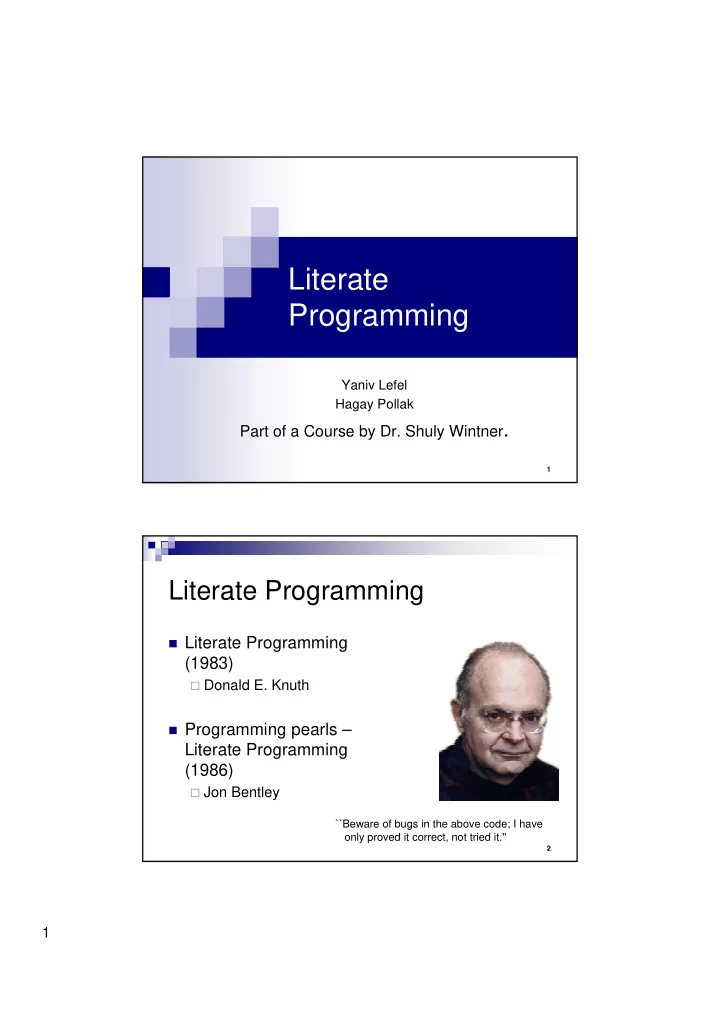
Literate Programming Yaniv Lefel Hagay Pollak Part of a Course by Dr. Shuly Wintner . 1 Literate Programming Literate Programming (1983) Donald E. Knuth Programming pearls Literate Programming (1986) Jon Bentley ``Beware


slide-1
SLIDE 1

1

1

Literate Programming

Yaniv Lefel Hagay Pollak

Part of a Course by Dr. Shuly Wintner.

2

Literate Programming

Literate Programming

(1983)

Donald E. Knuth

Programming pearls –

Literate Programming (1986)

Jon Bentley ``Beware of bugs in the above code; I have

  • nly proved it correct, not tried it.''
slide-2
SLIDE 2

2

4

Introduction

Improvements in programming

methodologies - Structured programming.

Programs are more reliable Easier to comprehend

The next thing should be better

documentation of programs.

5

Introduction – cont’

We should consider programs to be works

  • f literature.

We use the title “Literate Programming”.

slide-3
SLIDE 3

3

6

Motivation

Instead of instructing a computer what to

do, let us concentrate rather on explaining to human beings what we want a computer to do.

We introduce a new methodology: The

WEB system.

7

Programming and weaving

WEB - Three Letter Acronym. A program is like a WEB tangled and

weaved, with relations and connections in the program parts. We express a program as a web of ideas.

slide-4
SLIDE 4

4

8

The WEB System

The WEB system was developed in Stanford

University, by Knuth.

The WEB system embodies the ideas of literate

programming.

WEB is a combination of

A document formatting language. A program language.

WEB does not make other languages obsolete,

but rather enhances them.

9

The WEB System - cont

TeX – document formatting language. Pascal – programming language.

Other languages can be used (and indeed are used).

WEB language

I ... expect each member of the next generation

  • f programmers to be familiar with a document

and programming language.

slide-5
SLIDE 5

5

10

The WEB System – processes

Weaving – producing a document

describing the program clearly

Example: cob.w -> cob.tex -> cob.dvi dvi - Device Independent binary description.

Tangling - producing a machine

executable program.

Example: cob.w -> cob.pas -> cob.exe cob.exe – executable file.

11

The WEB System – processes

WEB PAS TeX DVI EXE

Tangle Weave Pascal TeX

slide-6
SLIDE 6

6

12

The CWEB System – processes

CWEB C TeX DVI exe

CTangle CWeave C compiler TeX

13

Demo

Hello World Fist

slide-7
SLIDE 7

7

15

A few features of WEB

WEAVE can parse program fragments.

(Handle different languages ? )

Macro usage. Statistics gathering

Keyword: stat … tats

Overcoming Language misfeatures e.g. Pascal:

Local variables. Samantics (semi-colon ;).

16

Left out of WEB

Conditional macros

Evaluation of Boolean expressions cannot

influence the output

Instead, we comment out optional code.

slide-8
SLIDE 8

8

17

Portability

WEB has already been transported to a

wide variety of computers and OS.

Based on the spread of TeX and Pascal/C

compilers on various platforms.

Note: WEB is a framework and methodology,

  • ne can use other languages, such as c++,

FORTRAN, …

Deployment – based on open source, and

  • n target compilation.

18

Portability – cont’

Portability problems:

Character sets, File naming conventions Data packing Etc.

Change file – In addition to WEB source file, .ch

files, e.g. TEX.CH (change file) contains changes required to customize TeX for a specific system.

New versions, can be updated. Same master file TANGLE.WEB used by all.

slide-9
SLIDE 9

9

19

Programming methodologies

“Top-down” programming – top level

description is given, and successively refined.

“Bottom-up” - starting with the definitions

  • f basic procedures and gradually

building.

20

Top-down & bottom-up

pros & cons

Top-down Bottom-up

You know where you are going. You need to keep plans in your head. You continually wield a more and more powerful pencil. You need to postpone the overall program organization.

slide-10
SLIDE 10

10

21

Opposing methodologies ?

Are top-down and bottom-

up programming opposing methodologies ?

22

Programs as webs

No need to choose A program is best thought of as a web

instead of a tree.

A hierarchical structure exists, but more

important are structural relationships.

The programmers task is to state the parts

and relationships in whatever order is best for human comprehension.

slide-11
SLIDE 11

11

23

Programs as webs – cont’

A person reading a program is ready to

comprehend it by learning its parts in a similar order in which it was written.

24

Programs as webs – cont’

WEB allows expressing a program in a

“stream of consciousness” order.

Its always an order that makes sense.

slide-12
SLIDE 12

12

25

Superior programs

Traditional programming languages caused

writing inferior programs

WEB programs were better than programs in

  • ther languages.

A programmer subconsciously tries to get by with the

fewest possible lines of code.

With WEB, it becomes natural to write better code,

since it allows each part of the program have its appropriate size (maintaining readability).

26

Stylistic issues

The reader should be able to grasp what is

happening without being overwhelmed with detail.

Section naming. Declaration location (use where needed

not only where the language requires it).

slide-13
SLIDE 13

13

27

Running WEB - time issues

Running TANGLE on a WEB file, is the same

time to compile a program.

Program is converted into a booklet – increasing

readability.

Total time of writing and debugging a WEB

program no greater than with regular programming language.

Extra time in comments regained in debugging

and maintaining.

WEB language encourages a discipline.

28

Who does WEB suite?

WEB language was not designed to suite

everybody.

WEB was intended for system programmers. You need to be able to deal with several

languages simultaneously.

Compile time error (.w .tex .c). Run time errors.

I.e. WEB is best suited for computer scientists.

slide-14
SLIDE 14

14

29

Conclusion

A program may be thought of as a “web” of

interconnected pieces.

We want to explain each individual part and its relations

to its neighbors.

The typographic tools provided by TEX give us an

  • pportunity to explain the local structure of each part.

The programming tools provided by Pascal\C make it

possible for us to specify the algorithms formally and unambiguously.

By combining the two, we can maximize our ability to

perceive the structure of a complex piece of software, and at the same time the documented programs can be mechanically translated into a working software system that matches the documentation.

30

Discussion