
SLIDE 1
Linguistics & Corpora
Plan for Today:
- Character Encodings
- Regular Expressions
Monday, February 2, 2015
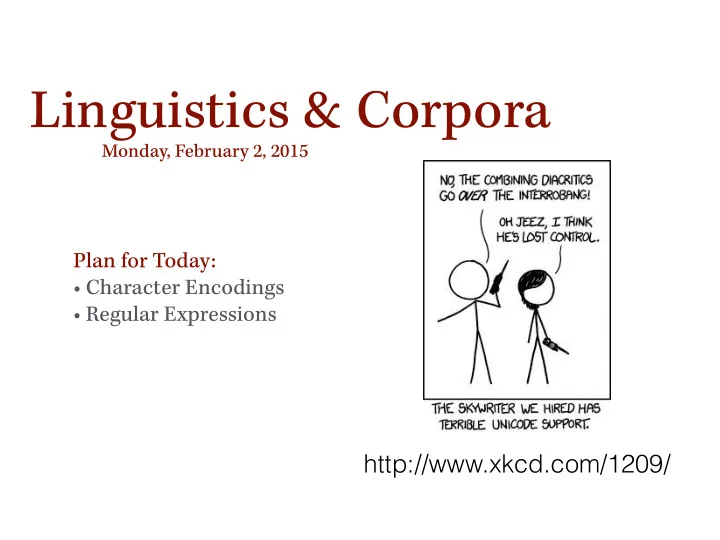
http://www.xkcd.com/1209/
Linguistics & Corpora Monday, February 2, 2015 Plan for Today: - - PowerPoint PPT Presentation
Linguistics & Corpora Monday, February 2, 2015 Plan for Today: Character Encodings Regular Expressions http://www.xkcd.com/1209/ Last time Syntax Word Alignment: Alien Language Activity Python 3 Today Working with raw text
Plan for Today:
Monday, February 2, 2015
http://www.xkcd.com/1209/
Syntax Word Alignment: Alien Language Activity Python 3
Working with raw text
Somebody gives you a fjle and says there’s text in it. Issues with obtaining the text?
How are individual characters represented in actual bits
(Short answer: It depends! And the differences end up being a major pain for us!)
Goal: Represent letters (and other text characters) as 0s and 1s Competing Factors:
Base-16 representation of numbers Symbols: 0-9, A-F Converting binary to hex:
Binary 0000 0001 0010 0011 0100 0101 0110 0111 Hexadecimal 1 2 3 4 5 6 7 Binary 1000 1001 1010 1011 1100 1101 1110 1111 Hexadecimal 8 9 A B C D E F
Baudot encoding 5 bits per character 2 sets of characters; one “shift character” to switch to each. How many total characters? WITHOUT LOWERCASE TODAY PEOPLE WILL THINK YOU ARE YELLING AT THEM
1960s: ASCII
characters
1980s: 8 bit characters
displayable characters.
“Tiat’s my favorite hat.”
1990s: Unicode
1,112,064 valid code points
Avoid 21 bits/character, especially if most of our text is ASCII
Currently makes up most of the web. Dominates standards, etc. What does it look like?
GB2312: 1980 Official character set of People's Republic of China GBK: 1990s expansion in response to unicode GB18030: 2000s update/expansion Why not just use Unicode/UTF-8?
In Python 3…
to code points using some encoding
Regular Expressions (“Regex”) We’ll look at:
Most characters match themselves. hmcNLP matches the exact string “hmcNLP” Case-sensitive (unless you use a special mode) Tiese are all valid regular expressions: Regular expressions are very powerful Look what can we do with regular expressions Tiese do not seem all that powerful yet
To do more than match string literals, some characters have special meaning. . match any character [ ] match any character inside the brackets ^ make a character set the complement of its contents, AND match beginning of line \ escapes metacharacters so they can be matched in strings, AND introduces special sequences $ match end of line
Tiere are lots, but most useful may be…
\d Match any decimal digit \D Match any non-digit character \w Match any alphanumeric character \W Match any non-alphanumeric character \s Match any whitespace character \S Match any non-whitespace character
Some characters modify the thing before them by saying how many times they can appear: *
Zero or more times
+
One or more times
?
Zero or one time
{m,n}
Anywhere from m to n times
Parentheses around characters form a group:
Tie pipe character | allows alternatives in a group:
… \N matches the contents of group N :
Group modifjers:
Regex functionality in re module Create regex object with re.compile() Match regex object to string with
Match objects can give information about the substrings that matched each group in a regular expression:
by group N
In Python, backslash is an escape character.
In regular expressions, backslash is an escape character.
How do we match the character “\” in a regex?
In raw strings, backslash is just a backslash.
If we represent regular expressions as raw strings, we
Make up a regular expression Exchange with someone next to you