
SLIDE 1
Learning Language
Lingít Yoo X̱ʼatángi Sh Tóo Dultóowu
comprehension speech vocabulary structure
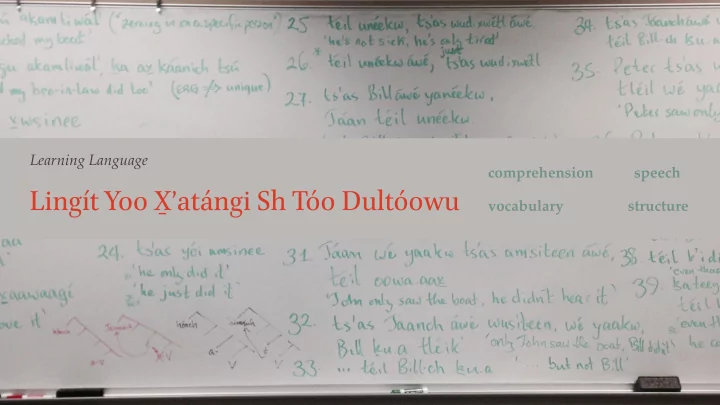
Lingt Yoo X atngi Sh To Dultowu vocabulary structure Text - - PowerPoint PPT Presentation
Learning Language comprehension speech Lingt Yoo X atngi Sh To Dultowu vocabulary structure Text Recommendation by: Shkooyil Tim Hall there is no one best way to learn a language find best practices and try to
Learning Language
comprehension speech vocabulary structure
Text Recommendation by:
works for one may not work for another
❖ Grammar-Translation Approach ❖ Direct Approach ❖ Reading Approach ❖ Audiolingual Approach ❖ Community Language Learning ❖ The Silent Way ❖ The Communicative Approach ❖ Functional Notional Approach ❖ Total Physical Response Approach ❖ The Natural Approach
❖ SLA: Second Language Acquisition ❖ L1: the first language learned ❖ L2: the second language learned ❖ Language B: local language
minority language, heritage language, mother tongue, dominated language, threatened language, or endangered language.
❖ Language A: language of wider communication
majority language,dominant language, killer language, or matrix language.
L1 L2 monolingual L1 L2 learner L1 L2 bilingual
Grenoble, Lenore A. and Lindsay Whaley. Saving Languages: An Introduction to Language
❖ listen to how the word, focusing on the image
and associating the name with the image.
❖ say the word, focusing on the consonants and
vowels, with special attention paid to vowel length and tone.
❖ read the word: count the total number of letters. ❖ write the word: focus on how letters associate
with sounds.
❖ draw a picture of the object. ❖ identify whether it is concrete or abstract, and
then make an English sentence using the Tlingit name for the object.
❖ listen ❖ repeat ❖ read (ḵ + á + kw = ḵákw) ❖ ḵákw (ḵ + á + kw) ❖ draw ❖ itʼs a concrete object. ❖ People used to use ḵákw for berry
picking, but I use plastic containers.