Linda Espinosa The Science of Dual Language Learning for Children - - PDF document

linda espinosa
SMART_READER_LITE
LIVE PREVIEW

Linda Espinosa The Science of Dual Language Learning for Children - - PDF document

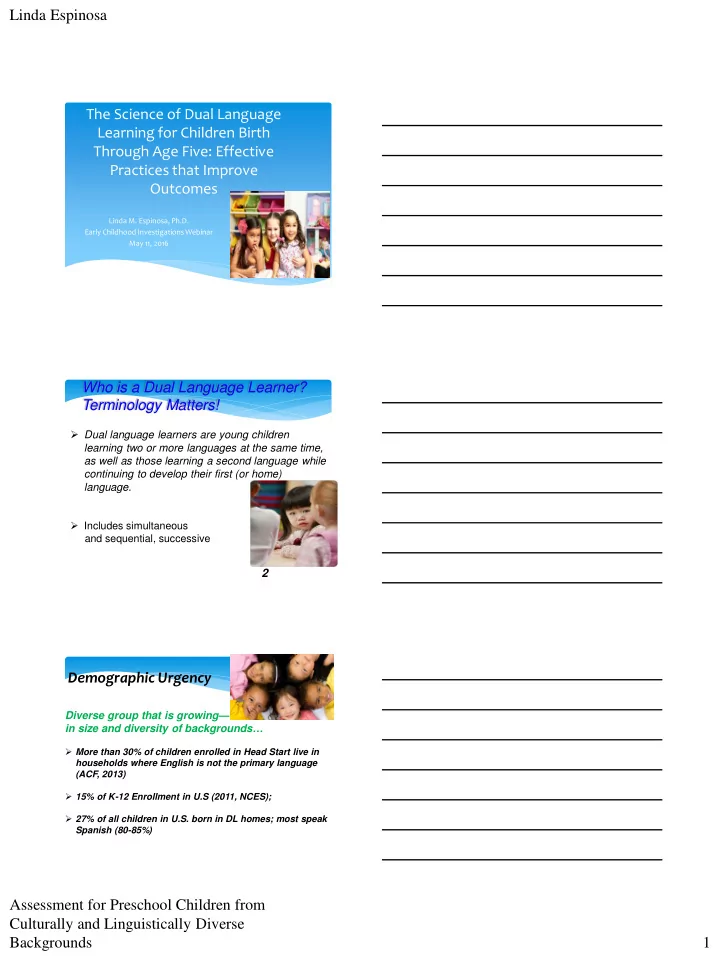
Linda Espinosa The Science of Dual Language Learning for Children Birth Through Age Five: Effective Practices that Improve Outcomes Linda M. Espinosa, Ph.D. Early Childhood Investigations Webinar May 11, 2016 Who is a Dual Language Learner?


slide-1
SLIDE 1

Linda Espinosa Assessment for Preschool Children from Culturally and Linguistically Diverse Backgrounds 1 The Science of Dual Language Learning for Children Birth Through Age Five: Effective Practices that Improve Outcomes

Linda M. Espinosa, Ph.D. Early Childhood Investigations Webinar May 11, 2016

2

Who is a Dual Language Learner? Terminology Matters!

  • Dual language learners are young children

learning two or more languages at the same time, as well as those learning a second language while continuing to develop their first (or home) language.

  • Includes simultaneous

and sequential, successive

Demographic Urgency

Diverse group that is growing— in size and diversity of backgrounds…

  • More than 30% of children enrolled in Head Start live in

households where English is not the primary language (ACF, 2013)

  • 15% of K-12 Enrollment in U.S (2011, NCES);
  • 27% of all children in U.S. born in DL homes; most speak

Spanish (80-85%)

slide-2
SLIDE 2

Linda Espinosa Assessment for Preschool Children from Culturally and Linguistically Diverse Backgrounds 2

4 Diversity Within the DLL Population

  • Countries of origin; family cultures
  • Immigrant vs non-immigrant

experience

  • Exposure and opportunities to

learn in home language & English

  • Socioeconomic status and parental

education

March 2014 5

POLL #1

6

Who are dual language learners and what do we know about their development and achievement?

Developmental Paradoxes!!

slide-3
SLIDE 3

Linda Espinosa Assessment for Preschool Children from Culturally and Linguistically Diverse Backgrounds 3

March 2014 7

POLL #2

 “…young DLL children may know certain words

in the home language, but not in English, and as a result, they may have a smaller vocabulary than English or Spanish monolinguals. For example, they may know the names of objects in the kitchen and home in Spanish but not in English. In these cases the child may look like he has limited vocabulary in each language.”

 In Challenging Common Myths About Young Dual Language Learners: An Update to the Seminal 2008 Report Page 17

8

Poll #2: Answer

POLL #3

5/10/2016 9

slide-4
SLIDE 4

Linda Espinosa Assessment for Preschool Children from Culturally and Linguistically Diverse Backgrounds 4

 Recent studies from cognitive neuroscientists have found differences in brain activity in the areas of the brain that process language across bilingual and monolingual PreKindergarteners. Young bilingual children develop more widely dispersed and evenly distributed neural pathways across both brain hemispheres.

 In Challenging Common Myths About Young Dual Language Learners: An Update to the Seminal 2008 Report Page 8

10

Poll #3: Answer

March 2014 11

POLL #4

 These studies have also demonstrated that knowing more than one language does not delay the acquisition of English or impede academic achievement in English when both languages are supported. Research on children who learn English after their home language has been established—usually around three years of age—has also shown that most young children are capable of adding a second language and that this dual language ability confers long-term cognitive, cultural, and economic advantages.  In Challenging Common Myths, page 6

March 2014 12

Poll #4: Answer

slide-5
SLIDE 5

Linda Espinosa Assessment for Preschool Children from Culturally and Linguistically Diverse Backgrounds 5

March 2014 13

POLL #5

 Even when teachers do not speak the child's home language, there are many specific teaching practices that will support continued development of the home

  • language. Teachers and ancillary staff can support

children’s home language throughout the day in all kinds of learning situations;… they can also train parents, community members, and volunteers to work with DLL children in their home language.

 In Challenging Common Myths About Young Dual Language Learners: An Update to the Seminal 2008 Report Page 12

14

Poll #5: Answer

March 2014 15

LATEST RESEARCH ON DLL DEVELOPMENT

AND ACHIEVEMENT

  • 1. California Department of Education (2013).

California’s Best Practices for Young Dual Language Learners: Research Overview Papers

  • 2. National Academies of Sciences: Report on Fostering

the Success of DLLs, Birth to 18 (in process)

  • 3. Center on Early Care and Education Research-Dual

Language Learners: 30 products on DLLs

http://cecerdll.fpg.unc.edu/

15

slide-6
SLIDE 6

Linda Espinosa Assessment for Preschool Children from Culturally and Linguistically Diverse Backgrounds 6

16

Children from Low-income and Dual Language Families Highly Vulnerable to Underachievement

  • NAEP Scores
  • State Achievement Data
  • K Entry Data
  • High School Completion
  • College Enrollment

5/10/2016 17

How Much of Achievement Gap is Due to Language Status (DLL) vs Poverty vs Cultural/Linguistic Discontinuity???

March 2014 18 5/10/2016 18

Dual Language Learners are Very Diverse

  • Context Matters!

– SES – Country of origin – Languages spoken – Age of exposure – Quantity and quality of language inputs – Opportunities to use language

18

slide-7
SLIDE 7

Linda Espinosa Assessment for Preschool Children from Culturally and Linguistically Diverse Backgrounds 7

5/10/2016 19

19

Having a second language is sometimes linked to higher achievement in English…ECLS-K data analysis.

Espinosa, et al., 2007

20

20

“The combination of living in poverty and having limited access to early education increases the vulnerability of young DLLs to negative outcomes.”

Castro, Espinosa, & Paez, (2011)

Having more than one language during ECE years should not be considered a risk factor !!

What WE Do in ECE Programs (from bus rides to meals to storybooks) Will Have Long-term Benefits for Children.

slide-8
SLIDE 8

Linda Espinosa Assessment for Preschool Children from Culturally and Linguistically Diverse Backgrounds 8

 Missed

  • pportunities

 Unrealized potentials

22

Young DLLs Often Underserved or Inappropriately Served

23

23

The Science of Early Bilingualism

1. Capacity of Young Children; Age

  • f Exposure
  • 2. Benefits/Differences:

Cognitive, Social, Linguistic, Executive Function Skills, Family Dynamisms Vocabulary

  • 3. Need to Support Both

Languages

  • 4. Families are Critical Partners

5/10/2016 24

Infant Brains & Bilingualism: Study Methods

slide-9
SLIDE 9

Linda Espinosa Assessment for Preschool Children from Culturally and Linguistically Diverse Backgrounds 9

25

25

Research Base

  • Brain development of young bilinguals:

– Different than monolinguals – Two linguistic systems develop – At birth, can perceive all phonemes in all languages; by 10-12 months phonemic pruning has occurred

5/10/2016 26 27

Cognitive Development*

Young bilinguals show advanced skills in non-verbal executive control skills….detectable at 7 months!  inhibitory control (ability to resist a habitual response or information not relevant)  working memory or updating (ability to hold information in mind and mentally manipulate it)  cognitive flexibility (ability to adjust to changes in demands or priorities and switch between goals)

* Barac, R., Bialystok, E., Castro, D. C., & Sanchez, M. (2014). The Cognitive Development of Young Dual Language Learners: A Critical Review. Early Childhood Research Quarterly, 29 (4), 699-714.

slide-10
SLIDE 10

Linda Espinosa Assessment for Preschool Children from Culturally and Linguistically Diverse Backgrounds 10

Language and Literacy Development of DLLs*

  • Timing: age of exposure
  • Amount and quality of

exposure

  • Opportunity to use and

practice

* Hammer, C. S., Hoff, E., Uchikoshi, Y., Gillanders, C. & Castro, D. C. (2014). The Language and Literacy Development of Young Dual Language Learners: A Critical Review. Early Childhood Research Quarterly, 29 (4), 715-733.

Language and Literacy Development of DLLs..

  • Vocabulary development looks different: longer

lexical retrieval time

  • Smaller vocabularies in each language; conceptual

vocabularies when combined in 2 languages comparable

  • Speech production somewhat slower
  • Grammatical development differed
  • Cross-language (L1-L2) influences varied by

similarities of 2 languages

29

30

  • Children of Mexican

immigrant families tended to have more social- emotional competencies (initiative and self-control) and fewer behavior problems than nonimmigrants at K entry. Social Emotional Development of DLLs*

* Halle, T., Whittaker, J. V., Zepeda, M., Rothenberg, L., Anderson, R., et al (2014). The Social- ‐Emotional Development of Dual Language Learners: Looking Back at Existing Research and Moving Forward with Purpose. Early Childhood Research Quarterly, 29 (4), 734-749.

slide-11
SLIDE 11

Linda Espinosa Assessment for Preschool Children from Culturally and Linguistically Diverse Backgrounds 11

 Balanced bilingualism necessary for cognitive, linguistic benefits  Bilingual advantages found across cultural and SES groups

5/10/2016 31

Bilingual Advantages Tied to Extent

  • f Bilingualism

32

Language Exposure and Opportunity to Use Best Predictors of Proficiency

  • Children need opportunities to hear,

process, and use language during meaningful interactions

  • Research suggests I/Ts need sufficient time

with high quality input in language to learn it

March 2014 33

EARLY CARE AND EDUCATION CONTEXTS Child care appears to be especially beneficial for DLLs: larger gains than other children

  • in center-based care
  • in high quality care
  • when home language is spoken in setting

Evidence suggests DLLs are less likely to

  • be in child care before Pre-K
  • be enrolled in center-based care before Pre-K

experience high quality care or use home language in center care

Espinosa, L. M., Burchinal, M., Winsler, A., Tien, H., Castro, D. C., & Peisner- Feinberg, E. (under review). Child Care Experiences among Dual Language Learners in the US: Analyses of the Early Childhood Longitudinal Survey-Birth

slide-12
SLIDE 12

Linda Espinosa Assessment for Preschool Children from Culturally and Linguistically Diverse Backgrounds 12

34

34

Importance of Supporting Both Languages

  • Frequently early English exposure leads to loss of home

language

  • Carefully balanced language approach is needed during

early years

  • Learning English is important, but should not come at the

expense of continued development in first language

5/10/2016

35

What does this mean?

  • DLLs should not be expected to perform like

monolinguals: different patterns of development

  • Initial differences may look like delays; DLLs need

time and language learning opportunities to become proficient in both languages

  • Bilinguals cannot be compared to monolingual

norms when assessing children

5/10/2016 36

Need to revise and implement improved policies and practices birth to eight that reflect the current research on bilingual development and the realities of local contexts.

slide-13
SLIDE 13

Linda Espinosa Assessment for Preschool Children from Culturally and Linguistically Diverse Backgrounds 13

37

Challenge: How do we support home language development and promote English language development with multiple languages of children/families, monolingual teachers, different educational contexts?

Program Approaches, Interaction and Instructional Strategies that Promote Improved Development and Achievement for DLLs

First--- Warm, Responsive, Enriched Interactions and Good Instructional Practices Help Dual Language Learners (but are not sufficient)

Goldenberg, et al., 2013

slide-14
SLIDE 14

Linda Espinosa Assessment for Preschool Children from Culturally and Linguistically Diverse Backgrounds 14

Considerations When Implementing a Language Model for Pre-K DLLs

  • Language Goals: Dual language or balanced

approach with explicit bilingualism and bi- literacy goals?

  • Staffing Capacity: Language abilities of

program staff, families, community FIRST STEP

  • Early in the year or at registration have a conversation with

parents:

  • Collect information on child’s earliest language

experiences, current language opportunities, family feelings about maintaining home language, family interests and talents

  • Record and use information
  • Conduct in family’s preferred language (may need to

hire an interpreter)

Important for establishing rapport, respect, and common focus on child’s well-being; Building relationship based on trust

4 1 4 2

slide-15
SLIDE 15

Linda Espinosa Assessment for Preschool Children from Culturally and Linguistically Diverse Backgrounds 15

DLL program considerations…

  • Structure of program: Who will speak which

language and for what purposes? 50-50, 90- 10, 75-25? Or

  • ELD with home language support? Each

requires careful planning and frequent monitoring.

Develop initial language goals for child:

E.g., if child has very little English and is mostly listening and following others or using only one-word responses, then design many opportunities for child to build receptive language skills and minimize demands for child to speak English publicly Must know child’s stage or level of English acquisition

Considerations, ….

5/10/2016 45

Examples of Phases of Second Language Acquisition

Phases of second language acquisition Example Example Home Language

William is on the sand table. He asks an English-speaking child, “¿Me das la pala?” Linda asks the teacher, ¿Cuándo vamos a comer el lonch?

Quiet period

Yazmin looks intently to the teacher and remains quiet while the teacher is reading a book aloud in English. Jessica holds the teacher’s hand to show her something interesting she has discovered in the classroom.

Telegraphic/ Formulaic Speech

Francisco uses expressions such as “come on” to invite

  • ther children to play in the

playground. Antonio tells to one of his classmates: “Two people” to indicate that only two people can be in the housekeeping area.

Productive Speech

Rogelio announces after being in the playground, “I sandbox in shoe.” Jessica tells the teacher, “Carlos es mi friend.”

slide-16
SLIDE 16

Linda Espinosa Assessment for Preschool Children from Culturally and Linguistically Diverse Backgrounds 16

 Labeling in both languages (color coding)  Visual cues pictures and graphics  Word walls in both languages  Daily schedule with pictures and both languages represented

Setting Up the Environment

Example of Daily Routine Example of Daily Schedule

slide-17
SLIDE 17

Linda Espinosa Assessment for Preschool Children from Culturally and Linguistically Diverse Backgrounds 17

Language, Any Language, is the Foundation for Literacy.......and Literacy in English is Critical for School Success

Focus on oral language (extended vocabulary, grammar, narratives, listening comprehension, academic language) Explicit/intentional teaching of some language and literacy skills (phonemic awareness, vocabulary) Grouping practices important (small, instructional groups, structured pairings)

Best Practices/Strategies…

  • Anchor book, intentional message, vocab. Imprinting,

songs, chants, visual cues/gestures

  • Skilled Story Book Reading (specific strategies that build

vocab and narrative)

  • Bring home language into classroom
  • Opportunities to Practice Across Contexts
  • Screening and Continuous Assessment
  • Strong Parent-Family Partnerships (home visiting, parent-

school collaborations, parent education, family support programs)

From Espinosa (2015),Getting It Right for Young Children from Diverse Backgrounds, Chapter 4 And CPPG (2015), DLL Chapter

How to Support Home Language While Promoting English Language Development

  • Set of Strategies

that Bridge between home language (L1) and English:

– Cognate charts – Front-loading vocabulary in home language – Use of photos and pics

slide-18
SLIDE 18

Linda Espinosa Assessment for Preschool Children from Culturally and Linguistically Diverse Backgrounds 18 ALL ECE Practitioners Can Support ALL Languages

  • If possible, hire qualified bilingual teachers, family

liaisons, and assessors

  • For monolingual, English speaking teachers there

are many strategies to provide rich learning

  • pportunities in each language

– Bring home language into setting (family, volunteers, community reps.), authentic bilingual materials, music, CDs, activities –videos

FINAL SUMMARY

“……young dual language learners are learning through two languages and both languages must be supported through intentional instruction, specific language interactions, frequent assessments of children’s progress in both languages, and culturally sensitive engagement with families.”

From CA Preschool Program Guidelines, 2015

  • Conclusion

While all ECE teachers cannot instruct in all languages, all teachers can support all languages by working with families and using specific strategies that bring home language and culture into ECE settings.

slide-19
SLIDE 19

Linda Espinosa Assessment for Preschool Children from Culturally and Linguistically Diverse Backgrounds 19

5/10/2016 55

Linda M. Espinosa, Ph.D. : espinosal@missouri.edu

March 2014 56

Contact Information