Leveraging Colossus in Auto Accident Claim Recovery: Guidance for - - PowerPoint PPT Presentation

leveraging colossus in auto accident claim recovery
SMART_READER_LITE
LIVE PREVIEW

Leveraging Colossus in Auto Accident Claim Recovery: Guidance for - - PowerPoint PPT Presentation

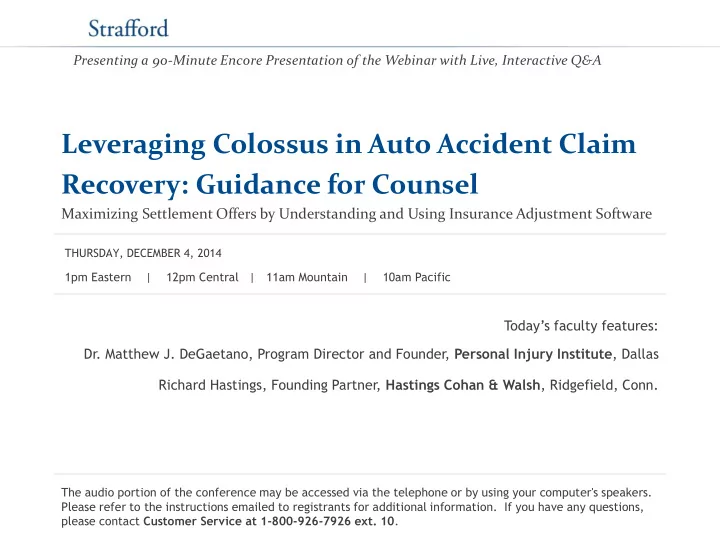
Presenting a 90-Minute Encore Presentation of the Webinar with Live, Interactive Q&A Leveraging Colossus in Auto Accident Claim Recovery: Guidance for Counsel Maximizing Settlement Offers by Understanding and Using Insurance Adjustment


slide-1
SLIDE 1

Leveraging Colossus in Auto Accident Claim Recovery: Guidance for Counsel

Maximizing Settlement Offers by Understanding and Using Insurance Adjustment Software

Today’s faculty features:

1pm Eastern | 12pm Central | 11am Mountain | 10am Pacific The audio portion of the conference may be accessed via the telephone or by using your computer's speakers. Please refer to the instructions emailed to registrants for additional information. If you have any questions, please contact Customer Service at 1-800-926-7926 ext. 10. THURSDAY, DECEMBER 4, 2014

Presenting a 90-Minute Encore Presentation of the Webinar with Live, Interactive Q&A

  • Dr. Matthew J. DeGaetano, Program Director and Founder, Personal Injury Institute, Dallas

Richard Hastings, Founding Partner, Hastings Cohan & Walsh, Ridgefield, Conn.

slide-2
SLIDE 2

Tips for Optimal Quality

Sound Quality If you are listening via your computer speakers, please note that the quality

  • f your sound will vary depending on the speed and quality of your internet

connection. If the sound quality is not satisfactory, you may listen via the phone: dial 1-866-961-9091 and enter your PIN when prompted. Otherwise, please send us a chat or e-mail sound@straffordpub.com immediately so we can address the problem. If you dialed in and have any difficulties during the call, press *0 for assistance. Viewing Quality To maximize your screen, press the F11 key on your keyboard. To exit full screen, press the F11 key again.

FOR LIVE EVENT ONLY

slide-3
SLIDE 3

Continuing Education Credits

For CLE purposes, please let us know how many people are listening at your location by completing each of the following steps:

  • Close the notification box
  • In the chat box, type (1) your company name and (2) the number of

attendees at your location

  • Click the SEND button beside the box

FOR LIVE EVENT ONLY

slide-4
SLIDE 4

Program Materials

If you have not printed the conference materials for this program, please complete the following steps:

  • Click on the ^ symbol next to “Conference Materials” in the middle of the left-

hand column on your screen.

  • Click on the tab labeled “Handouts” that appears, and there you will see a

PDF of the slides for today's program.

  • Double click on the PDF and a separate page will open.
  • Print the slides by clicking on the printer icon.

FOR LIVE EVENT ONLY

slide-5
SLIDE 5

Personal Injury Institute

  • Dr. Matthew J. DeGaetano, drmatt@personalinjuryinstitute.com
slide-6
SLIDE 6

THE HISTORY OF COLOSSUS

6

slide-7
SLIDE 7
  • Computer Software Program used by Insurance

Companies

  • The adjuster enters information about the claim

into the program

  • The program accesses over 10,720 rules or value

drivers to evaluate over 750 injuries

  • The program computes a settlement figure that is

consistent with the severity of the patient’s injury

COLOSSUS COLOSSUS

7

slide-8
SLIDE 8

Value drivers!

There are 10,720

What are value drivers?

8

slide-9
SLIDE 9

Colossus arrives at an evaluation by assigning points to value drivers associated with each injury.

9

slide-10
SLIDE 10

The actual assignment of points is determined by each individual insurer. They become the baseline data by which all injury values are arrived at.

10

slide-11
SLIDE 11

Each insurer has the ability to manipulate this point assignment and database any time it wishes.

11

slide-12
SLIDE 12

The points are represented by “value drivers” in a mathematical equation.

12

slide-13
SLIDE 13

Some of the “value drivers” have multipliers as well. These multipliers add significant points to each “value driver”.

13

slide-14
SLIDE 14
  • The mathematical equation consists
  • f the injury, symptoms and other

components, which all must be indicated in the medical records and be specifically stated in the demand from the attorney

14

slide-15
SLIDE 15

The Number 1 Value Driver Or Factor For Personal Injury

  • Diagnoses

15

slide-16
SLIDE 16

What Caused The Cultural Change In the Insurance Industry?

  • The Insurance Industry claim handling

culture went through a major transformation during the mid 1990’s adopting the opinions and advice of McKinsey Consulting.

16

slide-17
SLIDE 17

THE MEDICAL COMMUNITY ENVIRONMENT

  • This was accomplished by each individual insurer in

conjunction with McKinsey Consulting (Arthur Anderson or Accenture as it is currently known, also contributed to some insurers’ transformation) through the creation and implementation of the McKinsey “Business Process Improvement” (BPI)

  • culture. This transformation of claim culture is

evident in the McKinsey documents Allstate has produced in other cases across the country.

17

slide-18
SLIDE 18

Soft Tissue Injuries

  • The current industry percentage of these claims which would

involve “soft tissue” injuries varies between 85 and 90 percent.

  • Most of the injured parties have either PIP/MPC benefits

available to pay for the treatment. A very significant number

  • f the injured parties also have either third party claims

against an insured negligent tortfeasor or a first party claim under their UM/UIM (Uninsured Motorist/Underinsured Motorist) coverages.

18

slide-19
SLIDE 19

THE CONTINUUM COMPANY

  • At about the same time, an Australia based

computer software company creates Colossus.

  • Designed to evaluate claims based on:
  • Injuries
  • Treatment Specifics
  • Symptomology
  • Future need for Treatment
  • Impairments and Disabilities

19

slide-20
SLIDE 20

COMPUTER SCIENCE CORPORATION

  • Licensed Colossus from the Australian Firm

(Continuum Company)

  • CSC offered it to the insurance industry
  • McKinsey approved the venture and was retained by

each of the insurers to calibrate the values of Colossus.

  • Calibration was performed by Arthur Anderson or

A.K.A. as Accenture

20

slide-21
SLIDE 21

COLOSSUS MORE THAN JUST A SOFTWARE PROGRAM

It is an Artificial Intelligence Program!

21

slide-22
SLIDE 22

Colossus

  • The Colossus equation is designed to

establish:

Economic Damages or Special Damages –

Medical Bills & Loss of Income Non – Economic Damages or General Damages – Pain & Suffering

22

slide-23
SLIDE 23

UNTIL THE LATE 1980’S

  • Most claims were settled for 3-5 times the

special damages For example:

  • $5000 in specials settled at $15000

23

slide-24
SLIDE 24

“The case reserve in 1990 for a soft tissue injury liability claim was approximately $15,800.00 The case reserve for the same type of injury in 2001 was $5,800.00.

  • This is the amount of dollars set aside by the insurer in anticipating the amount to paid on this type

claim at settlement. The figure is based on a three year historical severity realized by the insurer.

  • Fowler vs. State Farm Mutual Automobile Insurance Company, Hawaii; The United States District Court

For the District of Hawaii; Civil No. CV07 00071 SPK/KSC;

24

slide-25
SLIDE 25

Considering that State Farm Claim Vice President (Fowler vs. State Farm) recently stated in a deposition. State Farm experiences 15,000 claims per day. It might be an eye

  • pening exercise to have some economist

actually extrapolate the direct and indirect economic impact on the public over the last fifteen years.

  • This is the amount of dollars set aside by the insurer in anticipating the amount to paid on this type claim at settlement.

The figure is based on a three year historical severity realized by the insurer.

  • Fowler vs. State Farm Mutual Automobile Insurance Company, Hawaii; The United States District Court For the District of

Hawaii; Civil No. CV07 00071 SPK/KSC; 25

slide-26
SLIDE 26

PROVIDERS HAVE BEEN DATABASED

  • The offer it comes up with for claims you

manage this year will be even lower!

  • BUT THAT IS NOT ALL:
  • The attorney in the case is also tracked!

26

slide-27
SLIDE 27

ATTORNEYS HAVE BEEN DATABASED

  • Attorneys will be categorized as one

representing threat of trial (and increased risk to the insurer) or one who will not go to trial

  • The non trial attorneys will receive lower

settlement offers that those who try cases!

27

slide-28
SLIDE 28
  • If Colossus devalued most of your cases last year

because:

  • Poor notes
  • Failed to refer for a second opinion
  • Used the wrong terminology
  • Used the wrong prognoses
  • Did not objectify your findings with diagnostics
  • Did not monitor clinical progression with correct

Outcomes Assessments

  • Did not use active care procedures
  • Then…………

28

slide-29
SLIDE 29

What Factors Is The Case Build Upon:

  • The Entire Case Is Calculated From The

Treating Physicians Records And Protocols.

29

slide-30
SLIDE 30

What Are Our Clinical Tools

  • Full Flexion / Extension Views
  • Lateral Flexion Open Mouth views bilateral
  • Flexion / Extension oblique views bilateral
  • Digital Motion X-Ray
  • EMG / NCV – Certified Neurologist
  • Diagnostic Ultrasound – Certified Radiologist
  • Proton Density MRI ( Upper Cervical Studies )
  • AMA Guides For Permanent Impairment

30

slide-31
SLIDE 31

Soft Tissue Injuries and the Attack by the Insurance Companies

  • Most doctors treat Soft Tissue Injuries
  • All doctors should be looking for. “CONNECTIVE

TISSUE INJURIES”

31

slide-32
SLIDE 32

All Injuries Must Be Identified

– Contusions all other body parts – Sprain/Strain all other body parts – Fracture all other body parts – Dislocation all other body parts – Ligament injuries – usually associated with joints – Laceration all other body parts – Penetrating wounds all other body parts – Crush wounds all other body parts – Amputation all other body parts – Concussion – Lastly, dental injuries

32

slide-33
SLIDE 33

All Injuries Must Be Identified

– Sprain/Strain cervical, thoracic and/or lumbar – Subluxation – Prolapse cervical, thoracic and/or lumbar – Bulge cervical, thoracic and/or lumbar – Herniation cervical, thoracic and/or lumbar – Dislocation cervical, thoracic and/or lumbar – Fracture cervical, thoracic and/or lumbar – Superficial Injuries all other body parts

33

slide-34
SLIDE 34

Do You Know The Four IV Phases Of Whiplash? The s-shaped curve, with hyperextension of the lower segments and flexion of the upper segments. This is one of the chief points of injury and occurs before the head strikes the head restraint. Adapted from Ono et al.

34

slide-35
SLIDE 35

IV Phases You Should Know

35

slide-36
SLIDE 36

UNDERSTANDING THE EQUATION

  • No human intuitive abilities
  • Depends on the input of the claim handler

alone

  • Garbage In – Garbage Out

36

slide-37
SLIDE 37

IN THE ABSENSE OF COMMUNICATION, THE PATIENT IS THE VICTIM

  • We need to speak the language of Colossus
  • Symptoms
  • Diagnosis
  • Treatment
  • Prognosis
  • Additional Factors
  • Permanent Impairments

37

slide-38
SLIDE 38

What Is The Second Most Important Factor for PI Cases:

  • Permanent Impairments.

38

slide-39
SLIDE 39

Permanent Impairment

  • Permanent Impairment is defined with the

following factors

  • A medical condition resulting from trauma or

work related disease or illness

  • A deviation from normal function of a body

part or organ system

  • Something the body or body part can no

longer perform normally

39

slide-40
SLIDE 40

Permanent Impairment

  • Permanent Impairment can only be entered in

the software when the injury has become

  • Stable : Stopped Receiving treatment
  • Static : When a period of time has passed

since treatment has stopped and the condition of the injury has not improved.

40

slide-41
SLIDE 41

How does permanent impairment differ from disability:

  • Disability is how the impairment affects and changes

the person’s ability to perform, social, or employment demands

  • Impairment is a medical assessment
  • Disability is a non-medical assessment

NOTE: Colossus is not capable of establishing an impairment rating, only a qualified medical physicians can assess impairment ratings.

41

slide-42
SLIDE 42

Colossus

  • Colossus is NOT capable of assessing brain

damage

  • The only head injury impairments, which may

be entered into colossus are related to sight, hearing, equilibrium, air passage, or mastication (TMJ)

42

slide-43
SLIDE 43

Colossus

  • Colossus Applies General Damage Compensation For

Impairments Based On The Following:

  • The Body Part Or System Impaired

The Degree (Amount) Of The Impairment Assigned By The Medical Examiner Impairment Ratings Must Be Part AMA (American Medical Association) 5th Edition is recommended for its ease of use.

43

slide-44
SLIDE 44

Injuries Diagnosed & Treated

  • Minimum Competency To treat PI Patients
  • The doctors ability to address each & every

Injury

44

slide-45
SLIDE 45

PROPER AND COMPLETE DIAGNOSIS

  • The Initial Records Must Reflect ALL Complaints Of

The Patient

  • The Examination Should Indicate All Injuries Related

To Each Complaint

  • Colossus Is Structured To Recognize Only The

Diagnosed Injuries Found In The Records

45

slide-46
SLIDE 46

Insurance Industry Application of Colossus

Other Processors

  • TEACH – State Farm
  • Decision Point – Progressive
  • Claims Outcome Advisor (COA) – GMAC & Fireman's fund
  • Injury IQ
  • Claims IQ
  • MYND
  • Injury Claims Evaluation (ICE)

46

slide-47
SLIDE 47

Insurance Industry Application of Colossus

Other Processors

  • IMS, AIM, MEDICO, MBRS (Replaced By Mitchell

Medical), ADP, Ingenix, HELP Systems, Injury IQ, AIM, Mitchell Medical And Med-data

  • The Billing MUST Identify

Dates Of Service Amount Of Each Modality ICD-9 Codes (Perhaps The Right ICD-9 Codes) CPT For Each Visit Patient Identification Medical Vendor (SIU?)

47

slide-48
SLIDE 48

Insurance Industry Application of Colossus

  • CSC is now managing all data and

evaluation of medical billings for Blue Cross Blue Shield and Group Health.

48

slide-49
SLIDE 49

Insurance Industry Application of Colossus

  • Continuum creates new company called ClaimIQ
  • Mitchell International purchases ClaimIQ and merges

it with Decision Point.

  • Mitchell then adds additional functions to ClaimIQ:
  • InjuryIQ
  • MedicalIQ
  • LiabilityIQ
  • NegotiationIQ

49

slide-50
SLIDE 50

Insurance Industry Application of Colossus and Related Software

  • Adjustor must now compare each billing record to

confirm all records are received prior to continuing with colossus.

  • Once all confirmed – data input process may

proceed.

  • Note: Significant Clinical Insight And Determination

Or There Lack Of May Increase Or Decrease The Value Ultimately Arrived By Colossus

50

slide-51
SLIDE 51

DIAGNOSE ALL INJURIES SEPARATELY!!!!!!

  • If the shoulder is included as a separate injury

then the colossus program would allow additional treatment for the shoulder.

  • Although radiating pain increases the value of

the case, it does not increase it as much as diagnosing the symptom as a separate injury.

51

slide-52
SLIDE 52

CPT Codes

  • Using forms that contains CPT codes is huge for your

case for 2 reasons. It helps the office biller work more quickly AND helps the Colossus data entry person work more quickly to settle the claim. Keeping good medical records makes the claim adjuster and all attorneys’ jobs easier because they have all the “facts” to know what injuries were diagnosed.

52

slide-53
SLIDE 53

The Third Most Important Clinical Consideration For PI Cases:

  • Patient Complaints and Or

Symptoms.

53

slide-54
SLIDE 54

DOCUMENTATION OF ALL SYMPTOMS

  • After the injuries (diagnosis) are inputted,

colossus asks a series of questions associated with each injury.

  • The corresponding input adds individual value

amounts to the claims general damage range.

54

slide-55
SLIDE 55

IMPORTANT SYMPTOMS BUT OFTEN IGNORED

  • Loss of range of motion
  • Headaches
  • Spasms
  • Dizziness
  • Visual disturbance
  • Radiating pain
  • Anxiety (must be treated)
  • TMJ
  • Stiffness
  • Tightness

55

slide-56
SLIDE 56

SYMPTOM DURATION

  • It is not necessary that the provider

acknowledge the symptom on each date of treatment, because symptoms will vary from visit to visit.

  • However, the entire duration of the symptom

should be reflected in the chart notes.

56

slide-57
SLIDE 57

PRE – EXISTING CONDITIONS

  • If a plaintiff has a pre-existing condition, Colossus will

place a higher value on the claim, but this needs to be done properly.

  • An asymptomatic condition with no treatment in the

past 24 months.

  • Even a condition that was symptomatic there is a

need for clinical discussion.

57

slide-58
SLIDE 58

Intake and Management Forms

  • Attorney Intake Form
  • DUD and LOE Worksheets
  • Physician Intake/Discharge Form
  • Physician Request Form
  • Common Injury Code Sheet
  • Supplemental HCFA Form
  • Body Shop Questionnaire

58

slide-59
SLIDE 59

S

Tips and Techniques for Adding Value to Your Client’s Claim with Adjusters who are using Colossus

Richard Hastings Hastings Cohan & Walsh RPHASTINGS@SNET.NET

slide-60
SLIDE 60

The four main players that can affect the value of a personal injury claim and what to do with each party

60

slide-61
SLIDE 61

The Claimant’s Attorney

S Choreography

61

slide-62
SLIDE 62

The Client

S Educate

62

slide-63
SLIDE 63

The Healthcare Providers

S Understanding restrictions and providing detailed medical

records

63

slide-64
SLIDE 64

The Adjuster

S

Constant contact and updating

64

slide-65
SLIDE 65

Adding Value Through Your Client’s Medical Records

S Educate your client S Specifically describing pain complaints S How do these problems affect them S Duties under duress S Home health activities and aids

65

slide-66
SLIDE 66

Value Drivers

S Medical bills SSpecialists SPositive diagnostic testing SBuzz words and key phrases SUse of medical devices and aids

66

slide-67
SLIDE 67

Value Drivers

SDocumented out-of-pocket expenses SMedical insurance premiums SProperty damage to your client’s vehicle SDocumenting lost time from work SDuties under duress

67

slide-68
SLIDE 68

Think Like an Adjuster

S Pain S Suffering

68

slide-69
SLIDE 69

Case Evaluation

S Plaintiffs’ Counsel S Defense Counsel S Mediators and Arbitrators S Claims Adjuster S Peer Review

69

slide-70
SLIDE 70

What is the Adjuster Doing?

S Know your client’s file S Keep your client controlled, involved and have

them regularly treat to improve their condition

70

slide-71
SLIDE 71

Intangibles

S The value intangibles bring cannot be stressed

enough

71

slide-72
SLIDE 72

Putting it all Together

S Client Education S Be proactive in the management of your files S Robust medical records S Detail all client challenges S Constant communication with adjuster

72

slide-73
SLIDE 73

Adjuster Secrets: Attorney & Adjuster Tips & Techniques That Guarantee Larger Settlements

www.adjustersecrets.com Download FREE Chapter

73