Lets FACE IT! A Conversation & Workshop on Diversity, Equity - - PowerPoint PPT Presentation

let s face it a conversation workshop on diversity equity
SMART_READER_LITE
LIVE PREVIEW

Lets FACE IT! A Conversation & Workshop on Diversity, Equity - - PowerPoint PPT Presentation

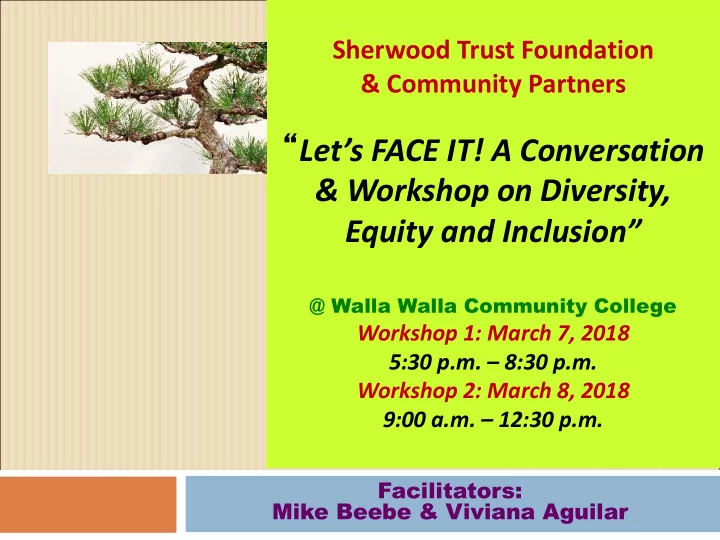
Sherwood Trust Foundation & Community Partners Lets FACE IT! A Conversation & Workshop on Diversity, Equity and Inclusion @ Walla Walla Community College Workshop 1: March 7, 2018 5:30 p.m. 8:30 p.m. Workshop 2: March 8,


slide-1
SLIDE 1

Sherwood Trust Foundation & Community Partners

Let’s FACE IT! A Conversation & Workshop on Diversity, Equity and Inclusion”

@ Walla Walla Community College

Workshop 1: March 7, 2018 5:30 p.m. – 8:30 p.m. Workshop 2: March 8, 2018 9:00 a.m. – 12:30 p.m.

Facilitators: Mike Beebe & Viviana Aguilar

slide-2
SLIDE 2

Welcome! Howdy! ¡Bienvenidos!¡Bienvenidas! Glad you’re here! !Bienvenue! Foon Ying! Aloha! Willkommen!

slide-3
SLIDE 3

Acknowledgements:

¨

Original keepers of this land

¨

Walla Walla Community College

¨

Lydia Caudill & the Sherwood Trust Foundation

slide-4
SLIDE 4

F . = Facilitating

  • A. = Awareness &
  • C. = Change for
  • E. = Equity

Consulting Collaborative

slide-5
SLIDE 5

Learning Outcomes:

v Grow our self awareness. v Create shared language and

definitions.

v Aspire to be more effective

ALLIES.

slide-6
SLIDE 6

EMPLOY AN APPROACH THAT LAYS A FOUNDATION FOR:

¨ SAFETY ¨ MUTUAL RESPECT ¨ OPEN DIALOGUE ¨ TRUST BUILDING ¨ MAKING ‘NEW

CONNECTIONS’

¨ CHALLENGING

ASSUMPTIONS

¨ ADDRESSING EQUITY ¨ TAKING NEEDED

ACTION

slide-7
SLIDE 7

Workshop Agenda:

¤ Welcome, intros, overview ¤ “Sharing Our Names” ¤ Shared language: Diversity, Equity, Inclusion ¤ Our Cultural identities ¤ “Hot buttons” & Microaggressions ¤ Shared language: Stereotype, Prejudice,

Discrimination, Oppression

¤ What are Aspiring Allies ¤ Ally Behaviors: Interrupting

Microaggressions

¤ Appreciations & Closing

7

Workshop Flow:

slide-8
SLIDE 8

**

Proposed WORKING AGREEMENTS:

8

¨ Share the talk time ¨ Respect & honor each

  • ther

¨ Do active listening ¨ Share your knowledge ¨ Technology for break

time please

¨ Help one another ¨ Get curious together ¨ Move up, move back ¨ Hold space for each

  • ther that is safe and

brave

¨ Keep confidentiality

slide-9
SLIDE 9
slide-10
SLIDE 10

Levels of the Work

Structural – institutional accountability

Institutional - recognize and challenge power imbalances Individual –lifelong learning & critical self reflection

slide-11
SLIDE 11

Relationship Building Activity:

“SHARING OUR NAMES”

¤ History, traditions, rituals? ¤ Meaning? ¤ Treatment and variation? ¤ Experiences, feelings,

thoughts?

¤ Preferences?

11

slide-12
SLIDE 12

WHAT IS CULTURE?

“Culture is the shared set of assumptions, values, and beliefs

  • f a group of people by which

they organize their common life.”

Gary Wederspahn

12

slide-13
SLIDE 13

Cultural competency & beyond

Culture is much like water for fish …

Other metaphors?

slide-14
SLIDE 14

14

slide-15
SLIDE 15

Question: Who are you, culturally? How do you identify?

slide-16
SLIDE 16

Significant dimensions of our cultural identities

RACE/ETHNICITY GENDER GENERATION/AGE GEOGRAPHIC LOCATION NATIONALITY BODY SIZE LANGUAGE OF ORIGIN MARITAL STATUS SEXUAL ORIENTATION RELIGION/SPIRITUALITY EDUCATION FAMILY STATUS IMMIGRATION STATUS PHYSICAL/ MENTAL ABILITY ECONOMIC CLASS WORK/LABOR BIOLOGICAL SEX

slide-17
SLIDE 17

Cultural Identity Sharing:

¤ Think of 4 key aspects; choose 4

pipe cleaners

¤ Reflect on how these aspects of your

identity help define/inform who you are

¤ Make pipe cleaner sculpture that

helps tell your story

¤ Share your story – 3-4 minutes

17

slide-18
SLIDE 18

Cultural identity Questions:

Who in our communities are continually asked/forced to give up parts of their identities? What is the impact of this?

¨ On individuals & families? ¨ On communities? ¨ On the broader society?

slide-19
SLIDE 19

“How microaggressions are like mosquito bites – Same Difference”

q Fusion Comedy video (1:58 min) q CLICK HERE

slide-20
SLIDE 20

MICROAGGRESSIONS Racial Context: Racism in U.S.

  • “Microaggression” coined by Chester Pierce in 1970 in his

work with Black Americans as “subtle, stunning, often automatic, and nonverbal exchanges which are ‘put downs’”

  • “…one must not look for the gross and obvious. The subtle,

cumulative miniassault is the substance of today’s racism” (Pierce, 1974, p. 516)

  • “In and of itself a microaggression may seem harmless, but

the cumulative burden of a lifetime of microaggressions can theoretically contribute to diminished mortality, augmented morbidity, and flattened confidence” (Pierce, 1995, p. 281)

slide-21
SLIDE 21

Microaggressions: Definition

“Brief and commonplace daily verbal, behavioral, and environmental indignities, whether intentional or unintentional, that communicate hostile, derogatory, or negative racial, gender, sexual-orientation, and religious slights and insults to the target person or group” (Derald Sue, 2010)

slide-22
SLIDE 22

MICROAGGRESSIONS Characteristics

  • Constantly and continuously experienced
  • Often committed unknowingly by well-

intentioned people

  • dismissed as innocent or innocuous
  • gaps between our lived experiences
  • Micro level manifestations of enduring

institutional and systemic imbalances of privilege and power

slide-23
SLIDE 23

Interrupting Do’s & Don’ts

Don’t…

  • Roll your eyes, cross your arms
  • Pretend you didn’t hear/see it
  • Say nothing
  • Change the subject
  • Yell, curse and berate the

person

  • Break off all ties with the

person

  • Put yourself at risk
slide-24
SLIDE 24

Interrupting Do’s & Don’ts

DO! ü GET CURIOUS ü NAME IT! ü MAKE A REQUEST

slide-25
SLIDE 25

ASPIRING ALLY

An aspiring ally is a member of the privileged or agent group who takes a stand against social injustice directed at targeted groups or group members. An aspiring ally works to be an agent of social change rather than an agent of

  • ppression or a passive member of society.
slide-26
SLIDE 26

Ally Behavior: Interrupting Microaggressions Pair & Share:

  • 1. Share what you WANT to say
  • 2. Share what you MIGHT ASK or

SAY to educate/interrupt and stay in dialogue

slide-27
SLIDE 27

ALLY B.R.A.V.E. MODEL Builds and brokers relationships Relates and shares information Advocates for justice and fairness Validates experiences, and Explains norms

(Nakashima & Hickman, 1995)

slide-28
SLIDE 28

Thanks for sharing!! Xie Xie Asante MAHALO! Danke! Salamat po!

¡Gracias!Grazie

Merci! Arigato! Toda Shukran

¡Buena suerte!