Less Assessment, M AKING P ROGRAM A SSESSMENT W ORK FOR Y OU More - - PDF document

less assessment
SMART_READER_LITE
LIVE PREVIEW

Less Assessment, M AKING P ROGRAM A SSESSMENT W ORK FOR Y OU More - - PDF document

3/15/13 PowerPoint slides for the Keynote Session in Less Assessment, M AKING P ROGRAM A SSESSMENT W ORK FOR Y OU More Learning The Ohio State University 9:30 to 10:45 AM, Friday 8 March 2013 Aligning Learning Outcomes and Dr. Tom


slide-1
SLIDE 1

3/15/13 ¡ 1 ¡

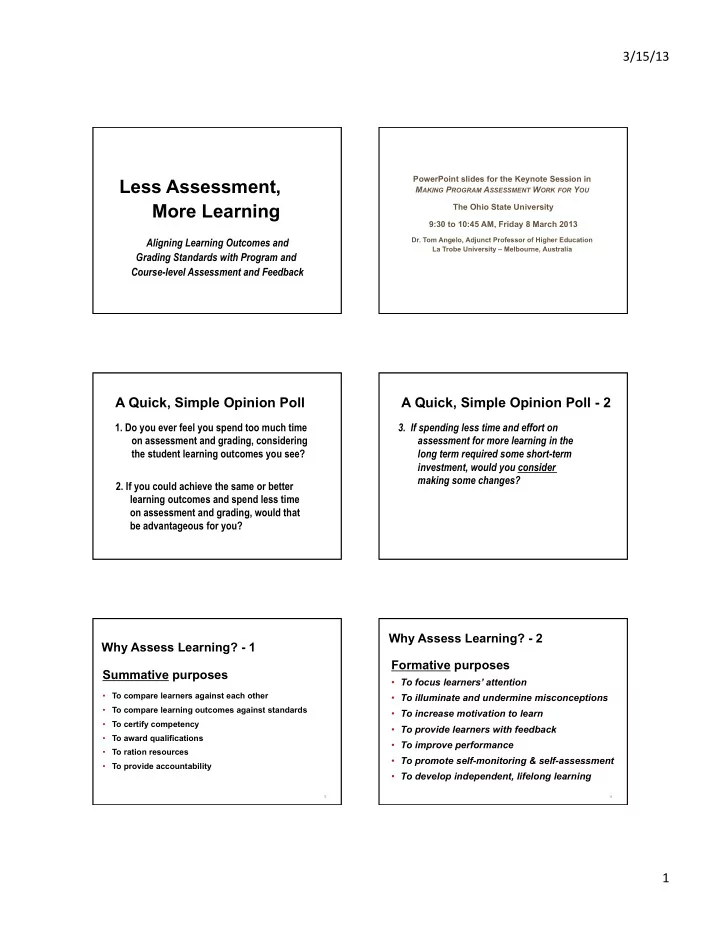
Less Assessment, More Learning

Aligning Learning Outcomes and

Grading Standards with Program and Course-level Assessment and Feedback

PowerPoint slides for the Keynote Session in MAKING PROGRAM ASSESSMENT WORK FOR YOU The Ohio State University 9:30 to 10:45 AM, Friday 8 March 2013

  • Dr. Tom Angelo, Adjunct Professor of Higher Education

La Trobe University – Melbourne, Australia

A Quick, Simple Opinion Poll

  • 2. If you could achieve the same or better

learning outcomes and spend less time

  • n assessment and grading, would that

be advantageous for you?

  • 1. Do you ever feel you spend too much time
  • n assessment and grading, considering

the student learning outcomes you see? ¡

A Quick, Simple Opinion Poll - 2

  • 3. If spending less time and effort on

assessment for more learning in the long term required some short-term investment, would you consider making some changes? ¡

5 ¡

Why Assess Learning? - 1 Summative purposes

  • To compare learners against each other
  • To compare learning outcomes against standards
  • To certify competency
  • To award qualifications
  • To ration resources
  • To provide accountability

6 ¡

Why Assess Learning? - 2 Formative purposes

  • To focus learners’ attention
  • To illuminate and undermine misconceptions
  • To increase motivation to learn
  • To provide learners with feedback
  • To improve performance
  • To promote self-monitoring & self-assessment
  • To develop independent, lifelong learning
slide-2
SLIDE 2

3/15/13 ¡ 2 ¡

To do assessment as if learning matters most, we must privilege the formative purposes.

7 ¡

8

“From the students’ point of view, the assessment is the curriculum."

Ramsden, Paul. (2003). Learning to Teach in Higher Education, 2nd Edition.

9

Handout Page 1 – Lower half

Some key terms/concepts that might be of use

Surface and deep learning Intended Learning outcomes (ILOs) Backward Design Strategic alignment Bus Test, Parrot Test, Car Park Test Cognitive load Metacognition Formative and Summative assessment Novice-Expert differences The 80/20 Rule (aka, the Pareto Principle)

10

Handout Page 1 – Lower half

Terms/Concepts

  • Please mark each item on the list with

a plus sign, minus sign, or question mark Use the plus ( + ) if you know what it means Use the minus ( – ) if you do not know Use the question mark (?) if you’re unsure

11

A “Balcony” Question If you followed directions: Did you read and think about the list on page 1 any differently than you would have if you had simply been asked to “read it”?

12

If you answered “yes” . . .

You’ve demonstrated how a simple formative assessment can promote metacognition.

slide-3
SLIDE 3

3/15/13 ¡ 3 ¡

13

Students’ prior knowledge and beliefs are among the most powerful influences on their learning Consequently, assessing that prior knowledge can provide powerful leverage

14

Page 2 Five Dimensions of Higher Learning

% Then? % Now? ____ Declarative Learning _____ ____ Procedural Learning _____ ____ Conditional Learning _____ ____ Reflective Learning _____ ____ Metacognitive Learning _____

Which of those five dimensions needs and deserves the most focus if we aim to foster: Critical thinking? Problem-solving? Professional practice?

16 ¡

Applications Card – p. 12

Interesting Possible IDEAS/TECHNIQUES APPLICATIONS

17

Backward Design – Page 3

Summative Assessments

Formative Assessments Major Learning Assignments Diagnostic Assessments Intended Learning Outcomes

18

“You can’t fix by analysis what you bungled by design.”

Light, R., Singer, J. & Willett, J. (1990). By Design. Cambridge, MA: Harvard U. Press.

slide-4
SLIDE 4

3/15/13 ¡ 4 ¡

19 ¡

Page 4

Clarifying Intended Learning Outcomes

20 ¡

Page 5

A Simple Grading Grid/Minimal Rubric

21

Thinking Otherwise about Grading Expect Mastery, Ensure Competence, and Promote Excellence. B = Mastery C = Competence, and A = Excellence

What are common core program/graduate outcomes applicable to all disciplines which could actually be explicitly assessed? § Writing § Speaking § Critical Thinking § Problem-solving § Teamwork § Inquiry/research § Ethical Practice/ Awareness § Social Responsibility § Global Citizenship § Sustainability § Lifelong Learning

22

What standards should Graduates be expected to achieve by the end of their course and how can those standards best be developed?

La Trobe University Setting graduate capability standards and evaluating outcomes

Year 3/4 Year 1 Year 2/3

Capstone Cornerstone Mid-point

Q u a l i t y

  • f

S t a n d a r d A c h i e v e d

Evaluation Points at which students would be evaluated as Standard Exceeded; Standard Met; or Standard Not Met.

How can student’s best be assisted to meet those standards within existing curriculum?

La Trobe University Setting graduate capability standards and evaluating outcomes

The ‘Stairway to Success’ Model

Year 3 Year 1 Year 2 Capstone Cornerstone Mid-point Standard Not Met Standard Exceeded Standard Met Stage 1 Stage 3 Stage 2 Standard Not Met Standard Exceeded Standard Met Standard Not Met Standard Exceeded Standard Met Stage 4 Stage 5

slide-5
SLIDE 5

3/15/13 ¡ 5 ¡

25 ¡

Applications Card – p. 12

Interesting Possible IDEAS/TECHNIQUES APPLICATIONS

26 ¡

Page 6

An Example of Program Assessment Embedded in Course Assessment

27 ¡

Page 7

Macroeconomics Essay Grading Grid

(Avoiding Low Ceilings)

28

If we want to promote critical thinking . . .

What might be some implications for our assessment and feedback practices?

29

Critical Thinking appears to . . .

Require a great deal of time and effort Cause discomfort and unhappiness Generate conflicts and tension Pose risks to relationships with family, friends, and work colleagues Be relatively easy to avoid Be strikingly rare in everyday life

30

Developing Critical Thinking

Approaches Well-Supported by Research

Step-by-step Guided Practice Authentic Problem-solving Structured Collaboration Focused Communication Formative Feedback

slide-6
SLIDE 6

3/15/13 ¡ 6 ¡

31

Impeding Critical Thinking

Approaches Contraindicated by Research

Focus on rote learning Information overload One-shot assignments/assessments Personally meaningless assignments Norm-referenced (curved) marking Assessment fatigue

32

Impeding Critical Thinking

Could any of these factors be issues for students in your courses/programs?

Focus on rote learning Information overload One-shot assignments/assessments Personally meaningless assignments Norm-referenced (curved) marking Assessment fatigue

33 ¡

Applications Card – p. 12

Interesting Possible IDEAS/TECHNIQUES APPLICATIONS

34 ¡

The Parking Lot Test

Choose one of your possible applications. Prepare to answer the three questions below about that specific application:

  • What is it?
  • Why do you think it might be useful?
  • How do you think you might use it?

“It’s not what we do, but what students do that’s the important thing.”

Biggs, J. & Tang, C. (2007). Teaching for Quality Learning at University, 3rd Edition.

Questions? Comments?

thomas.a.angelo@gmail.com