LeNet LeNet http://127.0.0.1:8000/lenet.slides.html?print-pdf/#/ - - PowerPoint PPT Presentation

lenet lenet
SMART_READER_LITE
LIVE PREVIEW

LeNet LeNet http://127.0.0.1:8000/lenet.slides.html?print-pdf/#/ - - PowerPoint PPT Presentation

2/23/2019 lenet slides LeNet LeNet http://127.0.0.1:8000/lenet.slides.html?print-pdf/#/ 1/7 2/23/2019 lenet slides In [1]: import d2l import mxnet as mx from mxnet import autograd, gluon, init, nd from mxnet.gluon import loss as gloss, nn


slide-1
SLIDE 1

2/23/2019 lenet slides http://127.0.0.1:8000/lenet.slides.html?print-pdf/#/ 1/7
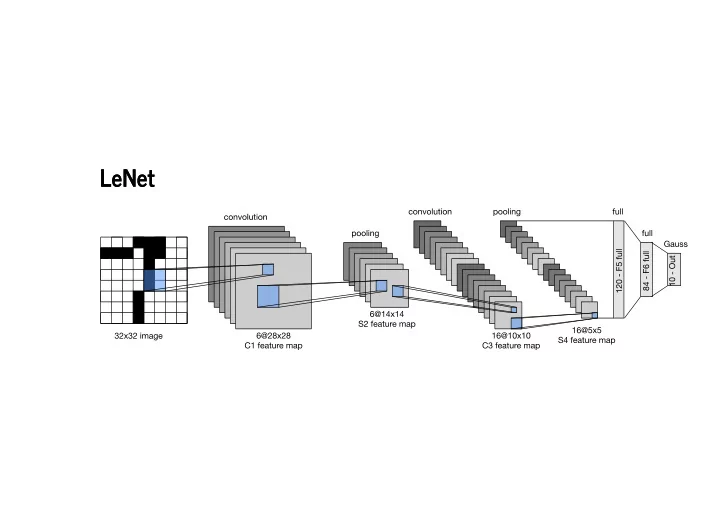
LeNet LeNet

slide-2
SLIDE 2

2/23/2019 lenet slides http://127.0.0.1:8000/lenet.slides.html?print-pdf/#/ 2/7

In [1]: import d2l import mxnet as mx from mxnet import autograd, gluon, init, nd from mxnet.gluon import loss as gloss, nn import time net = nn.Sequential() net.add(nn.Conv2D(channels=6, kernel_size=5, padding=2, activation='sigmoid'), nn.AvgPool2D(pool_size=2, strides=2), nn.Conv2D(channels=16, kernel_size=5, activation='sigmoid'), nn.AvgPool2D(pool_size=2, strides=2), # Dense will transform the input of the shape (batch size, channel, heigh t, width) # into the input of the shape (batch size, channel *height * width) automa tically # by default. nn.Dense(120, activation='sigmoid'), nn.Dense(84, activation='sigmoid'), nn.Dense(10))

slide-3
SLIDE 3

2/23/2019 lenet slides http://127.0.0.1:8000/lenet.slides.html?print-pdf/#/ 3/7

Feeding a single observation through the network

In [2]: X = nd.random.uniform(shape=(1, 1, 28, 28)) net.initialize() for layer in net: X = layer(X) print(layer.name, 'output shape:\t', X.shape) conv0 output shape: (1, 6, 28, 28) pool0 output shape: (1, 6, 14, 14) conv1 output shape: (1, 16, 10, 10) pool1 output shape: (1, 16, 5, 5) dense0 output shape: (1, 120) dense1 output shape: (1, 84) dense2 output shape: (1, 10)

slide-4
SLIDE 4

2/23/2019 lenet slides http://127.0.0.1:8000/lenet.slides.html?print-pdf/#/ 4/7

Data and training Data and training

In [3]: In [4]: batch_size = 256 train_iter, test_iter = d2l.load_data_fashion_mnist(batch_size=batch_size) # use a GPU if we have it def try_gpu(): try: ctx = mx.gpu() _ = nd.zeros((1,), ctx=ctx) except mx.base.MXNetError: ctx = mx.cpu() return ctx ctx = try_gpu() ctx Out[4]: cpu(0)

slide-5
SLIDE 5

2/23/2019 lenet slides http://127.0.0.1:8000/lenet.slides.html?print-pdf/#/ 5/7

Accuracy Accuracy

In [5]: def evaluate_accuracy(data_iter, net, ctx): acc_sum, n = nd.array([0], ctx=ctx), 0 for X, y in data_iter: # If ctx is the GPU, copy the data to the GPU. X, y = X.as_in_context(ctx), y.as_in_context(ctx).astype('float32') acc_sum += (net(X).argmax(axis=1) == y).sum() n += y.size return acc_sum.asscalar() / n

slide-6
SLIDE 6

2/23/2019 lenet slides http://127.0.0.1:8000/lenet.slides.html?print-pdf/#/ 6/7

Training loop Training loop

In [6]: # This function has been saved in the d2l package for future use. def train(net, train_iter, test_iter, batch_size, trainer, ctx, num_epochs): print('training on', ctx) loss = gloss.SoftmaxCrossEntropyLoss() for epoch in range(num_epochs): train_l_sum, train_acc_sum, n, start = 0.0, 0.0, 0, time.time() for X, y in train_iter: X, y = X.as_in_context(ctx), y.as_in_context(ctx) with autograd.record(): y_hat = net(X) l = loss(y_hat, y).sum() l.backward() trainer.step(batch_size) y = y.astype('float32') train_l_sum += l.asscalar() train_acc_sum += (y_hat.argmax(axis=1) == y).sum().asscalar() n += y.size test_acc = evaluate_accuracy(test_iter, net, ctx) print('epoch %d, loss %.4f, train acc %.3f, test acc %.3f, ' 'time %.1f sec' % (epoch + 1, train_l_sum / n, train_acc_sum / n, test_acc, time.time() - start))

slide-7
SLIDE 7

2/23/2019 lenet slides http://127.0.0.1:8000/lenet.slides.html?print-pdf/#/ 7/7

Network initialization and training Network initialization and training

In [7]: lr, num_epochs = 0.9, 5 net.initialize(force_reinit=True, ctx=ctx, init=init.Xavier()) trainer = gluon.Trainer(net.collect_params(), 'sgd', {'learning_rate': lr}) train(net, train_iter, test_iter, batch_size, trainer, ctx, num_epochs) training on cpu(0) epoch 1, loss 2.3176, train acc 0.102, test acc 0.100, time 15.7 sec epoch 2, loss 2.1522, train acc 0.170, test acc 0.523, time 15.5 sec epoch 3, loss 1.0306, train acc 0.581, test acc 0.665, time 15.5 sec epoch 4, loss 0.7861, train acc 0.689, test acc 0.741, time 15.8 sec epoch 5, loss 0.6708, train acc 0.736, test acc 0.766, time 15.5 sec