Legislative Update and Recent Enforcement Actions Texas Association - - PowerPoint PPT Presentation

legislative update and recent enforcement actions
SMART_READER_LITE
LIVE PREVIEW

Legislative Update and Recent Enforcement Actions Texas Association - - PowerPoint PPT Presentation

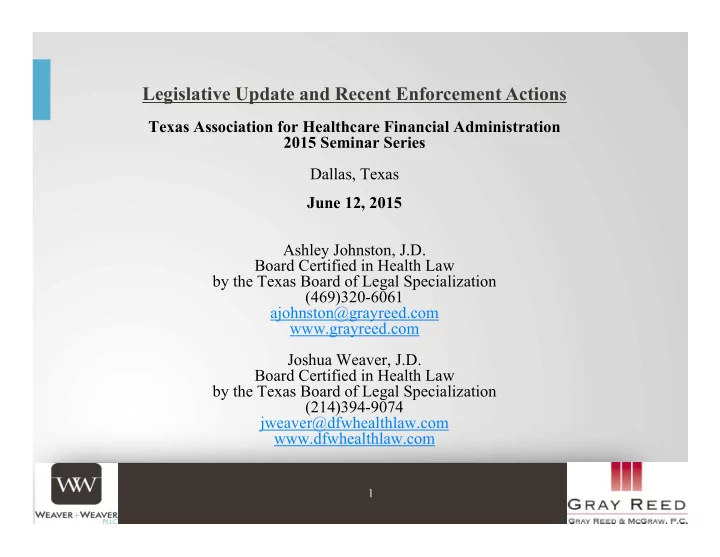
Legislative Update and Recent Enforcement Actions Texas Association for Healthcare Financial Administration 2015 Seminar Series Dallas, Texas June 12, 2015 Ashley Johnston, J.D. Board Certified in Health Law by the Texas Board of Legal


slide-1
SLIDE 1

6/12/2015 1

Legislative Update and Recent Enforcement Actions

Texas Association for Healthcare Financial Administration 2015 Seminar Series Dallas, Texas June 12, 2015 Ashley Johnston, J.D. Board Certified in Health Law by the Texas Board of Legal Specialization (469)320-6061 ajohnston@grayreed.com www.grayreed.com Joshua Weaver, J.D. Board Certified in Health Law by the Texas Board of Legal Specialization (214)394-9074 jweaver@dfwhealthlaw.com www.dfwhealthlaw.com

slide-2
SLIDE 2
  • 1. Recent Legislation
  • 2. Recent Enforcement Activity (time permitting)

2

Agenda

slide-3
SLIDE 3

6/12/2015 3

S.B. 373 – Effective 9/1/15

2015 Texas Legislature: Hospitals

Relating to increased oversight by the DSHS of hospitals that commit certain violations If the DSHS finds that a hospital has committed a violation that resulted in a potentially preventable adverse event which is reportable under Chapter 98 of the Texas Health & Safety Code, the DSHS shall require the hospital to develop and implement a plan for approval by the DSHS to address the deficiencies that may have contributed to the preventable adverse event. The plan shall include:

  • Staff training and education;
  • Supervision requirements for certain staff;
  • Increased staffing requirements;
  • Increased reporting to the DSHS; and
  • A review and amendment of hospital policies
slide-4
SLIDE 4

6/12/2015 4

S.B. 359 – Passed by House and Senate; Veto by Governor

2015 Texas Legislature: Hospitals

Relating to the authority of a peace officer to apprehend a person for emergency detention and the authority of certain facilities to temporarily detain a person with mental illness 1. A peace officer may take a person who has been admitted to a facility into custody 2. A facility may detain a person who voluntarily requested treatment or who lacks capacity to consent to treatment if:

  • The person expresses a desire to leave the facility or attempts to leave before the

examination or treatment is completed and

  • A physician at the facility (1) has reason to believe and does believe that the person has

mental illness and because of that mental illness there is a substantial risk of serious harm to the person or to others unless the person is immediately restrained; and (2) believes that there is not sufficient time to file an application for emergency detention.

slide-5
SLIDE 5

6/12/2015 5

S.B. 359 – Passed by House and Senate; Veto by Governor

2015 Texas Legislature: Hospitals

Relating to the authority of a peace officer to apprehend a person for emergency detention and the authority of certain facilities to temporarily detain a person with mental illness

  • A facility or physician may not detain a person who has been transported to the facility for

emergency detention

  • The facility staff or physician must notify the person of their intention to detain
  • A physician must document the decision to detain a person and must place a notice of

detention in the person’s medical record that contains the same information s required in a peace officer’s notification of detention under Section 573.002

  • The period of detention must not exceed 4 hours
  • The facility shall release the patient by the end of the 4 hour period unless the facility arranged

for a peace officer to take the person into custody

  • Facility that acts in good faith and without malice is not civilly or criminally liable
slide-6
SLIDE 6

6/12/2015 6

S.B. 359 – Passed by House and Senate; Veto by Governor

2015 Texas Legislature: Hospitals

Relating to the authority of a peace officer to apprehend a person for emergency detention and the authority of certain facilities to temporarily detain a person with mental illness Veto By Governor Abbott by public proclamation “The Fourth, Fifth, and Fourteenth Amendments to the United States Constitution limit the state’s authority to deprive a person of liberty. Under our constitutional tradition, the power to arrest and forcibly hold a person against his or her will is generally reserved for officers of the law acting in the name of the people of Texas. By bestowing that grave authority on private parties who lack the training of peace officers and are not bound by the same oath to protect and serve the public, SB 359 raises serious constitutional concerns and would lay the groundwork for further erosion

  • f constitutional liberties. Medical facilities have options at their disposal to protect mentally ill

patients and the public…just as law enforcement should not be asked to practice medicine, medical staff should not be asked to engage in law enforcement, especially when that means depriving a person of the liberty protected by the Constitution.”

slide-7
SLIDE 7

6/12/2015 7

S.B. 1670 – Effective 9/1/15

2015 Texas Legislature: Hospitals

Relating to the possession and removal of a placenta from a hospital or birthing center A hospital shall allow a woman to take possession of and remove from the facility the delivered placenta if: 1. The woman tests negative for infectious diseases; 2. The person taking the placenta signs a form acknowledging that (A) the person has received information concerning the spread of blood-borne diseases and (B) the placenta is for personal use. The form should be retained by the hospital in the patient’s medical records. A person may not sell the placenta.

slide-8
SLIDE 8

6/12/2015 8

S.B. 1753 – Effective 9/1/15

2015 Texas Legislature: Hospitals

Relating to the identification requirements of certain health care providers associated with a hospital

  • The identification badge of a health care provider licensed under Title 3,

Occupations, must clearly state when the practitioner is licensed under the applicable subtitle:

  • Physician, chiropractor, podiatrist, midwife, physician assistant, acupuncturist, surgical

assistant, dentist, dental hygienist, licensed vocational nurse, registered nurse, nurse practitioner, nurse midwife, nurse anesthetist, clinical nurse specialist, optometrist, therapeutic optometrist, speech-language pathologist, audiologist, physical therapist,

  • ccupational therapist, massage therapist, medical radiologic technologist, medical

physicist, perfusionist, respiratory care practitioner, orthotist, prosthetist, dietitian

  • If not included in this list, a hospital is not required to list the type of license held

by a provider on the provider’s identification badge until 9/1/2019

slide-9
SLIDE 9

6/12/2015 9

S.B. 2131– Effective 9/1/15

2015 Texas Legislature: Hospitals

Relating to the designation of centers of excellence to achieve healthy fetal outcomes in this state

  • The DSHS shall designate 1 or more centers of excellence for fetal

diagnosis and therapy

  • Priority Considerations for Center Designations
  • Offers fetal diagnosis and therapy through a multi-specialty clinical program

that is affiliated with a medical school in this state and an associated hospital that provides advanced maternal and neonatal care

  • Demonstrates a significant commitment to research in fetal diagnosis and

therapy

  • Offers advanced training in fetal diagnosis and therapy
  • Integrated an advanced fetal care program with a program that provides long-

term monitoring and follow-up care

slide-10
SLIDE 10

6/12/2015 10

S.B. 2131– Effective 9/1/15

2015 Texas Legislature: Hospitals

Relating to the designation of centers of excellence to achieve healthy fetal

  • utcomes in this state
  • Qualifications for Designation: The rules adopted for designation of centers of

excellence must ensure that a health care entity or program that receives such designation:

1. Provides or is affiliated with a hospital that provides advanced maternal and neonatal care in accordance with its level of care designation; 2. Implements and maintains a multidisciplinary health care team, including: maternal fetal medicine specialists, pediatric and surgical specialists, neonatologists, nurses with specialized maternal and neonatal training, and other ancillary support staff to provider maternal, fetal, and neonatal services 3. Establishes minimum criteria for medical staff, nursing staff, and ancillary support staff; 4. Measures short-term and long-term patient diagnostic and therapeutic outcomes; and 5. Provides to DSHS annual reports containing aggregate data on short and long- term diagnostic and therapeutic outcomes as requests or required by DSHS and makes those reports available to the public

slide-11
SLIDE 11

6/12/2015 11

H.B. 2641– Effective 9/1/15

2015 Texas Legislature: Health Care Providers

Relating to the exchange of health information in this state

  • Unless the health care provider acts with malice or gross

negligence, a health care provider who provides patient information to a health information exchange is not liable for any damages, penalties, or other relief related to the obtainment, use, or disclosure

  • f that information in violation of federal or state privacy laws by a

health information exchange, another health care provider, or any

  • ther person
slide-12
SLIDE 12

6/12/2015 12

H.B. 1945– Effective 9/1/15

2015 Texas Legislature: Health Care Providers

Relating to the provision of direct primary care

  • Direct Fee: a fee charged by a physician to a patient (or patient’s designee) for primary medical care

services provided by, or to be provided by, the physician to the patient.

  • The term includes a fee in any form, including: (1) monthly retainer; (2) membership fee; (3)

subscription fee; (4) fee paid under a medical service agreement; or (5) fee for a service, visit, or episode of care.

  • Direct Primary Care: primary medical care service provided by a physician to a patient in return for

payment in accordance with a direct fee

  • Medical Service Agreement: signed written agreement under which a physician agrees to provide direct

primary care services for a patient in exchange for a direct fee for a period of time that is entered into by the physician and:

  • The patient; or
  • The patient’s legal representative, guardian, or employer on behalf of the patient; or
  • The patient’s legal representative or guardian’s employer on behalf of the patient
slide-13
SLIDE 13

6/12/2015 13

H.B. 1945– Effective 9/1/15

2015 Texas Legislature: Health Care Providers

Relating to the provision of direct primary care

  • A physician providing direct primary care is not an insurer or HMO, and

the physician is not subject to regulation of the TX Dept. of Insurance for the direct primary care.

  • A medical service agreement is not health or accident insurance or

coverage under Title 8 of the Insurance Code, and is not subject to regulation by the TX Dept. of Insurance

  • A physician may not bill an insurer or HMO for direct primary care that is

paid under a medical service agreement.

  • A physician providing direct primary care must provide written or

electronic notice to the patient that a medical service agreement for direct primary care is not insurance, prior to entering into the agreement

slide-14
SLIDE 14

6/12/2015 14

S.B. 18 – Effective 9/1/15

Texas Legislature: Graduate Medical Education

Relating to measures to support or enhance graduate medical education in Texas

  • Creates a Trust Fund to support graduate medical education
  • A hospital may partner with an existing graduate medical education

program to plan a new graduate medical education program

slide-15
SLIDE 15

6/12/2015 15

S.B. 460 – Effective 9/1/15

Texas Legislature: Pharmacists and Pharmacies

Relating to the licensing and regulation of pharmacists and pharmacies

  • The board may discipline an applicant for or the holder of a pharmacy

license, if the board finds that the applicant or license holder has waived, discounted, or reduced, or offered to waive, discount, or reduce, a patient copayment or deductible for a compound drug in the absence of:

  • A legitimate, documented financial hardship of the patient; or
  • Evidence of a good faith effort to collect the copayment or

deductible from the patient.

slide-16
SLIDE 16

6/12/2015 15 16

S.B. 3519 – Effective 9/1/15

Texas Legislature: Telehealth

Relating to reimbursement for home telemonitoring services under Medicaid The commission may not reimburse providers under Medicaid for the provision of home telemonitoring services on or after September 1, 2019 “Home Telemonitoring Service” means a health service that requires scheduled remote monitoring of data related to a patient’s health and transmission of the data to a licensed home and community support services agency or a hospital. Tex. Gov't Code Ann. § 531.001 (Vernon)

slide-17
SLIDE 17

6/12/2015 16 17

H.B. 1878 – Effective 9/1/15

Texas Legislature: Telehealth

Relating to the provision of telemedicine medical services in a school- based setting, including the reimbursement of providers under Medicaid

  • Medicaid reimbursement shall be provided to a physician for telemedicine services, even if

the physician is not the patient’s primary care physician if: (1) the physician is an authorized health care provider under Medicaid; (2) the patient is a child who receives the services in a primary or secondary school setting; (3) the parent or legal guardian of the patient provides consent before the service is provided; and (4) a health professional is present during the treatment

  • If the patient has a primary care physician and consents, or the parent or legal guardian

consents, to the notification, the Commission requires that the primary care physician be notified of the telemedicine service for the purpose of sharing medical information. If the service is provided to a child in a school-based setting, then the notification must include a summary of the service, including exam findings, prescribed or administered medications, and patient instructions

  • If the patient does not have a primary care physician, the commission shall require that the

patient's parents or legal guardian receive the notification and a list of primary care physicians from which the patient may select the patient’s primary care physician.

slide-18
SLIDE 18

6/12/2015 18

S.B. 574 – Effective on 9/1/15

Texas Legislature: Out-of-Network Legislation

Relating to Operations of Managed Care Plans with Respect to Providers

  • An insurer may not terminate participation of a provider solely because the provider

informs an enrollee of the full range of providers available to the enrollee, including OON providers.

  • An insurer may not terminate, or threaten to terminate, an insured’s participation in a plan

solely because the insured uses an OON provider.

  • An insurer may not prohibit, penalize, terminate or otherwise restrict a preferred provider

from communicating with an insured about the availability of OON providers.

  • An insurer’s contract with a preferred provider may require that before an OON referral is

made, the provider inform the insured that (1) the insured may choose an OON provider; (2) the insured may have a higher out-of-pocket expense with an OON provider and (3) whether the provider has a financial interest in the OON provider.

slide-19
SLIDE 19

6/12/2015 19

S.B. 574 – Effective on 9/1/15

Texas Legislature: Out-of-Network Legislation

Relating to Operations of Managed Care Plans with Respect to Providers

  • An insurer may not condition payment on a physician providing a

notification stating that the physician is an OON provider to a current, prospective or former patient, if the form contains additional information that is intended or required to be presented in a manner that is intended to intimidate the patient.

  • On request, an insurer shall provide to a practitioner whose participation in

a preferred provider benefit plan is being terminated all information on which the insurer wholly or partly based the termination, including the economic profile of the preferred provider, the standards by which the provider is measured, and the statistics underlying the profile and standards.

slide-20
SLIDE 20

6/12/2015 20

S.B. 425 – Effective on 9/1/15

Texas Legislature: Freestanding Emergency Medical Care Facilities

Relating to health care information provided by and notice of facility fees charged by freestanding emergency medical care facilities

A FER shall post a notice that states the following:

  • That the FER is a FER;
  • That the FER charges rates comparable to a hospital ER;
  • That the FER and its physicians may not be participating providers in the patient’s

health plan; and

  • That the FER’s physicians may bill separately from the FER.
slide-21
SLIDE 21

6/12/2015 21

S.B. 425 – Effective on 9/1/15

Texas Legislature: Freestanding Emergency Medical Care Facilities

Relating to health care information provided by and notice of facility fees charged by freestanding emergency medical care facilities

  • The notice must be posted prominently and conspicuously at the

FER’s

  • Primary entrance
  • Each patient treatment room; and
  • At each location at which a person pays for health care services.
  • On the facility’s website
slide-22
SLIDE 22

6/12/2015 22

S.B. 1899 – Effective 9/1/15

Texas Legislature: Emergency Medical Services

Relating to the regulation of emergency medical services A person who:

  • Is certified under Chapter 773 of the Health and Safety Code as an

emergency medical technician-paramedic or licensed paramedic,

  • Is acting under the delegation and direct supervision of a licensed

physician, and

  • Is authorized to provide advanced life support by a health care facility

may, in accordance with department rules, provide advanced life support in a facility’s emergency or urgent care clinical setting, including a hospital emergency room and a freestanding emergency medical care facility.

slide-23
SLIDE 23

6/12/2015 23

H.B. 416 – Effective 9/1/15

Texas Legislature: Abortion Facilities

Relating to requiring personnel of abortion facilities and certain

  • ther facilities performing abortions to complete training on

human trafficking

  • Applies to individuals who are employed by, volunteers at, or

performs services under contract with: (1) an abortion facility or (2) an ambulatory surgical center that performs more than 50 abortions a year and the individual has direct contact with patients.

  • Individuals described shall be required to complete within a

reasonable time after beginning work at the facility a training program to identify and assist victims of human trafficking

slide-24
SLIDE 24

6/12/2015 24

H.B. 3994 – Effective 9/1/15

Texas Legislature: Abortion Facilities

Relating to notice of and consent to an abortion for a minor and associated requirements

  • A physician must use due diligence to determine that any woman on which the physician performs an

abortion has in fact reached the age of majority or has had the disabilities of minority removed

  • If a woman is unable to obtain proof of identity and age and the physician chooses to perform the

abortion, the physician must document that proof of identity and age was not obtained and report this to the DSHS.

  • If the physician who is to perform an abortion concludes that a medical emergency exists and there is

insufficient time to provide notice or to obtain consent, then the physician must make a reasonable effort to inform (in person or by telephone) the parent, managing conservator, or guardian of the unemancipated minor of the performance of the abortion and the basis of the physicians determination that a medical emergency existed

  • Within 24 hours
  • The physician who performs an abortion in a medical emergency (as described above) must also send

written notice that a medical emergency occurred and that the parent, managing conservator, or guardian may contact the physician for more information and medical records.

  • Within 48 hours
slide-25
SLIDE 25

6/12/2015 25

H.B. 2588– Effective 9/1/15

Texas Legislature: Nursing and Assisted Living Facilities

Relating to disclosures by nursing facilities and assisted living facilities regarding certification or classification to provide specialized care, treatment,

  • r personal care services to residents with Alzheimer’s disease or related

disorders

  • The Executive Commissioner of the Health and Human Services

Commission shall require each assisted living facility to include in the facility’s consumer disclosure statement whether the facility holds a license, classified under Section 247.029 of the Health and Safety Code, for the provision of personal care services to residents with Alzheimer’s disease or related disorders.

slide-26
SLIDE 26

6/12/2015 26

S.B. 207 – Effective 9/1/15

Texas Legislature: Medicaid Fraud or Abuse

Relating to the authority and duties of the office of inspector general of the Health and Human Services Commission

  • The office shall complete a full investigation of a complaint or allegation of

Medicaid fraud or abuse against a provider not later than the 180th day after the date the full investigation begins, unless the office determines that more time is needed.

  • If the office determines that more time is needed, the office shall provide notice to

the provider who is the subject of the investigation, stating that the investigation will exceed 180 days and specifying the reasons why the office is unable to complete the investigation within the 180-day period.

  • The office is not required to provide notice to the provider if the office determines

that providing notice would jeopardize the investigation.

slide-27
SLIDE 27

6/12/2015 27

H.B. 3781 – Effective 9/1/15

Texas Legislature: Population Health

Relating to the creation of the Texas Health Improvement Network

  • The Texas Health Improvement Network is established to address urgent health

care challenges and improve the health care system in this state and the nation and to develop, based on population health research, health care initiatives, policies, and best practices.

  • The network shall:
  • Function as an incubator and evaluator of health improvement practices; and
  • Support local communities in this state by offering leadership training, data

analytics, community health assessments, and grant writing support to local communities.

slide-28
SLIDE 28

6/12/2015 28

S.B. 339 – Effective Immediately

Texas Legislature: Compassionate-Use Act

Relating to the medical use of low-THC cannabis and the regulation of related organizations and individuals

  • Gives authority to physicians who meet certain criteria to prescribe low-THC cannabis to physicians

who treat patients with intractable epilepsy

  • Creation of an online registry that contains prescriber information, patient information, dosage

prescribed, means of administration ordered, total amount required to full prescription, and amount dispensed.

  • A license issued by the Dept. of Public Safety is required to operate a dispensing organization. An

applicant is eligible if:

  • The Applicant possesses: (1) the ability to cultivate and produce low-THC cannabis; (2) the ability to secure the

resources and personal necessary to operate, and premises reasonably located to allow patients on the registry access; (3) the ability to maintain accountability for the materials and finished product to prevent unlawful access; and (4) the financial ability to maintain operations for no less than two years;

  • Each director, manager, or employee of is registered under Subchapter D with the Dept. of Public Safety; and
  • The applicant satisfied any additional criteria determined to be necessary to safely implement this chapter
  • Additional requirements for those the organization hires (notice of intent to hire, background check)
  • Requirements for verification of prescription before dispensing and recording on registry after

dispensing

  • Lists individuals who are exempt from criminal offense of acquisition, possession, production, etc.
slide-29
SLIDE 29

6/12/2015 29

Joshua M. Weaver Weaver & Weaver, PLLC (214) 705-3516 jweaver@dfwhealthlaw.com

Josh and Ashley provide counsel to health care providers on complex operational, transactional and compliance issues. They have experience advising hospitals, ambulatory surgery centers, independent diagnostic testing facilities, laboratories, pharmacies, physicians and other health care providers on various issues, including matters implicating the Federal Anti-Kickback Statute, the Physician Self-Referral ("Stark") Statute, the Texas Illegal Remuneration Statute, The Health Insurance Portability and Accountability Act of 1996 ("HIPAA"), the False Claims Act, and the Emergency Medical Treatment and Active Labor Act ("EMTALA"), among many others. Josh and Ashley also advise clients with respect to reimbursement issues and payor audits. Their transactional experience includes drafting and negotiating a variety of health care contracts, including professional services agreements, physician employment agreements, asset purchase agreements, management and co-management agreements, business associate agreements, operating agreements, and equipment and space leases, among others. Josh and Ashley also assist clients in the formation and syndication of hospitals, ASCs, joint ventures, pharmacies, and laboratories. Josh and Ashley are both Board Certified in Health Law by the Texas Board of Legal Specialization.

Ashley E. Johnston Gray Reed & McGraw, PC (469)320-6061 ajohnston@grayreed.com

slide-30
SLIDE 30

RECENT ENFORCEMENT ACTIONS 30

slide-31
SLIDE 31

Qui Tam/Enforcement Actions

  • 62 healthcare qui tam actions filed from 1987 to 1992.
  • In 2011 alone, there were 471.
  • In 2012, there were 412.
  • FCA awards 15-30% of the recovery to whistleblowers.
  • Medicare Incentive Reward Program:
  • CMS can pay whistleblowers an additional 10%.
  • Proposed Rule would expand the amount to 15% up to the

first $66 million received (potential $9.9 million recovery for whistleblower).

slide-32
SLIDE 32

Qui Tam/Enforcement Actions 2013 and 2014

  • 752 new qui tam matters filed in 2013.
  • Total federal health care recoveries under the FCA

exceeded $2.5 billion in 2013 and $2.3 billion in 2014

  • 2014 was the 5th consecutive year FCA recoveries

from health care fraud exceeded $2 billion.

  • Total rewards paid to qui tam relators in health care

cases was $345 million in 2013 and $435 million in 2014.

slide-33
SLIDE 33

Recent OIG Statistics

Statistics are for cases in which there was a settlement with or judgment for the United States, and in which the OIG’s Office of Investigations was involved.

OIG Action FY09 FY10 FY11 FY12 FY13 Total Criminal Actions 671 647 723 778 960 3,779 Civil Actions 394 378 382 367 472 1,993 Exclusions 2,556 3,340 2,662 3,131 3,214 14,903 HHS Investigative Receivables $3.0 Billion $3.2 Billion $3.6 Billion $4.3 Billion $4.0 Billion $18.2 Billion Non-HHS Investigative Receivables $1.0 Billion $576.9 Million $952.8 Million $1.7 Billion $1.03 Billion $5.2 Billion Total Investigative Receivables $4.0 Billion $3.8 Billion $4.6 Billion $6.0 Billion $5.0 Billion $23.5 Billion

slide-34
SLIDE 34

HEAT Strike Force Activity

The Health Care Fraud Prevention and Enforcement Action Team (HEAT) was started in 2009 by HHS and DOJ to strengthen programs and invest in new resources and technologies to prevent and combat health care fraud, waste, and abuse. Hallmarks include data-driven analyses and interagency collaboration.

Statistics are for cases in which there was a settlement with or judgment for the United States, and in which the OIG’s Office of Investigations was involved between 2009 and 2013.

Location Criminal Actions Indictments Money* Miami 622 796 $881,561,175 Los Angeles 60 135 $48,295,354 Detroit 111 217 $60,515,775 Houston 56 99 $20,529,564 New York 31 84 $112,298,203 Baton Rouge 43 83 $39,166,607 Tampa 30 42 $56,056,891 Dallas 17 57 $30,277,662 Chicago 9 53 $4,825,501 Total 979 1,566 $1,203,526,733

slide-35
SLIDE 35

Qui Tam/Enforcement Actions

  • Most relators are employees (more than 75% according to most

recent surveys).

  • Some are employed or affiliated with competitors.
  • According the HHS’Health Care Fraud and Abuse Program

Annual Report released in February 2014, for every dollar spent

  • n health care-related fraud and abuse in the last three years, the

government recovered $8.10.

slide-36
SLIDE 36

Qui Tam/Enforcement Actions

  • Just in September, an Assistant US Attorney for the DOJ’s Criminal

Division, announced that the DOJ will be stepping up its review of False Claims Act (FCA) qui tam complaints.

  • All new qui tam complaints are shared by the Civil Division with the

Criminal Division as soon as the cases are filed for immediate review.

  • The Criminal Division will use criminal investigative tools (e.g.,

search warrants, wire taps, undercover operations and confidential informants) that it will be able to contribute to FCA cases.

  • “Cases involving fraud by executives at health care providers, such as

hospitals, are a high priority"

slide-37
SLIDE 37

Somewhat Recent Cases

Halifax - March 2014

  • Background: a Compliance Officer at Halifax Health Medical

Center filed a Qui Tam action alleging that the Hospital gave prohibited bonuses to least 6 doctors under employment agreements. It is alleged the amount of the bonuses increased when the doctors referred more patients to the Hospital.

  • A Federal Court has ruled the case can proceed even though

some of the claims were submitted to Medicaid and not Medicare.

  • Government has intervened in the case and the parties reached a

$85 million settlement on March 3, 2014.

slide-38
SLIDE 38
  • As a bonus, each oncologists would receive a portion of a total

bonus pool that was equal to 15 percent of the “operating margin” of the overall medical oncology program

  • “Operating margin” meant revenue minus direct expenses of

the overall program, determined on a basis that included “designated health services,” as defined by the Stark Law, including prescription drugs and

  • utpatient services not

personally performed by the medical oncologists themselves.

Halifax (Cont’d)

slide-39
SLIDE 39

U.S. ex rel. Drakeford v. Tuomey

2013

  • Surgeons begin development of an ASC and Tuomey Health System was

concerned about losing volume.

  • Hospital hires surgeons as employees
  • Part-time

employment during surgical procedures; surgeons maintained office practice separately

  • Compensation to physicians: fixed salary, plus 80% of collections,

plus quality incentives

  • DOJ alleged that compensation exceeded 100% of actual collections

(and was up to 140% of collections)

  • Hospital

internal documents projected losses

  • n

all employment agreements

slide-40
SLIDE 40
  • DOJ argues that compensation is not FMV because “the hospital’s motivation

in entering into these part-time agreements was to avoid losing the referrals”

  • While Stark Law is strict liability, the DOJ looked at motivation of parties
  • Hospital obtained multiple valuation analyses
  • During the trial, the hospital argued reliance on advice of counsel.
  • Jury found Tuomey submitted a total of 21,730 Medicare claims that were

illegal due to the compensation arrangements

  • Result: Hospital pays $237 million for false claims.

U.S. ex rel. Drakeford v. Tuomey

slide-41
SLIDE 41

6/12/2015 41

South Shore Physician Hospital Organization (SSPHO) (January 2015)

Enforcement Activity

  • SSPHO and its member organizations, South Shore Hospital, Inc.

and Physicians Organization of the South Shore, Inc. paid kickbacks in the form of cash grants to doctors who agreed to make referrals to SSPHO providers.

  • From 2001 to 2010, SSPHO approved 103 separate recruitment

grants to 33 different physician groups. The recruitment grant program requested that grant recipients refer patients to participating providers, which included the South Shore Hospital.

  • $1.775 million settlement
  • Additional Information: http://www.justice.gov/usao-ma/pr/south-

shore-physicians-hospital-organization-pay-1775-million-alleged- kickbacks-patient

slide-42
SLIDE 42

6/12/2015 42

Nason Medical (January 2015)

Enforcement Activity

  • Nason Medical, out of Charleston, South Carolina, and two of its owners, Dr. Baron S. Nason

and Robert T. Hamilton allegedly:

  • Submitted claims to Medicare and TRICARE for services that were provided by physician

assistants, as though the services were provided by physicians. Both Medicare and TRICARE pay 85% of the physician fee schedules for services provided by mid-level providers like physician assistants;

  • Submitted claims for testing that was not medically indicated including laboratory tests

and potentially harmful CT scans;

  • Submitted claims for radiological services provided by a radiology technician who did not

hold a current South Carolina license; and

  • Submitted claims for Tetanus Immunoglobulin when Tetanus Toxoid was given which is

considerably less expensive;

  • $1.021 million settlement
  • Qui Tam
  • Additional Information: http://www.justice.gov/usao/sc/news/1.14.15.nason.html
slide-43
SLIDE 43

6/12/2015 43

Hollywood Pavilion (November 2014)

Enforcement Activity

  • Former chief operating officer of a Miami-area hospital pleaded guilty for his role in a

mental health care fraud scheme that resulted in the submission of more than $67 million in fraudulent claims to Medicare by a psychiatric hospital located in Hollywood, Florida.

  • HP submitted false and fraudulent claims to Medicare for treatment that was not medically

necessary or not provided to patients. The COO supervised HP’s staff at both its inpatient and outpatient facilities, where Medicare beneficiaries were admitted to HP regardless of whether they qualified for mental health treatment, and were often admitted before seeing a doctor.

  • HP obtained Medicare beneficiaries from across the country by paying bribes and

kickbacks to various patient brokers. The COO instructed the patient brokers to falsify invoices and marketing reports in an effort to hide, and cover up the true nature of the bribes and kickbacks they were receiving from HP. 4 colleagues have already been sentenced to prison terms ranging from 6-25 years for the same offenses.

  • Additional Information: http://www.justice.gov/opa/pr/miami-area-hospital-chief-
  • perating-officer-pleads-guilty-67-million-mental-health-care-fraud
slide-44
SLIDE 44

6/12/2015 44

Shelby Regional Medical Center-Tyler, Texas (November 2014)

Enforcement Activity

  • Former CFO of Shelby Regional Medical Center in Center oversaw the

implementation of electronic health records for the hospital and was responsible for attesting to the meaningful use of electronic health records in order to qualify to receive incentive payments under Medicare’s Electronic Health Record (EHR) Incentive Program.

  • On Nov. 20, 2012, White knowingly made a false statement to Medicare

falsely representing that the hospital was a meaningful user of electronic health records, when the hospital did not meet the meaningful use requirements. As a result, Shelby Regional Medical Center received $785,655.00 from Medicare.

  • Faces up to 5 years in prison.
  • Additional Information: http://www.justice.gov/usao/txe/News/2014/edtx-

hcf-white-111314.html

slide-45
SLIDE 45

6/12/2015 45

Riverside General Hospital -Houston, Texas (October 2014)

Enforcement Activity

  • Hospital President and colleagues operated a scheme to defraud Medicare beginning in 2005 and

continuing until June 2012. The defendants caused the submission of false and fraudulent claims for partial hospitalization program (PHP) services to Medicare through the hospital. A PHP is a form of intensive outpatient treatment for severe mental illness.

  • Specifically, evidence at trial demonstrated that the Medicare beneficiaries for whom Riverside

and its satellite locations billed Medicare for PHP services did not qualify for or need PHP

  • services. Moreover, the Medicare beneficiaries rarely saw a psychiatrist and did not receive

intensive psychiatric treatment. In fact, some of the Medicare beneficiaries were suffering from Alzheimer’s and could not actively participate in any treatment even if they actually qualified to receive PHP services.

  • Kickbacks were paid to patient recruiters and to owners and operators of group care homes in

exchange for those individuals delivering ineligible Medicare beneficiaries to the hospital’s PHPs.

  • Federal judge sentenced former Hospital President to 45 years in prison following his conviction

in the $158 million Medicare fraud scheme. Other parties involved were sentenced to 20 years and twelve years. Collectively, the parties were ordered to pay approximately $100 million in

  • restitution. One party remains to be sentenced.
  • Additional Information: http://www.justice.gov/opa/pr/president-houston-hospital-and-three-
  • thers-convicted-158-million-medicare-fraud-scheme
slide-46
SLIDE 46

6/12/2015 46

Joshua M. Weaver Weaver & Weaver, PLLC (214) 705-3516 jweaver@dfwhealthlaw.com

Josh and Ashley provide counsel to health care providers on complex operational, transactional and compliance issues. They have experience advising hospitals, ambulatory surgery centers, independent diagnostic testing facilities, laboratories, pharmacies, physicians and other health care providers on various issues, including matters implicating the Federal Anti-Kickback Statute, the Physician Self-Referral ("Stark") Statute, the Texas Illegal Remuneration Statute, The Health Insurance Portability and Accountability Act of 1996 ("HIPAA"), the False Claims Act, and the Emergency Medical Treatment and Active Labor Act ("EMTALA"), among many others. Josh and Ashley also advise clients with respect to reimbursement issues and payor audits. Their transactional experience includes drafting and negotiating a variety of health care contracts, including professional services agreements, physician employment agreements, asset purchase agreements, management and co-management agreements, business associate agreements, operating agreements, and equipment and space leases, among others. Josh and Ashley also assist clients in the formation and syndication of hospitals, ASCs, joint ventures, pharmacies, and laboratories. Josh and Ashley are both Board Certified in Health Law by the Texas Board of Legal Specialization.

Ashley E. Johnston Gray Reed & McGraw, PC (469) 320-6061 ajohnston@grayreed.com