
SLIDE 1
Legal Issues in the Parthenon Marbles conflict
Tatiana Flessas LSE Law
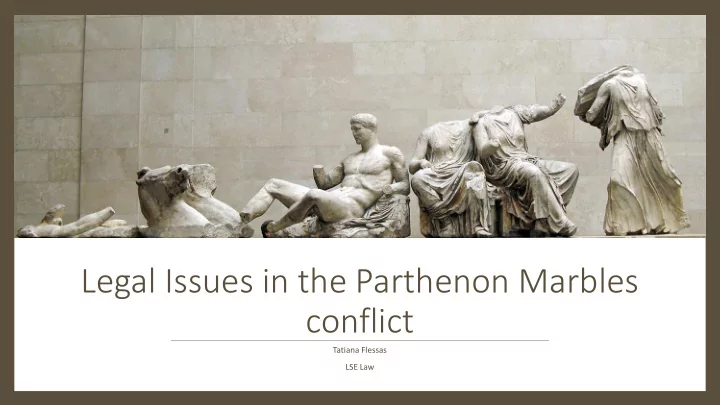
Legal Issues in the Parthenon Marbles conflict Tatiana Flessas LSE - - PowerPoint PPT Presentation
Legal Issues in the Parthenon Marbles conflict Tatiana Flessas LSE Law To send or bring someone, or sometimes money or other property, back to the country that he, she, or it came from (Cambridge Dictionary) Root: patria
Tatiana Flessas LSE Law
‘To send or bring someone, or sometimes money or other property, back to the country that he, she, or it came from’ (Cambridge Dictionary) Root: ‘patria’ ‘fatherland’ or ‘home country’ (Latin) In ‘cultural property’ cases, it means the return of cultural objects to their countries or places of
➢who is/are the legal owner of the object(s)? ➢is there a difference between the legal owner(s) and the moral or historical owner(s)? ➢how were the objects transferred to where they are today? Legally? Illegally? ➢is it possible and/or appropriate to return the
the Sublime Porte) authorizing his activity on the Acropolis?
document?
government later?
(a) destruction in wartime (1954 Convention for the Protection of Cultural Property in the Event of Armed Conflict (the 1954 Hague Convention) & its two Protocols (1954 & 1999)) (b) illicit trade/trafficking (1970 Convention on the Means of Prohibiting and Preventing the Illicit Import, Export and Transfer of Ownership of Cultural Property (the 1970 Convention)) (c) Listing (World Heritage Convention) (d)
including implementing statutes, UN Security Council Resolutions, etc.
‘This is our history, this is our soul… [T]hey are the symbol and the blood and the soul of the Greek people… [W]e have fought and died for the Parthenon and the Acropolis…’ (Melina Mercouri) ‘To rip the Elgin Marbles from the walls of the British Museum [would be] a much greater disaster than the threat of blowing up the Parthenon’ and ‘The moral
because Britain is the true heir of Pericles’ democracy.’ ‘How can we live without our lives? How will we know it’s us without our past?’ (John Steinbeck, The Grapes of Wrath)